



 Chat with AI
Exam 16: Capital and Financial Markets

Exam 1: The Central Idea156 Questions
Exam 2: Observing and Explaining the Economy143 Questions
Exam 3: The Supply and Demand Model166 Questions
Exam 4: Subtleties of the Supply and Demand Model176 Questions
Exam 5: The Demand Curve and the Behavior of Consumers176 Questions
Exam 6: The Supply Curve and the Behavior of Firms179 Questions
Exam 7: The Efficiency of Markets163 Questions
Exam 8: Costs and the Changes at Firms Over Time191 Questions
Exam 9: The Rise and Fall of Industries139 Questions
Exam 10: Monopoly184 Questions
Exam 11: Product Differentiation, Monopolistic Competition, and Oligopoly169 Questions
Exam 12: Antitrust Policy and Regulation152 Questions
Exam 13: Labor Markets179 Questions
Exam 14: Taxes, Transfers, and Income Distribution179 Questions
Exam 15: Public Goods, Externalities, and Government Behavior197 Questions
Exam 16: Capital and Financial Markets188 Questions
Exam 17: Macroeconomics: the Big Picture159 Questions
Exam 18: Measuring the Production, Income, and Spending of Nations177 Questions
Exam 19: The Spending Allocation Model166 Questions
Exam 20: Unemployment and Employment212 Questions
Exam 21: Productivity and Economic Growth162 Questions
Exam 22: Money and Inflation153 Questions
Exam 23: The Nature and Causes of Economic Fluctuations185 Questions
Exam 24: The Economic Fluctuations Model205 Questions
Exam 25: Using the Economic Fluctuations Model176 Questions
Exam 26: Fiscal Policy138 Questions
Exam 27: Monetary Policy180 Questions
Exam 28: Economic Growth Around the World157 Questions
Exam 29: International Trade242 Questions
Exam 30: International Finance125 Questions
Select questions type


The regulatory capture theory suggests that the way banks and government officials looked after each other led to the financial crisis in 2008.
(True/False)
4.9/5  (88)
(88) The return on a stock is equal to its dividend plus the change in stock price.
(True/False)
4.9/5 (87)
(87) If a new tax is placed on a good with a vertical supply curve, the price paid by demanders
(Multiple Choice)
4.8/5 (82)
(82) Government has a role to play in dealing with some corporate governance problems because these problems can be viewed as a form of market failure.
(True/False)
4.9/5 (74)
(74) One way in which problems of moral hazard and adverse selection can be limited is through the use of profit sharing agreements, whereby managers and employees are given a share of the profits earned by the firm. That way the agents of the firms have a financial stake in the firm's success, and hence have their interests aligned with the principals.
(True/False)
4.9/5 (91)
(91) A bond's yield is the fixed amount that the borrower agrees to pay the bondholder each year.
(True/False)
4.8/5 (79)
(79) Suppose a stock has the same expected rate of return as a bank account. Then
(Multiple Choice)
4.9/5 (79)
(79) Which of the following situations would increase the demand for capital?
(Multiple Choice)
4.9/5 (74)
(74) In a competitive market, the rental price of capital equals its marginal revenue product.
(True/False)
4.8/5 (71)
(71) A difference between financial capital and physical capital is that
(Multiple Choice)
5.0/5 (88)
(88) In insurance and other markets, adverse selection is known as a situation in which the people who choose to buy insurance will be the riskiest group in the population.
(True/False)
4.8/5 (83)
(83) Exhibit 16-1 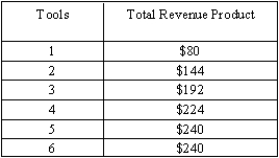 -Refer to Exhibit 16-1. The marginal revenue product for the sixth unit of tools is
 (Multiple Choice)
5.0/5 (72)
(72) Calculate the maximum price that should be paid for a bond with a face value of $100, a coupon of $12, and a maturity date of three years from now if the prevailing interest rate is 15 percent.
(Essay)
4.9/5 (76)
(76) Gretchen Morgenson and Joshua Rosner argued that the main reason for the most recent financial crisis was that
(Multiple Choice)
4.8/5 (77)
(77) Residential housing is considered physical capital only if it is used for business purposes.
(True/False)
4.7/5 (81)
(81) 
Filters
- Essay(0)
- Multiple Choice(0)
- Short Answer(0)
- True False(0)
- Matching(0)