



 Chat with AI
Exam 27: Monetary Policy

Exam 1: The Central Idea156 Questions
Exam 2: Observing and Explaining the Economy143 Questions
Exam 3: The Supply and Demand Model166 Questions
Exam 4: Subtleties of the Supply and Demand Model176 Questions
Exam 5: The Demand Curve and the Behavior of Consumers176 Questions
Exam 6: The Supply Curve and the Behavior of Firms179 Questions
Exam 7: The Efficiency of Markets163 Questions
Exam 8: Costs and the Changes at Firms Over Time191 Questions
Exam 9: The Rise and Fall of Industries139 Questions
Exam 10: Monopoly184 Questions
Exam 11: Product Differentiation, Monopolistic Competition, and Oligopoly169 Questions
Exam 12: Antitrust Policy and Regulation152 Questions
Exam 13: Labor Markets179 Questions
Exam 14: Taxes, Transfers, and Income Distribution179 Questions
Exam 15: Public Goods, Externalities, and Government Behavior197 Questions
Exam 16: Capital and Financial Markets188 Questions
Exam 17: Macroeconomics: the Big Picture159 Questions
Exam 18: Measuring the Production, Income, and Spending of Nations177 Questions
Exam 19: The Spending Allocation Model166 Questions
Exam 20: Unemployment and Employment212 Questions
Exam 21: Productivity and Economic Growth162 Questions
Exam 22: Money and Inflation153 Questions
Exam 23: The Nature and Causes of Economic Fluctuations185 Questions
Exam 24: The Economic Fluctuations Model205 Questions
Exam 25: Using the Economic Fluctuations Model176 Questions
Exam 26: Fiscal Policy138 Questions
Exam 27: Monetary Policy180 Questions
Exam 28: Economic Growth Around the World157 Questions
Exam 29: International Trade242 Questions
Exam 30: International Finance125 Questions
Select questions type


Which of the following statements about the Phillips curve is not true?
(Multiple Choice)
4.8/5  (81)
(81) Monetary policy is subject to fewer "mistakes" than fiscal policy.
(True/False)
4.8/5 (77)
(77) The current chairperson of the Federal Reserve Board (Fed) is Alan Greenspan.
(True/False)
4.9/5 (73)
(73) Data from the U.S. economy in the 1960s and 1970s support a long-run tradeoff between inflation and unemployment, whereas data from the 1980s and 1990s do not support such a tradeoff.
(True/False)
4.9/5 (75)
(75) Which of the following best explains why independent central banks need to be held accountable?
(Multiple Choice)
4.9/5 (85)
(85) As a result of the financial crisis, the Fed has begun buying securities in troubled markets, as it has been trying to provide more credit to the markets and thereby mitigate the crisis. This is known as
(Multiple Choice)
4.8/5 (72)
(72) Explain why the interest rate is the opportunity cost of holding money.
(Essay)
4.9/5 (80)
(80) If money demand is very volatile, the preferred policy is to target the interest rate instead of the money supply.
(True/False)
4.8/5 (79)
(79) If the Fed wants to cool off the economy, how will it adjust its monetary policy?
(Essay)
4.8/5 (72)
(72) If the Fed wants to fix the interest rate, how does it guarantee that money demand will equal money supply?
(Essay)
4.8/5 (78)
(78) If the Fed believes that real GDP is above potential GDP, it will
(Multiple Choice)
4.9/5 (78)
(78) The buying and selling government securities is the traditional role of central banks as they go about doing open market operations.
(True/False)
4.8/5 (82)
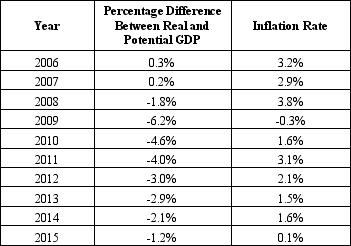
(82) The table shows the percentage difference between real and potential GDP and the rate of inflation for the years 2006 through 2015. If there was a presidential election in the year 2007, would these data support the view that there was a political business cycle during this period?
(Essay)
4.9/5 (83)
(83) The Federal Reserve System is part of the Department of the Treasury.
(True/False)
4.8/5 (86)
(86) 
Filters
- Essay(0)
- Multiple Choice(0)
- Short Answer(0)
- True False(0)
- Matching(0)