



 Chat with AI
Exam 27: Monetary Policy

Exam 1: The Central Idea156 Questions
Exam 2: Observing and Explaining the Economy143 Questions
Exam 3: The Supply and Demand Model166 Questions
Exam 4: Subtleties of the Supply and Demand Model176 Questions
Exam 5: The Demand Curve and the Behavior of Consumers176 Questions
Exam 6: The Supply Curve and the Behavior of Firms179 Questions
Exam 7: The Efficiency of Markets163 Questions
Exam 8: Costs and the Changes at Firms Over Time191 Questions
Exam 9: The Rise and Fall of Industries139 Questions
Exam 10: Monopoly184 Questions
Exam 11: Product Differentiation, Monopolistic Competition, and Oligopoly169 Questions
Exam 12: Antitrust Policy and Regulation152 Questions
Exam 13: Labor Markets179 Questions
Exam 14: Taxes, Transfers, and Income Distribution179 Questions
Exam 15: Public Goods, Externalities, and Government Behavior197 Questions
Exam 16: Capital and Financial Markets188 Questions
Exam 17: Macroeconomics: the Big Picture159 Questions
Exam 18: Measuring the Production, Income, and Spending of Nations177 Questions
Exam 19: The Spending Allocation Model166 Questions
Exam 20: Unemployment and Employment212 Questions
Exam 21: Productivity and Economic Growth162 Questions
Exam 22: Money and Inflation153 Questions
Exam 23: The Nature and Causes of Economic Fluctuations185 Questions
Exam 24: The Economic Fluctuations Model205 Questions
Exam 25: Using the Economic Fluctuations Model176 Questions
Exam 26: Fiscal Policy138 Questions
Exam 27: Monetary Policy180 Questions
Exam 28: Economic Growth Around the World157 Questions
Exam 29: International Trade242 Questions
Exam 30: International Finance125 Questions
Select questions type


Once a zero interest rate has been reached, even though continuing to increase the money supply will not lower the interest rate, the process can stimulate the economy.
(True/False)
4.8/5  (95)
(95) The European Economic and Monetary Union (EMU) was formed to
(Multiple Choice)
4.8/5 (76)
(76) The Fed's monetary policy rule is more than just a simple relationship between inflation and interest rates.
(True/False)
4.8/5 (78)
(78) 
In most cases, the Fed can determine whether real and potential GDP are equal.
(True/False)
4.9/5 (81)
(81) Who is the current chairperson of the Federal Reserve Board?
(Multiple Choice)
4.8/5 (81)
(81) If the Fed believes that real GDP is below potential GDP, it will
(Multiple Choice)
4.8/5 (84)
(84) If prices and wages were perfectly flexible and Congress had control over central bank decisions, Congress would have
(Multiple Choice)
4.8/5 (83)
(83) Given that the money demand function is not stable, why does the Fed think it is best to fix interest rates instead of growth in the money supply?
(Essay)
4.8/5 (74)
(74) If prices and wages are perfectly flexible, there is never any tradeoff between inflation and unemployment.
(True/False)
4.8/5 (82)
(82) What do economists mean when they refer to the "size" of the Fed's balance sheet?
(Multiple Choice)
4.8/5 (77)
(77) As a result of the financial crisis, from 2007 to 2009, the size of the Fed's balance sheet more than doubled.
(True/False)
4.7/5 (74)
(74) Explain why there is a tradeoff between inflation and unemployment in the medium run.
(Essay)
4.7/5 (79)
(79) The Central Bank of New Zealand has lost its independence in the last three decades.
(True/False)
4.9/5 (75)
(75) Suppose a country is experiencing a deflation while real GDP is below potential GDP.
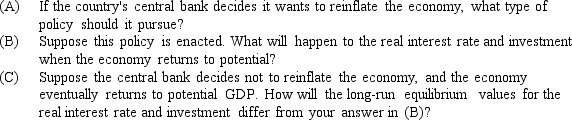
(Essay)
4.8/5 (89)
(89) A situation in which the interest rate gets so high that consumers and companies no longer can afford to obtain credit is known as a liquidity trap.
(True/False)
5.0/5 (60)
(60) 
Filters
- Essay(0)
- Multiple Choice(0)
- Short Answer(0)
- True False(0)
- Matching(0)