



 Chat with AI
Exam 27: Monetary Policy

Exam 1: The Central Idea156 Questions
Exam 2: Observing and Explaining the Economy143 Questions
Exam 3: The Supply and Demand Model166 Questions
Exam 4: Subtleties of the Supply and Demand Model176 Questions
Exam 5: The Demand Curve and the Behavior of Consumers176 Questions
Exam 6: The Supply Curve and the Behavior of Firms179 Questions
Exam 7: The Efficiency of Markets163 Questions
Exam 8: Costs and the Changes at Firms Over Time191 Questions
Exam 9: The Rise and Fall of Industries139 Questions
Exam 10: Monopoly184 Questions
Exam 11: Product Differentiation, Monopolistic Competition, and Oligopoly169 Questions
Exam 12: Antitrust Policy and Regulation152 Questions
Exam 13: Labor Markets179 Questions
Exam 14: Taxes, Transfers, and Income Distribution179 Questions
Exam 15: Public Goods, Externalities, and Government Behavior197 Questions
Exam 16: Capital and Financial Markets188 Questions
Exam 17: Macroeconomics: the Big Picture159 Questions
Exam 18: Measuring the Production, Income, and Spending of Nations177 Questions
Exam 19: The Spending Allocation Model166 Questions
Exam 20: Unemployment and Employment212 Questions
Exam 21: Productivity and Economic Growth162 Questions
Exam 22: Money and Inflation153 Questions
Exam 23: The Nature and Causes of Economic Fluctuations185 Questions
Exam 24: The Economic Fluctuations Model205 Questions
Exam 25: Using the Economic Fluctuations Model176 Questions
Exam 26: Fiscal Policy138 Questions
Exam 27: Monetary Policy180 Questions
Exam 28: Economic Growth Around the World157 Questions
Exam 29: International Trade242 Questions
Exam 30: International Finance125 Questions
Select questions type


Central bank independence guarantees that there will be no monetary policy mistakes.
(True/False)
4.8/5  (83)
(83) The table below shows the percentage difference between real and potential GDP and the rate of inflation for the years 1999 through 2003. If there were a presidential election in the year 2000, would these data support the view that there was a political business cycle during this period? 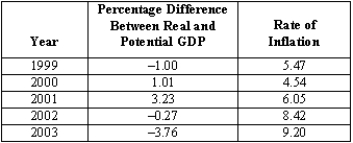
(Essay)
4.7/5 (77)
(77) How does the institutional setup of the Federal Reserve contribute to its independence?
(Essay)
4.8/5 (75)
(75) When the actual and target rate of inflation are equal, the Fed will change interest rates only if it wants to change the target rate of inflation.
(True/False)
4.8/5 (66)
(66) In an attempt to avert the worst consequences of the financial crisis of 2007 and 2008, the Fed cut the interest rate all the way to zero during the crisis, requiring that it find other ways to stimulate the economy.
(True/False)
4.9/5 (77)
(77) Suppose real and potential GDP are initially equal. If the Fed increases the target inflation rate, then in the short run we would expect
(Multiple Choice)
4.9/5 (79)
(79) Currency-the amount of coins and bills in circulation-is the main liability of the Fed.
(True/False)
4.7/5 (81)
(81) Which of the following would cause the Fed to raise interest rates even though the rate of inflation is equal to the target rate?
(Multiple Choice)
4.9/5 (78)
(78) The original Phillips curve argued that there was a long-run tradeoff between inflation and unemployment.
(True/False)
4.8/5 (87)
(87) The Fed's monetary policy was one of the possible factors leading to the Great Inflation in the 1970s and the housing price boom in the mid-2000s.
(True/False)
4.8/5 (82)
(82) One of the main liabilities on the Fed's balance sheet is reserves. Which of the following is the best definition of that item?
(Multiple Choice)
4.9/5 (90)
(90) Suppose real and potential GDP are initially equal. If the Fed increases the target inflation rate, then in the long run we would expect
(Multiple Choice)
4.7/5 (76)
(76) Explain why the Fed adjusts monetary policy in response to both inflation and the output gap.
(Essay)
4.7/5 (86)
(86) 
Filters
- Essay(0)
- Multiple Choice(0)
- Short Answer(0)
- True False(0)
- Matching(0)