



 Chat with AI
Exam 27: Monetary Policy

Exam 1: The Central Idea156 Questions
Exam 2: Observing and Explaining the Economy143 Questions
Exam 3: The Supply and Demand Model166 Questions
Exam 4: Subtleties of the Supply and Demand Model176 Questions
Exam 5: The Demand Curve and the Behavior of Consumers176 Questions
Exam 6: The Supply Curve and the Behavior of Firms179 Questions
Exam 7: The Efficiency of Markets163 Questions
Exam 8: Costs and the Changes at Firms Over Time191 Questions
Exam 9: The Rise and Fall of Industries139 Questions
Exam 10: Monopoly184 Questions
Exam 11: Product Differentiation, Monopolistic Competition, and Oligopoly169 Questions
Exam 12: Antitrust Policy and Regulation152 Questions
Exam 13: Labor Markets179 Questions
Exam 14: Taxes, Transfers, and Income Distribution179 Questions
Exam 15: Public Goods, Externalities, and Government Behavior197 Questions
Exam 16: Capital and Financial Markets188 Questions
Exam 17: Macroeconomics: the Big Picture159 Questions
Exam 18: Measuring the Production, Income, and Spending of Nations177 Questions
Exam 19: The Spending Allocation Model166 Questions
Exam 20: Unemployment and Employment212 Questions
Exam 21: Productivity and Economic Growth162 Questions
Exam 22: Money and Inflation153 Questions
Exam 23: The Nature and Causes of Economic Fluctuations185 Questions
Exam 24: The Economic Fluctuations Model205 Questions
Exam 25: Using the Economic Fluctuations Model176 Questions
Exam 26: Fiscal Policy138 Questions
Exam 27: Monetary Policy180 Questions
Exam 28: Economic Growth Around the World157 Questions
Exam 29: International Trade242 Questions
Exam 30: International Finance125 Questions
Select questions type


Between 1942 and 1951, the Federal Reserve, in order to help the United States Treasury cheaply finance World War II, maintained the interest rate on long-term government bonds at 2.5 percent. Between 1950 and 1951, the consumer price index rose by 8 percent because of the Korean War. Explain why this event resulted in a conflict between the Federal Reserve and the United States Treasury.
(Essay)
4.8/5  (86)
(86) 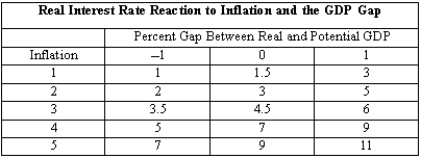 -According to the data in Exhibit 27-1,
Throughout history, higher money growth has been associated with
(Multiple Choice)
4.8/5 (70)
(70) Fed officials are appointed to long terms that may span several different presidents.
(True/False)
4.7/5 (85)
(85) Because it emphasizes the fact that the process involves the purchase of certain types of private securities, the Fed uses the following related term to refer to quantitative easing.
(Multiple Choice)
4.9/5 (84)
(84) The Fed can fix the interest rate or the money supply, but not both at the same time. Please explain.
(Essay)
4.9/5 (82)
(82) The policy of quantitative easing aims at reducing the interest rate.
(True/False)
4.8/5 (80)
(80) Increases or decreases in the monetary base eventually become corresponding increases or decreases in the money supply.
(True/False)
4.7/5 (91)
(91) The AD-AI analysis in conjunction with the Phillips curve relationship shows that
(Multiple Choice)
4.9/5 (86)
(86) Use a supply and demand for money diagram to show why, if the Fed is interested in lowering the federal funds rate by a certain amount, the interest sensitivity of the demand for money function will determine the extent of the open market operation, that is, by how much the money supply will have to increase.
(Essay)
4.9/5 (85)
(85) The Federal Reserve must have Congress approve its monetary policy decisions.
(True/False)
4.7/5 (82)
(82) During the financial crisis of 2007 and 2008, the Fed raised interest rates in an attempt to stabilize the financial system.
(True/False)
4.9/5 (82)
(82) There is a tradeoff between inflation and unemployment in the medium run only.
(True/False)
4.9/5 (86)
(86) Who was the chairperson of the Federal Reserve Board from 1987 to 2006?
(Multiple Choice)
4.8/5 (93)
(93) Assume the Fed has complete control over the money supply. If the demand for money were greater than the supply of money, we would expect
(Multiple Choice)
4.7/5 (81)
(81) If the public does not believe the government's claim that it will pursue low inflation policies, and the government then goes ahead and adopts an expansionary policy as the public expected, then
(Multiple Choice)
4.9/5 (74)
(74) If banks start paying higher interest rates on checking accounts, we would expect, assuming everything else held equal,
(Multiple Choice)
4.9/5 (73)
(73) 
Filters
- Essay(0)
- Multiple Choice(0)
- Short Answer(0)
- True False(0)
- Matching(0)