



 Chat with AI
Exam 11: Project Management

Exam 1: Introduction to Quantitative Analysis96 Questions
Exam 2: Probability Concepts and Applications155 Questions
Exam 3: Decision Analysis128 Questions
Exam 4: Regression Models129 Questions
Exam 5: Forecasting138 Questions
Exam 6: Inventory Control Models147 Questions
Exam 7: Linear Programming Models: Graphical and Computer Methods141 Questions
Exam 8: Linear Programming Applications89 Questions
Exam 9: Transportation, Assignment, and Network Models112 Questions
Exam 10: Integer Programming, Goal Programming, and Nonlinear Programming86 Questions
Exam 11: Project Management142 Questions
Exam 12: Waiting Lines and Queuing Theory Models127 Questions
Exam 13: Simulation Modeling94 Questions
Exam 14: Markov Analysis103 Questions
Exam 15: Statistical Quality Control96 Questions
Exam 16: Analytic Hierarchy Process66 Questions
Exam 17: Dynamic Programming86 Questions
Exam 18: Decision Theory and the Normal Distribution62 Questions
Exam 19: Game Theory59 Questions
Exam 20: Mathematical Tools: Determinants and Matrices104 Questions
Exam 21: Calculus-Based Optimization39 Questions
Exam 22: Linear Programming: The Simplex Method98 Questions
Exam 23: Transportation, Assignment, and Network Algorithms120 Questions
Select questions type


Table 11-1
The following represents a project with known activity times.All times are in weeks.
 -Using the data in Table 11-1, compute the latest finish time for activity E.
 (Multiple Choice)
4.8/5  (76)
(76) Table 11-7
A project manager calculated early and late start and finish times for all activities in her eight-activity project but spilled her energy drink on the paper and the acid in the beverage wiped out some of the table entries.The remaining legible entries are correct.
 -Consider the project summarized in Table 11-7.What is the slack for Activity C?
 (Multiple Choice)
4.8/5 (81)
(81) Table 11-7
A project manager calculated early and late start and finish times for all activities in her eight-activity project but spilled her energy drink on the paper and the acid in the beverage wiped out some of the table entries.The remaining legible entries are correct.
-Consider the project summarized in Table 11-7.What is the early finish time for Activity E?
-Consider the project summarized in Table 11-7.What is the early finish time for Activity E? (Multiple Choice)
4.7/5 (75)
(75) With PERT, we are able to calculate the probability of finishing the project within a specified time.
(True/False)
4.8/5 (79)
(79) Table 11-9
A mad scientist has identified the twelve steps required to complete his "take over the world" rehabilitation.The estimated time in weeks and cost in US dollars appear in the table along with the shortest possible duration for each activity and cost of those expedited activities.
 -Consider the project summarized in Table 11-9.What is the duration of the normal completion time and project cost at that time? What activities should be crashed to reduce completion time by ten weeks as inexpensively as possible? What is the new project duration and cost?
 (Essay)
4.8/5 (82)
(82) Table 11-7
A project manager calculated early and late start and finish times for all activities in her eight-activity project but spilled her energy drink on the paper and the acid in the beverage wiped out some of the table entries.The remaining legible entries are correct.
-Consider the project summarized in Table 11-7.What is the slack for Activity D?
-Consider the project summarized in Table 11-7.What is the slack for Activity D? (Multiple Choice)
4.7/5 (87)
(87) Given an activity's optimistic, most likely, and pessimistic time estimates of 4, 6, and 14 days respectively, compute the PERT expected activity time for this activity.
(Multiple Choice)
4.8/5 (75)
(75) Table 11-1
The following represents a project with known activity times.All times are in weeks.
-Using the data in Table 11-1, what is the latest possible time that C may be started without delaying completion of the project?
-Using the data in Table 11-1, what is the latest possible time that C may be started without delaying completion of the project? (Multiple Choice)
4.8/5 (71)
(71) The first step in planning and scheduling a project is to develop the work breakdown structure.
(True/False)
4.9/5 (84)
(84) CPM was developed for use in managing projects about which we have good information about activity or task completion times.
(True/False)
4.8/5 (83)
(83) Consider the following project schedule:
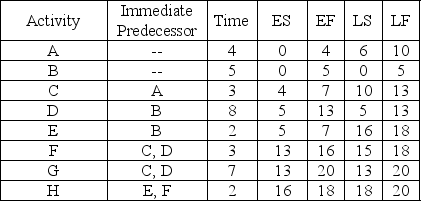 (a)Which activities are critical?
(b)Which activity has the most slack?
(a)Which activities are critical?
(b)Which activity has the most slack? (Short Answer)
4.9/5 (90)
(90) Table 11-3
 -According to Table 11-3, there are five activities in a PERT project.Which activities are on the critical path?
 (Multiple Choice)
4.9/5 (81)
(81) The project described by:  is best represented by which of the following networks?
 (Multiple Choice)
4.8/5 (82)
(82) Table 11-4
The following represents a project with known activity times.All times are in weeks.
 -Using the data in Table 11-4, compute the slack time for activity D.
 (Multiple Choice)
5.0/5 (80)
(80) Table 11-1
The following represents a project with known activity times.All times are in weeks.
-Using the data in Table 11-1, what is the minimum possible time required for completing the project?
-Using the data in Table 11-1, what is the minimum possible time required for completing the project? (Multiple Choice)
4.8/5 (71)
(71) Given an activity's optimistic, most likely, and pessimistic time estimates of 4, 14, and 18 days respectively, compute the PERT expected activity time for this activity.
(Multiple Choice)
4.7/5 (78)
(78) Given an activity's optimistic, most likely, and pessimistic time estimates of 3, 5, and 15 days, respectively, compute the PERT standard deviation for this activity.
(Multiple Choice)
4.9/5 (80)
(80) The value of work completed for an activity is determined by which of the following?
(Multiple Choice)
4.8/5 (80)
(80) 
Filters
- Essay(0)
- Multiple Choice(0)
- Short Answer(0)
- True False(0)
- Matching(0)