



 Chat with AI
Exam 11: Project Management

Exam 1: Introduction to Quantitative Analysis96 Questions
Exam 2: Probability Concepts and Applications155 Questions
Exam 3: Decision Analysis128 Questions
Exam 4: Regression Models129 Questions
Exam 5: Forecasting138 Questions
Exam 6: Inventory Control Models147 Questions
Exam 7: Linear Programming Models: Graphical and Computer Methods141 Questions
Exam 8: Linear Programming Applications89 Questions
Exam 9: Transportation, Assignment, and Network Models112 Questions
Exam 10: Integer Programming, Goal Programming, and Nonlinear Programming86 Questions
Exam 11: Project Management142 Questions
Exam 12: Waiting Lines and Queuing Theory Models127 Questions
Exam 13: Simulation Modeling94 Questions
Exam 14: Markov Analysis103 Questions
Exam 15: Statistical Quality Control96 Questions
Exam 16: Analytic Hierarchy Process66 Questions
Exam 17: Dynamic Programming86 Questions
Exam 18: Decision Theory and the Normal Distribution62 Questions
Exam 19: Game Theory59 Questions
Exam 20: Mathematical Tools: Determinants and Matrices104 Questions
Exam 21: Calculus-Based Optimization39 Questions
Exam 22: Linear Programming: The Simplex Method98 Questions
Exam 23: Transportation, Assignment, and Network Algorithms120 Questions
Select questions type


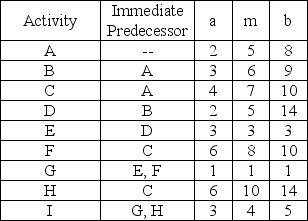
Table 11-4
The following represents a project with known activity times.All times are in weeks.
 -Using the data in Table 11-4, what is the latest possible time that C may be started without delaying completion of the project?
 (Multiple Choice)
4.8/5  (92)
(92) Figure 11-1  -Given the network in Figure 11-1, the critical path is
 (Multiple Choice)
4.8/5 (84)
(84) The optimistic time is the greatest amount of time that could be required to complete an activity.
(True/False)
4.8/5 (85)
(85) The activity crash cost is equal to the incremental cost of shortening the project.
(True/False)
4.8/5 (83)
(83) The activity difference is the actual duration of an activity less the planned duration of that same activity.
(True/False)
4.9/5 (63)
(63) Development of a new deluxe version of a particular software product is being considered.The activities necessary for the completion of this are listed in the table below (Time in weeks).
 (a)If you wish to reduce the time required to complete this project by two weeks, which activity(ies)should be crashed, and how much will this increase the total cost?
(b)What would be the added cost if you wanted to complete the project in the minimum time possible?
(a)If you wish to reduce the time required to complete this project by two weeks, which activity(ies)should be crashed, and how much will this increase the total cost?
(b)What would be the added cost if you wanted to complete the project in the minimum time possible? (Essay)
4.8/5 (70)
(70) Given an activity's optimistic, most likely, and pessimistic time estimates of 1, 9, and 23 days respectively, compute the PERT expected activity time for this activity.
(Multiple Choice)
4.9/5 (78)
(78) Table 11-8
A mad scientist has identified the ten steps required to create a race of atomic supermen to complete his plans for world conquest.The estimated time in weeks and cost in US dollars appear in the table along with the shortest possible duration for each activity and cost of those expedited activities.Activities are designated generically as A, B, and so on in order to avoid any copycat projects of this nature.
 -Consider the project summarized in Table 11-8.Suppose in addition to the costs shown in the table, the mad scientist faces a $2,000 per week opportunity cost of not being in control of the world.Determine the minimum cost project factoring in both the costs of expediting and the opportunity cost.What is the overall minimum cost?
 (Multiple Choice)
4.9/5 (72)
(72) Given the variability of the activity completion times, the original critical path we identify in our PERT analysis may not always be the actual critical path as the project takes place.
(True/False)
4.8/5 (84)
(84) Given an activity's optimistic, most likely, and pessimistic time estimates of 3, 6, and 9 days respectively, compute the PERT variance for this activity.
(Multiple Choice)
4.9/5 (80)
(80) Figure 11-1
-Given the network shown in Figure 11-1 and the following information, what is the variance of the critical path? 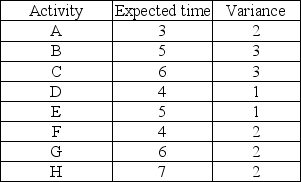
-Given the network shown in Figure 11-1 and the following information, what is the variance of the critical path? (Multiple Choice)
4.9/5 (78)
(78) Table 11-3
 -According to Table 11-3, there are five activities in a PERT project.What is the variance of the critical path?
 (Multiple Choice)
4.9/5 (75)
(75) In CPM, crashing an activity that is not on the critical path increases the cost of the project.
(True/False)
4.8/5 (75)
(75) Given an activity's optimistic, most likely, and pessimistic time estimates of 2, 10, and 20 days respectively, compute the PERT variance for this activity.
(Multiple Choice)
4.9/5 (72)
(72) Activity C of a project has a budgeted cost of $40,000 and is 20% complete.The actual cost is $10,000.
(a)What is the value of work completed?
(b)What is the activity difference?
(Short Answer)
4.9/5 (83)
(83) Consider the project with the following estimates for activity times and precedence relationships:
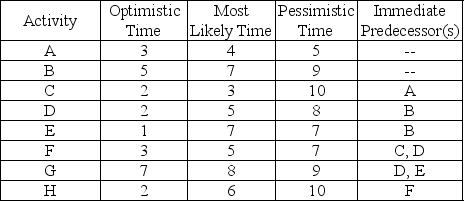 (a)What is the expected duration of the project?
(b)What is the project variance?
(c)If the deadline of the project is 25 days, what is the probability of finishing the project on time?
(a)What is the expected duration of the project?
(b)What is the project variance?
(c)If the deadline of the project is 25 days, what is the probability of finishing the project on time? (Short Answer)
4.8/5 (74)
(74) A PERT/CPM network is a graphical display of a project that connects activities.
(True/False)
4.8/5 (86)
(86) Table 11-8
A mad scientist has identified the ten steps required to create a race of atomic supermen to complete his plans for world conquest.The estimated time in weeks and cost in US dollars appear in the table along with the shortest possible duration for each activity and cost of those expedited activities.Activities are designated generically as A, B, and so on in order to avoid any copycat projects of this nature.
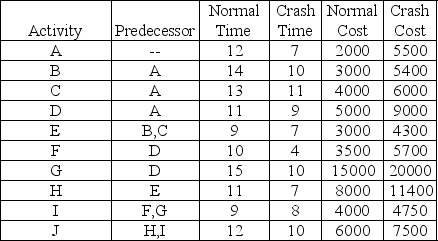 -Consider the project summarized in Table 11-8.Suppose in addition to the costs shown in the table, the mad scientist faces a $2,000 per week opportunity cost of not being in control of the world.Determine the minimum cost project factoring in both the costs of expediting and the opportunity cost.What is the overall minimum cost and duration of the project?
 (Essay)
4.9/5 (82)
(82) 
Filters
- Essay(0)
- Multiple Choice(0)
- Short Answer(0)
- True False(0)
- Matching(0)