



 Chat with AI
Exam 10: From Dna to Protein: Gene Expression

Exam 1: Introduction81 Questions
Exam 2: The Chemistry and Energy of Life87 Questions
Exam 3: Nucleic Acids, Proteins, and Enzymes118 Questions
Exam 4: Cells: the Working Units of Life115 Questions
Exam 5: Cell Membranes and Signaling95 Questions
Exam 6: Pathways That Harvest and Store Chemical Energy130 Questions
Exam 7: The Cell Cycle and Cell Division119 Questions
Exam 8: Inheritance, Genes, and Chromosomes80 Questions
Exam 9: DNA and Its Role in Heredity94 Questions
Exam 10: From Dna to Protein: Gene Expression80 Questions
Exam 11: Regulation of Gene Expression94 Questions
Exam 12: Genomes78 Questions
Exam 13: Biotechnology83 Questions
Exam 14: Genes, Development, and Evolution94 Questions
Exam 15: Processes of Evolution83 Questions
Exam 16: Reconstructing and Using Phylogenies76 Questions
Exam 17: Speciation80 Questions
Exam 18: The History of Life on Earth82 Questions
Exam 19: Bacteria, Archaea, and Viruses100 Questions
Exam 20: The Origin and Diversification of Eukaryotes96 Questions
Exam 21: The Evolution of Plants130 Questions
Exam 22: The Evolution and Diversity of Fungi103 Questions
Exam 23: Animal Origins and Diversity136 Questions
Exam 24: The Plant Body90 Questions
Exam 25: Plant Nutrition and Transport129 Questions
Exam 26: Plant Growth and Development85 Questions
Exam 27: Reproduction of Flowering Plants85 Questions
Exam 28: Plants in the Environment85 Questions
Exam 29: Fundamentals of Animal Function86 Questions
Exam 30: Nutrition and Digestion81 Questions
Exam 31: Breathing83 Questions
Exam 32: Circulation80 Questions
Exam 33: Muscle and Movement75 Questions
Exam 34: Neurons, Sense Organs, and Nervous Systems171 Questions
Exam 35: Nervous and Endocrine Control94 Questions
Exam 36: Water and Salts: Excretion85 Questions
Exam 37: Animal Reproduction84 Questions
Exam 38: Animal Development104 Questions
Exam 39: Immunology: Animal Defense Systems91 Questions
Exam 40: Animal Behavior83 Questions
Exam 41: The Distribution of Earths Ecological Systems82 Questions
Exam 42: Populations78 Questions
Exam 43: Ecological and Evolutionary Consequences of Interactions Within and Among Species114 Questions
Exam 44: Ecological Communities121 Questions
Exam 45: The Global Ecosystem127 Questions
Select questions type


Imagine that a novel life form is found deep within Earth's crust.It uses DNA as an information storage molecule,and transcription and translation occur as in other life forms with one exception: a codon for this organism is just two bases in length.What is the maximum number of different amino acids that could be encoded from such a genetic code?
(Multiple Choice)
4.8/5  (69)
(69) In bacteria,_______ kind(s)of RNA polymerase catalyze(s)the synthesis of RNA from DNA.
(Multiple Choice)
4.9/5 (90)
(90) Use the following to answer questions :
Suppose that a wild-type bacterium can synthesize substance D,but various mutant strains cannot.We know that substance D is synthesized from substance X in a pathway that involves three intermediate substances (A,B,and C),but we do not know the order of the steps in the pathway.Below is a table of four different mutant strains that have been tested for their ability to grow on the various substances.The plus sign means that the strain can grow on that substance;the negative sign means that the strain cannot grow on that substance. 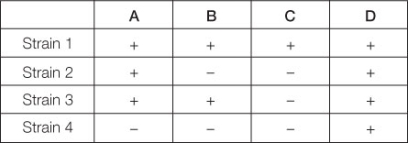 -According to the data above,what is the most likely order of the pathway?
 (Multiple Choice)
4.7/5 (79)
(79) What is the most likely reason that alkaptonuria is a recessive disease?
(Multiple Choice)
4.9/5 (74)
(74) The three codons in the genetic code that do not specify amino acids are called
(Multiple Choice)
4.9/5 (93)
(93) UGU and UGC both code for cysteine.A change from UGU to UGC would thus be a(n)_______ mutation.
(Multiple Choice)
4.8/5 (88)
(88) Ribosomes are a collection of _______ that are needed for _______.
(Multiple Choice)
4.9/5 (86)
(86) Which principle does the genetics of hemoglobin in humans illustrate?
(Multiple Choice)
4.9/5 (80)
(80) Mapping studies have determined that within a group of mutants with the same growth requirements (i.e. ,the same overt phenotype),individual mutations are on different chromosomes.This indicates that
(Multiple Choice)
4.8/5 (82)
(82) The "adapters" that allow translation of the four-letter nucleic acid language into the 20-letter protein language are called
(Multiple Choice)
4.9/5 (79)
(79) If a 5'-to-3' strand of DNA has the sequence GTCTATGCATTA,what is the template DNA strand that would be used for transcription?
(Multiple Choice)
4.9/5 (74)
(74) The _______ strand of DNA is transcribed to produce an RNA strand by DNA bases pairing with _______ bases of RNA.
(Multiple Choice)
4.7/5 (88)
(88) Suppose that a certain mRNA is transcribed at a normal rate in the nucleus,but it is found at very low levels in the cytoplasm.Which of the following would be the most plausible explanation for this phenomenon?
(Multiple Choice)
4.9/5 (80)
(80) 
Filters
- Essay(0)
- Multiple Choice(0)
- Short Answer(0)
- True False(0)
- Matching(0)