



 Chat with AI
Exam 17: Speciation

Exam 1: Introduction81 Questions
Exam 2: The Chemistry and Energy of Life87 Questions
Exam 3: Nucleic Acids, Proteins, and Enzymes118 Questions
Exam 4: Cells: the Working Units of Life115 Questions
Exam 5: Cell Membranes and Signaling95 Questions
Exam 6: Pathways That Harvest and Store Chemical Energy130 Questions
Exam 7: The Cell Cycle and Cell Division119 Questions
Exam 8: Inheritance, Genes, and Chromosomes80 Questions
Exam 9: DNA and Its Role in Heredity94 Questions
Exam 10: From Dna to Protein: Gene Expression80 Questions
Exam 11: Regulation of Gene Expression94 Questions
Exam 12: Genomes78 Questions
Exam 13: Biotechnology83 Questions
Exam 14: Genes, Development, and Evolution94 Questions
Exam 15: Processes of Evolution83 Questions
Exam 16: Reconstructing and Using Phylogenies76 Questions
Exam 17: Speciation80 Questions
Exam 18: The History of Life on Earth82 Questions
Exam 19: Bacteria, Archaea, and Viruses100 Questions
Exam 20: The Origin and Diversification of Eukaryotes96 Questions
Exam 21: The Evolution of Plants130 Questions
Exam 22: The Evolution and Diversity of Fungi103 Questions
Exam 23: Animal Origins and Diversity136 Questions
Exam 24: The Plant Body90 Questions
Exam 25: Plant Nutrition and Transport129 Questions
Exam 26: Plant Growth and Development85 Questions
Exam 27: Reproduction of Flowering Plants85 Questions
Exam 28: Plants in the Environment85 Questions
Exam 29: Fundamentals of Animal Function86 Questions
Exam 30: Nutrition and Digestion81 Questions
Exam 31: Breathing83 Questions
Exam 32: Circulation80 Questions
Exam 33: Muscle and Movement75 Questions
Exam 34: Neurons, Sense Organs, and Nervous Systems171 Questions
Exam 35: Nervous and Endocrine Control94 Questions
Exam 36: Water and Salts: Excretion85 Questions
Exam 37: Animal Reproduction84 Questions
Exam 38: Animal Development104 Questions
Exam 39: Immunology: Animal Defense Systems91 Questions
Exam 40: Animal Behavior83 Questions
Exam 41: The Distribution of Earths Ecological Systems82 Questions
Exam 42: Populations78 Questions
Exam 43: Ecological and Evolutionary Consequences of Interactions Within and Among Species114 Questions
Exam 44: Ecological Communities121 Questions
Exam 45: The Global Ecosystem127 Questions
Select questions type


An evolutionary biologist who makes decisions about whether to consider different populations of lacewings as separate species based on observations of the individuals with which these lacewings will mate is most likely employing the _______ species concept.
(Multiple Choice)
4.8/5  (66)
(66) Use the following to answer questions :
Two species of crickets have partially overlapping ranges.Hybrids are never found in the areas where the species meet.Individuals taken either from areas where they meet or areas where they do not meet will rarely mate in the lab because the females reject the songs sung by males of the other species.Of the few hybrids that are produced in lab crosses,all have low viability.
-The two cricket species exhibit _______ isolation.
(Multiple Choice)
4.9/5 (82)
(82) Which statement about the Dobzhansky-Muller model of speciation is false?
(Multiple Choice)
4.9/5 (72)
(72) Despite inhabiting overlapping ranges,the western spotted skunk and the eastern spotted skunk do not interbreed,partly because the western species breeds in early fall and the eastern species breeds in late winter to early spring.This is an example of _______ isolation.
(Multiple Choice)
4.8/5 (72)
(72) Which condition is least likely to lead to allopatric speciation?
(Multiple Choice)
5.0/5 (68)
(68) Even trained biologists have difficulty telling females of Drosophila melanogaster and D.sechellia apart,and yet these species are reproductively isolated.Thus,these species are considered _______ species.
(Multiple Choice)
4.9/5 (88)
(88) Two species of monkeyflowers have diverged in the structure of their flowers such that they can no longer be effectively pollinated by the same pollinator species.This is an example of _______ isolation.
(Multiple Choice)
4.8/5 (82)
(82) Refer to the diagram below showing different species of Bombina toads occupying different regions of Europe.A small area of overlap between these regions constitutes a hybrid zone.If individuals from differing populations overcome prezygotic reproductive barriers,additional postzygotic barriers may prevent the formation of stable hybrids.Based on the data shown below,which statement is true? 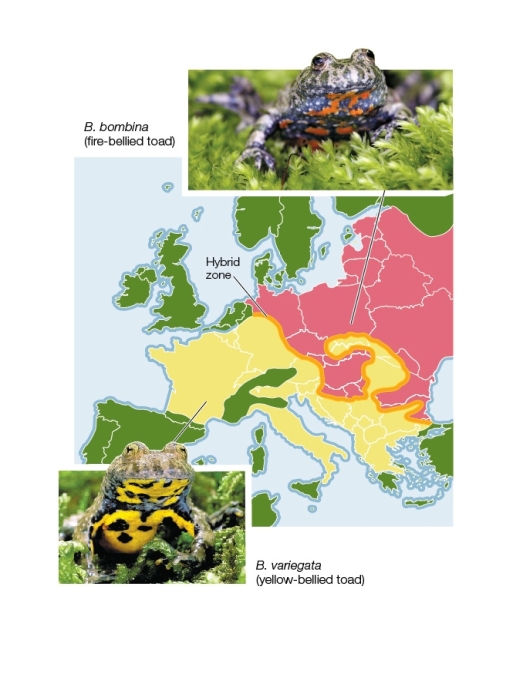
(Multiple Choice)
4.7/5 (74)
(74) What is an advantage that a lineage species concept has over the biological species concept?
(Multiple Choice)
4.7/5 (65)
(65) The biological species concept does not apply to which group of organisms?
(Multiple Choice)
4.9/5 (71)
(71) Phylogenetic information is most useful for _______ species concept.
(Multiple Choice)
4.8/5 (76)
(76) Self-fertilization is common in many plant species but less common in animals.One consequence of this difference is that
(Multiple Choice)
4.9/5 (64)
(64) The Isthmus of Panama cut off gene flow between Atlantic and Pacific populations of a species of fish.The cessation of gene flow led to the accumulation of genetic differences between the populations,which led to reproductive isolation.Now Atlantic and Pacific populations of this fish are separate species,and even if they were again to come into contact with each other,they could not interbreed.This situation illustrates the phenomenon of
(Multiple Choice)
4.8/5 (79)
(79) Which condition is least likely to lead to geographic isolation and allopatric speciation?
(Multiple Choice)
4.8/5 (66)
(66) Which statement about the hybrid zone between species of the European Bombina toad is false?
(Multiple Choice)
4.9/5 (77)
(77) Which mode of speciation is believed to be the dominant one among most groups of organisms?
(Multiple Choice)
4.7/5 (80)
(80) Which situation would pose a major difficulty for applying the biological species concept?
(Multiple Choice)
4.7/5 (93)
(93) 
Filters
- Essay(0)
- Multiple Choice(0)
- Short Answer(0)
- True False(0)
- Matching(0)