



 Chat with AI
Exam 36: Water and Salts: Excretion

Exam 1: Introduction81 Questions
Exam 2: The Chemistry and Energy of Life87 Questions
Exam 3: Nucleic Acids, Proteins, and Enzymes118 Questions
Exam 4: Cells: the Working Units of Life115 Questions
Exam 5: Cell Membranes and Signaling95 Questions
Exam 6: Pathways That Harvest and Store Chemical Energy130 Questions
Exam 7: The Cell Cycle and Cell Division119 Questions
Exam 8: Inheritance, Genes, and Chromosomes80 Questions
Exam 9: DNA and Its Role in Heredity94 Questions
Exam 10: From Dna to Protein: Gene Expression80 Questions
Exam 11: Regulation of Gene Expression94 Questions
Exam 12: Genomes78 Questions
Exam 13: Biotechnology83 Questions
Exam 14: Genes, Development, and Evolution94 Questions
Exam 15: Processes of Evolution83 Questions
Exam 16: Reconstructing and Using Phylogenies76 Questions
Exam 17: Speciation80 Questions
Exam 18: The History of Life on Earth82 Questions
Exam 19: Bacteria, Archaea, and Viruses100 Questions
Exam 20: The Origin and Diversification of Eukaryotes96 Questions
Exam 21: The Evolution of Plants130 Questions
Exam 22: The Evolution and Diversity of Fungi103 Questions
Exam 23: Animal Origins and Diversity136 Questions
Exam 24: The Plant Body90 Questions
Exam 25: Plant Nutrition and Transport129 Questions
Exam 26: Plant Growth and Development85 Questions
Exam 27: Reproduction of Flowering Plants85 Questions
Exam 28: Plants in the Environment85 Questions
Exam 29: Fundamentals of Animal Function86 Questions
Exam 30: Nutrition and Digestion81 Questions
Exam 31: Breathing83 Questions
Exam 32: Circulation80 Questions
Exam 33: Muscle and Movement75 Questions
Exam 34: Neurons, Sense Organs, and Nervous Systems171 Questions
Exam 35: Nervous and Endocrine Control94 Questions
Exam 36: Water and Salts: Excretion85 Questions
Exam 37: Animal Reproduction84 Questions
Exam 38: Animal Development104 Questions
Exam 39: Immunology: Animal Defense Systems91 Questions
Exam 40: Animal Behavior83 Questions
Exam 41: The Distribution of Earths Ecological Systems82 Questions
Exam 42: Populations78 Questions
Exam 43: Ecological and Evolutionary Consequences of Interactions Within and Among Species114 Questions
Exam 44: Ecological Communities121 Questions
Exam 45: The Global Ecosystem127 Questions
Select questions type


A sponge living in a marine environment does not actively regulate the osmolarity of its cells,but simply equilibrates with the osmolarity of the seawater.A sponge is therefore a(n)_______.
(Essay)
4.9/5  (87)
(87) Organisms whose tissue fluids can have the same osmolarity as the environment are said to be _______ with respect to their environment.
(Essay)
4.7/5 (92)
(92) To osmoregulate in fresh water,a fish must _______ salts and produce _______ amounts of _______ urine.
(Multiple Choice)
4.8/5 (82)
(82) If a person was stranded for several days in a desert without food or water,the blood plasma would _______ and the U/P ratio would _______.
(Multiple Choice)
4.9/5 (81)
(81) Adult toads and frogs living in fresh water excrete nitrogenous wastes primarily in the form of _______.
(Essay)
4.8/5 (86)
(86) Biologists have observed that kangaroo rats living in desert habitats change their diet from dry seeds to vegetation and insects depending on the season.Based on this information,which statement is most likely true?
(Multiple Choice)
4.8/5 (75)
(75) At present,there are no osmotic conformers in any freshwater animal species on Earth.Why?
(Multiple Choice)
4.9/5 (78)
(78) If interstitial fluid around the human loops of Henle reaches a concentration of 1,000 mOsm/L,what is the highest concentration that can be reached in urine in the collecting ducts?
(Multiple Choice)
4.9/5 (80)
(80) The normal blood osmotic pressure of terrestrial vertebrates is typically _______ mOsm.
(Multiple Choice)
4.8/5 (70)
(70) Which condition or process would not contribute to production of highly concentrated urine in mammals?
(Multiple Choice)
4.7/5 (63)
(63) Which sequence represents the correct order in which urine passes from the human kidney?
(Multiple Choice)
4.8/5 (63)
(63) In addition to producing water and carbon dioxide,the metabolism of proteins and nucleic acids produces nitrogenous waste,most frequently in the form of _______.
(Essay)
4.9/5 (76)
(76) The table below lists the primary mode of nitrogenous waste excretion in the juvenile and adult forms of five different species.If one species is known to be an amphibian and one is a desert reptile,then species _______ is most likely the amphibian and species _______ is most likely the desert reptile. 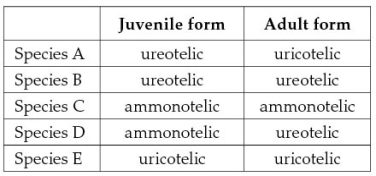
(Multiple Choice)
4.8/5 (75)
(75) Mammalian nephrons are different from amphibian nephrons in that only mammalian nephrons
(Multiple Choice)
4.8/5 (96)
(96) Which factor is most important in determining whether an animal excretes urea,uric acid,or ammonia?
(Multiple Choice)
5.0/5 (74)
(74) The loops of Henle are considered to function as a countercurrent multiplier because
(Multiple Choice)
4.8/5 (90)
(90) Which of the following is not a water conservation adaptation of a desert rodent?
(Multiple Choice)
4.8/5 (82)
(82) Which sequence represents the correct order in which fluid moves through the nephron,from beginning to end?
(Multiple Choice)
4.8/5 (69)
(69) 
Filters
- Essay(0)
- Multiple Choice(0)
- Short Answer(0)
- True False(0)
- Matching(0)