



 Chat with AI
Exam 36: Water and Salts: Excretion

Exam 1: Introduction81 Questions
Exam 2: The Chemistry and Energy of Life87 Questions
Exam 3: Nucleic Acids, Proteins, and Enzymes118 Questions
Exam 4: Cells: the Working Units of Life115 Questions
Exam 5: Cell Membranes and Signaling95 Questions
Exam 6: Pathways That Harvest and Store Chemical Energy130 Questions
Exam 7: The Cell Cycle and Cell Division119 Questions
Exam 8: Inheritance, Genes, and Chromosomes80 Questions
Exam 9: DNA and Its Role in Heredity94 Questions
Exam 10: From Dna to Protein: Gene Expression80 Questions
Exam 11: Regulation of Gene Expression94 Questions
Exam 12: Genomes78 Questions
Exam 13: Biotechnology83 Questions
Exam 14: Genes, Development, and Evolution94 Questions
Exam 15: Processes of Evolution83 Questions
Exam 16: Reconstructing and Using Phylogenies76 Questions
Exam 17: Speciation80 Questions
Exam 18: The History of Life on Earth82 Questions
Exam 19: Bacteria, Archaea, and Viruses100 Questions
Exam 20: The Origin and Diversification of Eukaryotes96 Questions
Exam 21: The Evolution of Plants130 Questions
Exam 22: The Evolution and Diversity of Fungi103 Questions
Exam 23: Animal Origins and Diversity136 Questions
Exam 24: The Plant Body90 Questions
Exam 25: Plant Nutrition and Transport129 Questions
Exam 26: Plant Growth and Development85 Questions
Exam 27: Reproduction of Flowering Plants85 Questions
Exam 28: Plants in the Environment85 Questions
Exam 29: Fundamentals of Animal Function86 Questions
Exam 30: Nutrition and Digestion81 Questions
Exam 31: Breathing83 Questions
Exam 32: Circulation80 Questions
Exam 33: Muscle and Movement75 Questions
Exam 34: Neurons, Sense Organs, and Nervous Systems171 Questions
Exam 35: Nervous and Endocrine Control94 Questions
Exam 36: Water and Salts: Excretion85 Questions
Exam 37: Animal Reproduction84 Questions
Exam 38: Animal Development104 Questions
Exam 39: Immunology: Animal Defense Systems91 Questions
Exam 40: Animal Behavior83 Questions
Exam 41: The Distribution of Earths Ecological Systems82 Questions
Exam 42: Populations78 Questions
Exam 43: Ecological and Evolutionary Consequences of Interactions Within and Among Species114 Questions
Exam 44: Ecological Communities121 Questions
Exam 45: The Global Ecosystem127 Questions
Select questions type


Ammonia and urea are waste products derived from the metabolic breakdown of
(Multiple Choice)
4.8/5  (93)
(93) Which structure is found in the inner medulla of the mammalian kidney?
(Multiple Choice)
4.9/5 (81)
(81) What evidence supports the hypothesis that marine bony fish evolved from freshwater ancestors?
(Multiple Choice)
4.9/5 (85)
(85) Refer to the table below containing field research data collected about a species of desert woodrat.Activity levels of the rats were monitored at all times,and maximum daytime temperatures were recorded.Based on these data,which statement could the researchers propose as a hypothesis about water conservation in this species? 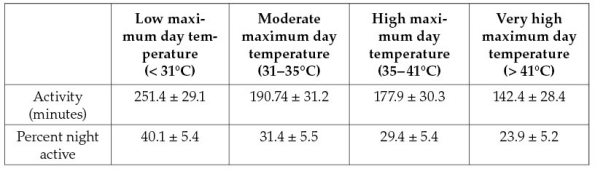
(Multiple Choice)
4.8/5 (86)
(86) Which statement about the function of excretory systems is false?
(Multiple Choice)
5.0/5 (75)
(75) Which group of animals would be most suitable for a study of ammonia excretion?
(Multiple Choice)
4.9/5 (76)
(76) Suppose that a petite woman has a total of 4 liters of blood in her body and it moves through her glomeruli at a rate of 120 mL per minute.How long does it take for her kidneys to process her entire volume of blood?
(Multiple Choice)
4.8/5 (73)
(73) If two mammals are the same size but one has a greater ability to concentrate its urine,which feature is the likely source of this capacity?
(Multiple Choice)
4.9/5 (80)
(80) The brine shrimp Artemia is a hyposmotic regulator that lives in an extremely high saline environment.Which statement would most likely be true of this organism?
(Multiple Choice)
4.8/5 (84)
(84) What is the human body's response to ingestion of much more than the recommended daily limit of salt (e.g. ,an entire bag of potato chips)?
(Multiple Choice)
4.8/5 (79)
(79) _______ urine is produced in the Bowman's capsules and glomeruli.
(Multiple Choice)
4.8/5 (83)
(83) Anadromous bony fish,such as shad,leave the ocean and return to their natal freshwater streams to breed.When their environment changes from salt water to fresh water,these fish are likely to
(Multiple Choice)
4.8/5 (73)
(73) A scientist wishing to study how animals produce urine that is more concentrated than their body fluids should choose a study species from which group?
(Multiple Choice)
4.9/5 (94)
(94) Which factor would be most important in bringing about a change in mammalian urine concentration from dilute to concentrated in a short period of time?
(Multiple Choice)
4.7/5 (93)
(93) 
Filters
- Essay(0)
- Multiple Choice(0)
- Short Answer(0)
- True False(0)
- Matching(0)