



 Chat with AI
Exam 39: Immunology: Animal Defense Systems

Exam 1: Introduction81 Questions
Exam 2: The Chemistry and Energy of Life87 Questions
Exam 3: Nucleic Acids, Proteins, and Enzymes118 Questions
Exam 4: Cells: the Working Units of Life115 Questions
Exam 5: Cell Membranes and Signaling95 Questions
Exam 6: Pathways That Harvest and Store Chemical Energy130 Questions
Exam 7: The Cell Cycle and Cell Division119 Questions
Exam 8: Inheritance, Genes, and Chromosomes80 Questions
Exam 9: DNA and Its Role in Heredity94 Questions
Exam 10: From Dna to Protein: Gene Expression80 Questions
Exam 11: Regulation of Gene Expression94 Questions
Exam 12: Genomes78 Questions
Exam 13: Biotechnology83 Questions
Exam 14: Genes, Development, and Evolution94 Questions
Exam 15: Processes of Evolution83 Questions
Exam 16: Reconstructing and Using Phylogenies76 Questions
Exam 17: Speciation80 Questions
Exam 18: The History of Life on Earth82 Questions
Exam 19: Bacteria, Archaea, and Viruses100 Questions
Exam 20: The Origin and Diversification of Eukaryotes96 Questions
Exam 21: The Evolution of Plants130 Questions
Exam 22: The Evolution and Diversity of Fungi103 Questions
Exam 23: Animal Origins and Diversity136 Questions
Exam 24: The Plant Body90 Questions
Exam 25: Plant Nutrition and Transport129 Questions
Exam 26: Plant Growth and Development85 Questions
Exam 27: Reproduction of Flowering Plants85 Questions
Exam 28: Plants in the Environment85 Questions
Exam 29: Fundamentals of Animal Function86 Questions
Exam 30: Nutrition and Digestion81 Questions
Exam 31: Breathing83 Questions
Exam 32: Circulation80 Questions
Exam 33: Muscle and Movement75 Questions
Exam 34: Neurons, Sense Organs, and Nervous Systems171 Questions
Exam 35: Nervous and Endocrine Control94 Questions
Exam 36: Water and Salts: Excretion85 Questions
Exam 37: Animal Reproduction84 Questions
Exam 38: Animal Development104 Questions
Exam 39: Immunology: Animal Defense Systems91 Questions
Exam 40: Animal Behavior83 Questions
Exam 41: The Distribution of Earths Ecological Systems82 Questions
Exam 42: Populations78 Questions
Exam 43: Ecological and Evolutionary Consequences of Interactions Within and Among Species114 Questions
Exam 44: Ecological Communities121 Questions
Exam 45: The Global Ecosystem127 Questions
Select questions type


When a T cell is activated by an antigen,it will most likely
(Multiple Choice)
4.9/5  (83)
(83) The bacteria and fungi that live on our body's surfaces but do not cause disease (and often perform essential roles in defense and other activities)are known collectively as _______.
(Essay)
4.8/5 (83)
(83) Virally infected cells often produce small amounts of antimicrobial proteins known as _______ that increase the resistance of neighboring cells to infection.
(Essay)
4.9/5 (87)
(87) Cruise ship passengers find themselves fighting flulike symptoms for the first four or five days of their trip,but eventually they recover.Which is the last defensive component involved in their recovery?
(Multiple Choice)
4.7/5 (80)
(80) Harmful organisms and viruses that can cause disease are collectively known as _______.
(Essay)
4.9/5 (69)
(69) Many passengers on a cruise ship at sea are suffering from flulike symptoms.Which component of the immune system will protect the passengers from becoming sick from the same viral strain the next time they are exposed?
(Multiple Choice)
4.8/5 (75)
(75) Which is not an opportunistic infection or cancer often associated with AIDS?
(Multiple Choice)
4.7/5 (68)
(68) Lymphocytes that are specific for certain antigens proliferate by a process known as
(Multiple Choice)
4.7/5 (86)
(86) HIV can be transmitted from person to person by all of the following except
(Multiple Choice)
4.9/5 (78)
(78) The simplest immunoglobulins have _______ polypeptide chain(s).
(Multiple Choice)
4.8/5 (86)
(86) Use the following to answer questions :
Refer to the diagram below showing a receptor on a cell. 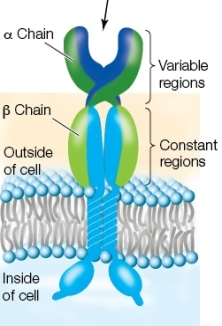 -Which of the following binds to the region of the receptor indicated by the arrow?
 (Multiple Choice)
4.9/5 (90)
(90) A college student taking a 24-hour bus trip is surrounded by people sniffling and sneezing.This is her first exposure to the bacterial pathogen responsible for their "head cold," but she never develops any symptoms.Which is not one of the factors involved in her resistance?
(Multiple Choice)
4.9/5 (74)
(74) Use the following to answer questions :
Refer to the experiment below,which points to blood as an important factor in adaptive immunity. 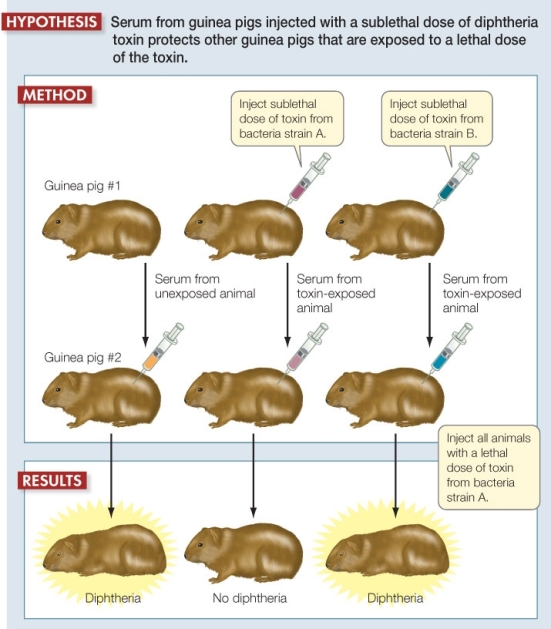 -Suppose that in the final step of the experiment,all the animals were injected with a lethal dose of toxin from bacteria strain B rather than from strain A.What would be the most likely outcome?
 (Multiple Choice)
4.9/5 (69)
(69) The _______ region of an antibody determines its class;the _______ region determines its specificity.
(Multiple Choice)
4.8/5 (86)
(86) 
Filters
- Essay(0)
- Multiple Choice(0)
- Short Answer(0)
- True False(0)
- Matching(0)