



 Chat with AI
Exam 39: Immunology: Animal Defense Systems

Exam 1: Introduction81 Questions
Exam 2: The Chemistry and Energy of Life87 Questions
Exam 3: Nucleic Acids, Proteins, and Enzymes118 Questions
Exam 4: Cells: the Working Units of Life115 Questions
Exam 5: Cell Membranes and Signaling95 Questions
Exam 6: Pathways That Harvest and Store Chemical Energy130 Questions
Exam 7: The Cell Cycle and Cell Division119 Questions
Exam 8: Inheritance, Genes, and Chromosomes80 Questions
Exam 9: DNA and Its Role in Heredity94 Questions
Exam 10: From Dna to Protein: Gene Expression80 Questions
Exam 11: Regulation of Gene Expression94 Questions
Exam 12: Genomes78 Questions
Exam 13: Biotechnology83 Questions
Exam 14: Genes, Development, and Evolution94 Questions
Exam 15: Processes of Evolution83 Questions
Exam 16: Reconstructing and Using Phylogenies76 Questions
Exam 17: Speciation80 Questions
Exam 18: The History of Life on Earth82 Questions
Exam 19: Bacteria, Archaea, and Viruses100 Questions
Exam 20: The Origin and Diversification of Eukaryotes96 Questions
Exam 21: The Evolution of Plants130 Questions
Exam 22: The Evolution and Diversity of Fungi103 Questions
Exam 23: Animal Origins and Diversity136 Questions
Exam 24: The Plant Body90 Questions
Exam 25: Plant Nutrition and Transport129 Questions
Exam 26: Plant Growth and Development85 Questions
Exam 27: Reproduction of Flowering Plants85 Questions
Exam 28: Plants in the Environment85 Questions
Exam 29: Fundamentals of Animal Function86 Questions
Exam 30: Nutrition and Digestion81 Questions
Exam 31: Breathing83 Questions
Exam 32: Circulation80 Questions
Exam 33: Muscle and Movement75 Questions
Exam 34: Neurons, Sense Organs, and Nervous Systems171 Questions
Exam 35: Nervous and Endocrine Control94 Questions
Exam 36: Water and Salts: Excretion85 Questions
Exam 37: Animal Reproduction84 Questions
Exam 38: Animal Development104 Questions
Exam 39: Immunology: Animal Defense Systems91 Questions
Exam 40: Animal Behavior83 Questions
Exam 41: The Distribution of Earths Ecological Systems82 Questions
Exam 42: Populations78 Questions
Exam 43: Ecological and Evolutionary Consequences of Interactions Within and Among Species114 Questions
Exam 44: Ecological Communities121 Questions
Exam 45: The Global Ecosystem127 Questions
Select questions type


The _______ acid in gastric juice is lethal to many pathogens.
(Multiple Choice)
4.9/5  (81)
(81) One V gene,one D gene,and one J gene encode for the _______ region of the _______ chain of a specific antibody.
(Multiple Choice)
4.9/5 (76)
(76) Which statement about specific and nonspecific defenses is false?
(Multiple Choice)
4.9/5 (86)
(86) Each B cell produces antibodies with _______ kind(s)of antigen specificity.
(Multiple Choice)
4.8/5 (88)
(88) If you travel to a tropical region and encounter malaria for the first time,your _______ immunity may protect you from becoming infected.
(Essay)
4.9/5 (95)
(95) Use the following to answer questions :
Refer to the diagram below showing a receptor on a cell. 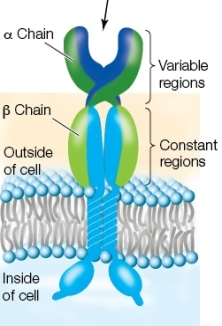 -What type of cell is shown in the diagram?
 (Multiple Choice)
4.9/5 (86)
(86) When an individual is first exposed to the smallpox virus,several days pass before significant numbers of specific antibody molecules and T cells are produced.However,a second exposure to the virus causes a large and rapid production of antibodies and T cells.This later response is an example of
(Multiple Choice)
4.8/5 (80)
(80) A student studying abroad finds himself feeling ill.He recovers after about a week and does not experience the symptoms again,even after he is exposed numerous times to other students with the same illness.After the first bout of sickness he is likely benefiting from _______ immunity.
(Essay)
4.9/5 (86)
(86) A bacterium in the bloodstream is most likely to encounter an _______ antibody.
(Multiple Choice)
4.9/5 (72)
(72) Hashimoto's thyroiditis is an autoimmune disease.Which cell type normally prevents the development of this disease?
(Multiple Choice)
4.9/5 (73)
(73) The mechanisms of joining and random deletion account for only a part of antibody diversity.Vast numbers of unique immunoglobulins are also produced by
(Multiple Choice)
4.8/5 (72)
(72) Interferons are produced in response to a _______ infection.
(Multiple Choice)
4.8/5 (85)
(85) The body's tolerance to its own molecules involves all of the following except
(Multiple Choice)
4.8/5 (69)
(69) The bacteria and fungi that typically live and reproduce on the skin without causing disease are called
(Multiple Choice)
4.9/5 (90)
(90) A successful cellular immune response to a viral infection is dependent upon the activity of
(Multiple Choice)
4.9/5 (76)
(76) Which event must take place for a B cell to become an antibody-secreting plasma cell?
(Multiple Choice)
4.8/5 (68)
(68) The most abundant antibody class circulating in the human body is
(Multiple Choice)
4.7/5 (74)
(74) 
Filters
- Essay(0)
- Multiple Choice(0)
- Short Answer(0)
- True False(0)
- Matching(0)