



 Chat with AI
Exam 39: Immunology: Animal Defense Systems

Exam 1: Introduction81 Questions
Exam 2: The Chemistry and Energy of Life87 Questions
Exam 3: Nucleic Acids, Proteins, and Enzymes118 Questions
Exam 4: Cells: the Working Units of Life115 Questions
Exam 5: Cell Membranes and Signaling95 Questions
Exam 6: Pathways That Harvest and Store Chemical Energy130 Questions
Exam 7: The Cell Cycle and Cell Division119 Questions
Exam 8: Inheritance, Genes, and Chromosomes80 Questions
Exam 9: DNA and Its Role in Heredity94 Questions
Exam 10: From Dna to Protein: Gene Expression80 Questions
Exam 11: Regulation of Gene Expression94 Questions
Exam 12: Genomes78 Questions
Exam 13: Biotechnology83 Questions
Exam 14: Genes, Development, and Evolution94 Questions
Exam 15: Processes of Evolution83 Questions
Exam 16: Reconstructing and Using Phylogenies76 Questions
Exam 17: Speciation80 Questions
Exam 18: The History of Life on Earth82 Questions
Exam 19: Bacteria, Archaea, and Viruses100 Questions
Exam 20: The Origin and Diversification of Eukaryotes96 Questions
Exam 21: The Evolution of Plants130 Questions
Exam 22: The Evolution and Diversity of Fungi103 Questions
Exam 23: Animal Origins and Diversity136 Questions
Exam 24: The Plant Body90 Questions
Exam 25: Plant Nutrition and Transport129 Questions
Exam 26: Plant Growth and Development85 Questions
Exam 27: Reproduction of Flowering Plants85 Questions
Exam 28: Plants in the Environment85 Questions
Exam 29: Fundamentals of Animal Function86 Questions
Exam 30: Nutrition and Digestion81 Questions
Exam 31: Breathing83 Questions
Exam 32: Circulation80 Questions
Exam 33: Muscle and Movement75 Questions
Exam 34: Neurons, Sense Organs, and Nervous Systems171 Questions
Exam 35: Nervous and Endocrine Control94 Questions
Exam 36: Water and Salts: Excretion85 Questions
Exam 37: Animal Reproduction84 Questions
Exam 38: Animal Development104 Questions
Exam 39: Immunology: Animal Defense Systems91 Questions
Exam 40: Animal Behavior83 Questions
Exam 41: The Distribution of Earths Ecological Systems82 Questions
Exam 42: Populations78 Questions
Exam 43: Ecological and Evolutionary Consequences of Interactions Within and Among Species114 Questions
Exam 44: Ecological Communities121 Questions
Exam 45: The Global Ecosystem127 Questions
Select questions type


Also known as white blood cells,_______ fall into the two broad classes of phagocytes and lymphocytes.
(Essay)
4.8/5  (82)
(82) Which is not a key trait of a primary specific immune response?
(Multiple Choice)
4.9/5 (91)
(91) A T cell is stimulated by the binding of its receptor to an antigen‒MHC complex expressed by a host cell.The outcome of this interaction is the death of the cell if
(Multiple Choice)
5.0/5 (81)
(81) After surviving an infection during the plague of Athens (in the Peloponnesian War),Thucydides noted that he no longer feared the disease,"for the same man was never attacked twice." Unknowingly,he was referring to
(Multiple Choice)
4.9/5 (75)
(75) In terms of its speed and effectiveness,the primary immune response is _______ the secondary immune response.
(Multiple Choice)
4.8/5 (78)
(78) Doctors trying to identify the nature of the immune response to a newly identified pathogen note that every time they isolate the antigen that the immune system is responding to,it is bound to the surface of a cell.This means that the component(s)of the immune system involved could be
(Multiple Choice)
4.8/5 (78)
(78) Which consequence of HIV infection is the primary factor leading to the development of acquired immune deficiency syndrome (AIDS)?
(Multiple Choice)
4.8/5 (81)
(81) For every white blood cell in a given volume of human blood,there are about _______ red blood cells.
(Multiple Choice)
4.8/5 (80)
(80) Which symptom or observation would support the hypothesis that a person is undergoing an adaptive immune response after exposure to a pathogen?
(Multiple Choice)
4.8/5 (79)
(79) Use the following to answer questions :
Refer to the experiment below,which points to blood as an important factor in adaptive immunity. 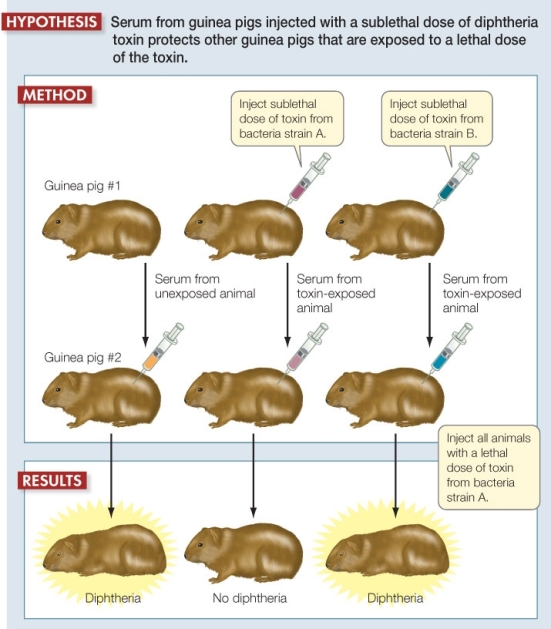 -Which statement about the effects of toxin from bacteria strain B is true?
 (Multiple Choice)
4.9/5 (86)
(86) Soluble signal proteins called _______,which are released by many cells,bind to and alter the behavior of their target cells.
(Essay)
4.8/5 (88)
(88) The plague of Athens (during the Peloponnesian War)was most likely caused by _______.
(Essay)
4.8/5 (80)
(80) 
Filters
- Essay(0)
- Multiple Choice(0)
- Short Answer(0)
- True False(0)
- Matching(0)