



 Chat with AI
Exam 44: Ecological Communities

Exam 1: Introduction81 Questions
Exam 2: The Chemistry and Energy of Life87 Questions
Exam 3: Nucleic Acids, Proteins, and Enzymes118 Questions
Exam 4: Cells: the Working Units of Life115 Questions
Exam 5: Cell Membranes and Signaling95 Questions
Exam 6: Pathways That Harvest and Store Chemical Energy130 Questions
Exam 7: The Cell Cycle and Cell Division119 Questions
Exam 8: Inheritance, Genes, and Chromosomes80 Questions
Exam 9: DNA and Its Role in Heredity94 Questions
Exam 10: From Dna to Protein: Gene Expression80 Questions
Exam 11: Regulation of Gene Expression94 Questions
Exam 12: Genomes78 Questions
Exam 13: Biotechnology83 Questions
Exam 14: Genes, Development, and Evolution94 Questions
Exam 15: Processes of Evolution83 Questions
Exam 16: Reconstructing and Using Phylogenies76 Questions
Exam 17: Speciation80 Questions
Exam 18: The History of Life on Earth82 Questions
Exam 19: Bacteria, Archaea, and Viruses100 Questions
Exam 20: The Origin and Diversification of Eukaryotes96 Questions
Exam 21: The Evolution of Plants130 Questions
Exam 22: The Evolution and Diversity of Fungi103 Questions
Exam 23: Animal Origins and Diversity136 Questions
Exam 24: The Plant Body90 Questions
Exam 25: Plant Nutrition and Transport129 Questions
Exam 26: Plant Growth and Development85 Questions
Exam 27: Reproduction of Flowering Plants85 Questions
Exam 28: Plants in the Environment85 Questions
Exam 29: Fundamentals of Animal Function86 Questions
Exam 30: Nutrition and Digestion81 Questions
Exam 31: Breathing83 Questions
Exam 32: Circulation80 Questions
Exam 33: Muscle and Movement75 Questions
Exam 34: Neurons, Sense Organs, and Nervous Systems171 Questions
Exam 35: Nervous and Endocrine Control94 Questions
Exam 36: Water and Salts: Excretion85 Questions
Exam 37: Animal Reproduction84 Questions
Exam 38: Animal Development104 Questions
Exam 39: Immunology: Animal Defense Systems91 Questions
Exam 40: Animal Behavior83 Questions
Exam 41: The Distribution of Earths Ecological Systems82 Questions
Exam 42: Populations78 Questions
Exam 43: Ecological and Evolutionary Consequences of Interactions Within and Among Species114 Questions
Exam 44: Ecological Communities121 Questions
Exam 45: The Global Ecosystem127 Questions
Select questions type


An ecologist who runs a transect across a gradient from serpentine soils to non-serpentine soils will most likely find
(Multiple Choice)
4.8/5  (86)
(86) According to the theory of island biogeography,which type of island would have the highest species diversity?
(Multiple Choice)
4.8/5 (83)
(83) The theory of island biogeography is based on the conclusion that equilibrium in species richness is reached when the rate of species colonization of an island matches the rate of species _______.
(Essay)
4.7/5 (68)
(68) Design an experiment that a group of scientists could use to determine how climate change is affecting the species composition of pond communities.
(Essay)
4.9/5 (70)
(70) Which pair of scientists is most associated with the theory of island biogeography?
(Multiple Choice)
4.9/5 (77)
(77) Suppose that plants are able to convert 80 percent of the energy that they obtain into biomass,and that the ecological efficiency of primary consumers is 20 percent.For every calorie that is converted into primary consumer biomass,how much energy must be captured and converted into chemical energy?
(Multiple Choice)
4.8/5 (85)
(85) Characteristics of the surface features of the environment of a natural community,plus the horizontal and vertical distribution of objects in that environment,are known as the _______ structure.
(Essay)
4.8/5 (85)
(85) The process by which the beetle community changes over the hours and days after the deposition of dung is called
(Multiple Choice)
4.8/5 (87)
(87) For study purposes,which of the following would not be considered an ecological community?
(Multiple Choice)
4.9/5 (81)
(81) Biome A supports approximately 1,400 species of birds,biome B supports approximately 105 species,and biome C supports 56 species.Based on these numbers,what are the likely climates of these biomes?
(Multiple Choice)
4.9/5 (76)
(76) After a major ice storm,most trees in an area fall and die.Over the course of two decades,a new community reassembles there.The ice storm would be considered a(n)
(Multiple Choice)
4.7/5 (79)
(79) An ecologist is studying changes in the abundance of plant species in a marsh as one moves away from the ocean.This means the ecologist is studying species changes that occur along a(n)
(Multiple Choice)
4.8/5 (79)
(79) The volcanic island of Krakatau provides a very good illustration of
(Multiple Choice)
4.7/5 (82)
(82) One possible reason for the increase in species richness toward the tropical latitudes is that
(Multiple Choice)
4.9/5 (72)
(72) Latitudinal gradients in species diversity exist in marine as well as terrestrial habitats.Which ocean community would most likely have the highest species diversity?
(Multiple Choice)
4.8/5 (76)
(76) Three plant communities have the species compositions shown in the table below.Which community or communities have the highest species richness? 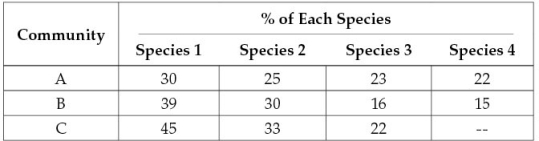
(Multiple Choice)
4.8/5 (83)
(83) David Tilman's experiments showed that as species richness in prairie plots increases,those plots show _______ NPP.
(Essay)
4.9/5 (80)
(80) Corridors help mitigate the effect of habitat fragmentation because they
(Multiple Choice)
4.9/5 (105)
(105) The number of trophic levels in a community is limited-most communities have no more than four levels.Explain why this is the case.
(Essay)
4.7/5 (88)
(88) 
Filters
- Essay(0)
- Multiple Choice(0)
- Short Answer(0)
- True False(0)
- Matching(0)