



 Chat with AI
Exam 44: Ecological Communities

Exam 1: Introduction81 Questions
Exam 2: The Chemistry and Energy of Life87 Questions
Exam 3: Nucleic Acids, Proteins, and Enzymes118 Questions
Exam 4: Cells: the Working Units of Life115 Questions
Exam 5: Cell Membranes and Signaling95 Questions
Exam 6: Pathways That Harvest and Store Chemical Energy130 Questions
Exam 7: The Cell Cycle and Cell Division119 Questions
Exam 8: Inheritance, Genes, and Chromosomes80 Questions
Exam 9: DNA and Its Role in Heredity94 Questions
Exam 10: From Dna to Protein: Gene Expression80 Questions
Exam 11: Regulation of Gene Expression94 Questions
Exam 12: Genomes78 Questions
Exam 13: Biotechnology83 Questions
Exam 14: Genes, Development, and Evolution94 Questions
Exam 15: Processes of Evolution83 Questions
Exam 16: Reconstructing and Using Phylogenies76 Questions
Exam 17: Speciation80 Questions
Exam 18: The History of Life on Earth82 Questions
Exam 19: Bacteria, Archaea, and Viruses100 Questions
Exam 20: The Origin and Diversification of Eukaryotes96 Questions
Exam 21: The Evolution of Plants130 Questions
Exam 22: The Evolution and Diversity of Fungi103 Questions
Exam 23: Animal Origins and Diversity136 Questions
Exam 24: The Plant Body90 Questions
Exam 25: Plant Nutrition and Transport129 Questions
Exam 26: Plant Growth and Development85 Questions
Exam 27: Reproduction of Flowering Plants85 Questions
Exam 28: Plants in the Environment85 Questions
Exam 29: Fundamentals of Animal Function86 Questions
Exam 30: Nutrition and Digestion81 Questions
Exam 31: Breathing83 Questions
Exam 32: Circulation80 Questions
Exam 33: Muscle and Movement75 Questions
Exam 34: Neurons, Sense Organs, and Nervous Systems171 Questions
Exam 35: Nervous and Endocrine Control94 Questions
Exam 36: Water and Salts: Excretion85 Questions
Exam 37: Animal Reproduction84 Questions
Exam 38: Animal Development104 Questions
Exam 39: Immunology: Animal Defense Systems91 Questions
Exam 40: Animal Behavior83 Questions
Exam 41: The Distribution of Earths Ecological Systems82 Questions
Exam 42: Populations78 Questions
Exam 43: Ecological and Evolutionary Consequences of Interactions Within and Among Species114 Questions
Exam 44: Ecological Communities121 Questions
Exam 45: The Global Ecosystem127 Questions
Select questions type


Conservation of critical parts of food webs is important because removal of these critical species may
(Multiple Choice)
4.8/5  (97)
(97) A biologist is interested in tracking community changes along environmental gradients.If he measures the species turnover of plant communities from sea level to the top of a mountain,he is measuring changes along a(n)_______ gradient.
(Essay)
4.9/5 (96)
(96) The notion of species diversity incorporates which factor(s)?
(Multiple Choice)
4.8/5 (77)
(77) If a disturbance in a community is strong enough to push it over a "tipping point," the community will fail to return to its original condition and instead will undergo a(n)_______,forming a new type of community.
(Essay)
4.8/5 (85)
(85) Use the following to answer questions :
Refer to the graphs below. 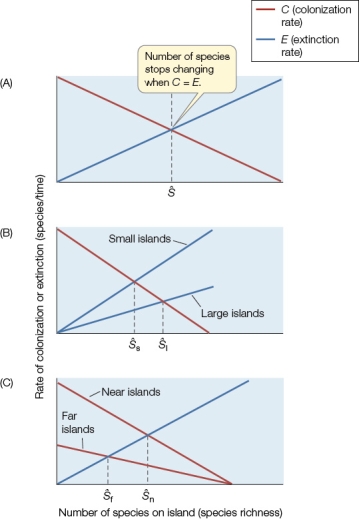 -As shown in graph A,numbers on an island or other isolated natural area become stabilized (reach equilibrium)when the rate of colonization by new species equals the rate of extinction.Based on graphs B and C,how does size of islands and distance from the mainland (near vs.far)affect the stabilization of species numbers?
 (Essay)
4.9/5 (71)
(71) As the volcanic island of Krakatau was repopulated,which types of species would most likely have been the last to colonize the island?
(Multiple Choice)
4.7/5 (94)
(94) Long-term stable climatic conditions in tropical regions are often cited as one reason for high species diversity at these low latitudes.Which of the following consequences of a more stable climate has not been proposed as a likely mechanism explaining increased species diversity in the tropics?
(Multiple Choice)
4.9/5 (80)
(80) A highly diverse community may have representatives of many functional groups,or niches,which makes the community more efficient at using resources.This structural component is known as _______.
(Essay)
4.9/5 (84)
(84) Net primary productivity (NPP)of a community is approximately equivalent to
(Multiple Choice)
4.9/5 (80)
(80) The theory of island biogeography can be applied to oceanic islands as well as to other types of habitat islands.For which of these habitats,however,would it be least relevant?
(Multiple Choice)
4.7/5 (74)
(74) Species richness results in increased numbers of functional groups,or niches,in a community,because having more species
(Multiple Choice)
4.9/5 (76)
(76) Under stress,a community loses a number of species.When the stress is removed,the species composition recovers and then stabilizes.During this process,what will be the most likely effect on net primary productivity?
(Multiple Choice)
4.9/5 (77)
(77) In Brazil,corridors have been left to connect some fragmented forest patches to undisturbed forest.This form of forest management is beneficial because it
(Multiple Choice)
4.9/5 (67)
(67) In 1883,a volcanic eruption on the Indonesian island of Krakatau eradicated most life from the island.Over the following years,plants and animals arrived from nearby landmasses to recolonize the island.The process that enables recolonization of devastated island communities such as Krakatau is called _______.
(Essay)
4.8/5 (77)
(77) Consider two natural communities: a pond in the Midwest and a coral reef off the coast of Florida.Describe the boundaries for each of these ecosystems and how the boundaries might be different.
(Essay)
4.9/5 (77)
(77) In natural communities,the number of species generally _______ as one moves away from the equator.
(Essay)
4.9/5 (66)
(66) More than a thousand species of frogs live in the Amazon rainforest.They live in varied habitats,from the forest floor to the highest levels of the canopy.In this situation,the factor that most likely is having a direct effect on species diversity is
(Multiple Choice)
4.8/5 (86)
(86) The goods and services provided to humans from biological organisms and the communities in which they interact are known as _______.
(Essay)
5.0/5 (97)
(97) Explain the difference between highly technological methods of growing coffee and traditional coffee growing that relies on more ecological methods.What techniques are used in traditional coffee growing,and how do these techniques use principles of community ecology?
Answer Key
(Essay)
4.7/5 (81)
(81) 
Filters
- Essay(0)
- Multiple Choice(0)
- Short Answer(0)
- True False(0)
- Matching(0)