



 Chat with AI
Exam 44: Ecological Communities

Exam 1: Introduction81 Questions
Exam 2: The Chemistry and Energy of Life87 Questions
Exam 3: Nucleic Acids, Proteins, and Enzymes118 Questions
Exam 4: Cells: the Working Units of Life115 Questions
Exam 5: Cell Membranes and Signaling95 Questions
Exam 6: Pathways That Harvest and Store Chemical Energy130 Questions
Exam 7: The Cell Cycle and Cell Division119 Questions
Exam 8: Inheritance, Genes, and Chromosomes80 Questions
Exam 9: DNA and Its Role in Heredity94 Questions
Exam 10: From Dna to Protein: Gene Expression80 Questions
Exam 11: Regulation of Gene Expression94 Questions
Exam 12: Genomes78 Questions
Exam 13: Biotechnology83 Questions
Exam 14: Genes, Development, and Evolution94 Questions
Exam 15: Processes of Evolution83 Questions
Exam 16: Reconstructing and Using Phylogenies76 Questions
Exam 17: Speciation80 Questions
Exam 18: The History of Life on Earth82 Questions
Exam 19: Bacteria, Archaea, and Viruses100 Questions
Exam 20: The Origin and Diversification of Eukaryotes96 Questions
Exam 21: The Evolution of Plants130 Questions
Exam 22: The Evolution and Diversity of Fungi103 Questions
Exam 23: Animal Origins and Diversity136 Questions
Exam 24: The Plant Body90 Questions
Exam 25: Plant Nutrition and Transport129 Questions
Exam 26: Plant Growth and Development85 Questions
Exam 27: Reproduction of Flowering Plants85 Questions
Exam 28: Plants in the Environment85 Questions
Exam 29: Fundamentals of Animal Function86 Questions
Exam 30: Nutrition and Digestion81 Questions
Exam 31: Breathing83 Questions
Exam 32: Circulation80 Questions
Exam 33: Muscle and Movement75 Questions
Exam 34: Neurons, Sense Organs, and Nervous Systems171 Questions
Exam 35: Nervous and Endocrine Control94 Questions
Exam 36: Water and Salts: Excretion85 Questions
Exam 37: Animal Reproduction84 Questions
Exam 38: Animal Development104 Questions
Exam 39: Immunology: Animal Defense Systems91 Questions
Exam 40: Animal Behavior83 Questions
Exam 41: The Distribution of Earths Ecological Systems82 Questions
Exam 42: Populations78 Questions
Exam 43: Ecological and Evolutionary Consequences of Interactions Within and Among Species114 Questions
Exam 44: Ecological Communities121 Questions
Exam 45: The Global Ecosystem127 Questions
Select questions type


Daniel Simberloff and Edward O.Wilson tested the theory of island biogeography by first removing all arthropods from a group of mangrove islands and then measuring the recolonization of the islands over a two-year period.Which result did they not observe?
(Multiple Choice)
4.9/5  (90)
(90) Two 1-km2 areas of mature forest are at the same latitude.Area A is surrounded by developed land with housing and shopping centers.Area B is in the center of a 100-km2 conservation area of mature forest.A team of scientists does surveys to determine the diversity of arthropod species in both areas.Which area will likely show greater species diversity,and why?
(Multiple Choice)
4.9/5 (90)
(90) Which statement best describes the changes in the biological community of Krakatau since the volcanic eruption?
(Multiple Choice)
4.9/5 (94)
(94) Coral reefs are found in tropical waters around the world,some on islands far from large landmasses.They are the most highly diverse ocean ecosystems,equivalent in their diversity to tropical rainforests on land.How might organisms arrive to build and colonize coral reefs,and how does coral reef diversity become so great?
(Essay)
4.9/5 (72)
(72) After a large-scale disturbance,such as a volcanic eruption or a major hurricane,
(Multiple Choice)
4.7/5 (88)
(88) A large lake in a relatively isolated environment has had clear water and a stable,moderately diverse species composition for hundreds of years.When the region is developed into farmland,the lake begins receiving large amounts of fertilizer runoff,making it turbid and highly eutrophic (excessively rich in nutrients).The species composition becomes much less diverse and is made up of species that tolerate low oxygen.Even after the farmland is abandoned and fertilization stops,the lake remains eutrophic.This is an example of a(n)
(Multiple Choice)
4.7/5 (91)
(91) Until the mid-1960s,dung from introduced cattle accumulated in Australia because
(Multiple Choice)
4.9/5 (90)
(90) Bumblebees live in nests in loose soil on the ground,in areas with little vegetation.However,they must be near vegetated areas,where they feed on and pollinate many flowering plants.This information describes the bumblebee's
(Multiple Choice)
4.8/5 (68)
(68) Based on information in the graphs below,explain how species richness is related to number of functional groups in a community,and how they both relate to net primary productivity (measured as plant biomass per unit time). 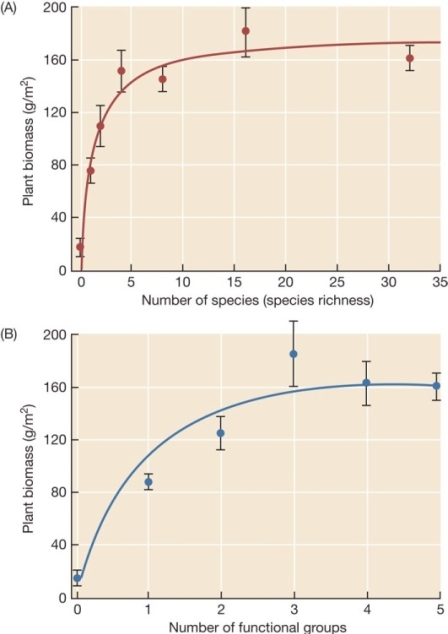
(Essay)
5.0/5 (81)
(81) Three plant communities have the species composition shown in the table below.Which community or communities have the highest species evenness? 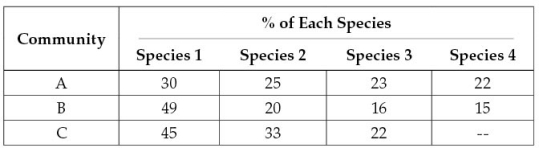
(Multiple Choice)
4.8/5 (71)
(71) In a microbial community,autotrophs generate 1,000 calories per hour of GPP and 500 calories per hour of NPP.Primary consumers convert 60 calories per hour into their own biomass.What is the ecological efficiency in the link between autotrophs and primary consumers in this community?
(Multiple Choice)
4.7/5 (80)
(80) Use the following to answer questions :
Refer to the graphs below showing data from the studies of David Tilman and colleagues on the effect of species diversity on net primary productivity in prairie ecosystems. 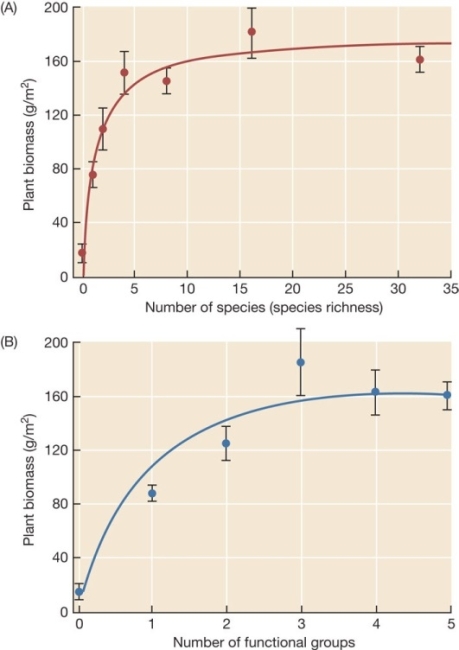 -Based on the data in the two graphs,how can the effects of species richness and number of functional groups (niches)on NPP best be described?
 (Multiple Choice)
5.0/5 (80)
(80) Suppose that in a study of an ecological community,NPP increases as species richness increases,but scientists find no relationship between NPP and the number of functional roles played by the species.Which conclusion could be inferred?
(Multiple Choice)
4.7/5 (82)
(82) Grain is eaten by cows,and cows are eaten by humans.If the ecological transfer efficiency between each trophic level is 10 percent,how much grain is required to produce 70 kg of human biomass?
(Multiple Choice)
4.7/5 (67)
(67) The diagram below shows changes in species composition for the first year after recolonization of mangrove islands that were defaunated (had their arthropod species removed).One hypothesis proposed for recolonization was that every island has a specific set of niches,and recolonization will be complete when the original set of species filling those niches has been reassembled.Do these data support that hypothesis? Why or why not? 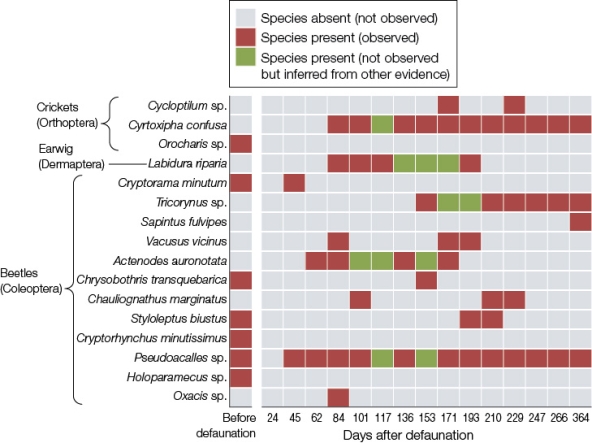
(Essay)
4.8/5 (76)
(76) As climate change continues,average temperatures are increasing at all latitudes and spring is beginning two to three weeks earlier in many areas.How will these changes likely affect plant communities?
(Multiple Choice)
4.8/5 (76)
(76) To minimize ecosystem damage due to fragmentation,ecologists can increase colonization by locating habitat fragments close together,keeping some large patches,and creating _______ to connect patches.
(Essay)
4.8/5 (89)
(89) The loss of a single species from a community will most often affect community function by affecting the community's
(Multiple Choice)
4.7/5 (78)
(78) The first naturalist to observe and remark on the relationship between species richness and latitude was
(Multiple Choice)
4.9/5 (86)
(86) 
Filters
- Essay(0)
- Multiple Choice(0)
- Short Answer(0)
- True False(0)
- Matching(0)