



 Chat with AI
Exam 2: The Economic Problem

Exam 1: What Is Economics479 Questions
Exam 2: The Economic Problem439 Questions
Exam 3: Demand and Supply515 Questions
Exam 4: Elasticity533 Questions
Exam 5: Efficiency and Equity449 Questions
Exam 6: Government Actions in Markets410 Questions
Exam 7: Global Markets in Action200 Questions
Exam 8: Utility and Demand364 Questions
Exam 9: Possibilities, Preferences, and Choices464 Questions
Exam 10: Organizing Production385 Questions
Exam 11: Output and Costs494 Questions
Exam 12: Perfect Competition487 Questions
Exam 13: Monopoly606 Questions
Exam 14: Monopolistic Competition320 Questions
Exam 15: Oligopoly280 Questions
Exam 16: Public Choices and Public Goods356 Questions
Exam 17: Externalities and the Environment284 Questions
Exam 18: Markets for Factors of Production382 Questions
Exam 19: Economic Inequality354 Questions
Exam 20: Uncertainty and Information233 Questions
Exam 21: Extension A: Review11 Questions
Exam 22: Extension B: Review25 Questions
Exam 23: Extension C: Review14 Questions
Exam 24: Extension D: Review38 Questions
Exam 25: Extension E: Review11 Questions
Exam 26: Extension F: Review18 Questions
Select questions type


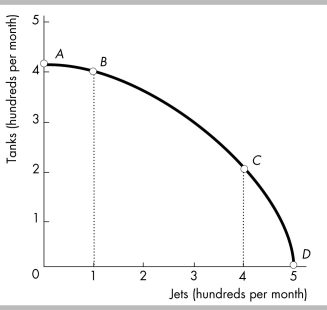 -In the above figure, which of the following is TRUE regarding the movements from point A to B and from point C to D? I. The movement from point A to B shows that the economy has chosen to produce 100 more jets.
II) The movement from point C to D shows that the economy has chosen to produce 100 more jets.
III) The movement from point A to B and from point C to D have the same opportunity cost.
-In the above figure, which of the following is TRUE regarding the movements from point A to B and from point C to D? I. The movement from point A to B shows that the economy has chosen to produce 100 more jets.
II) The movement from point C to D shows that the economy has chosen to produce 100 more jets.
III) The movement from point A to B and from point C to D have the same opportunity cost. (Multiple Choice)
4.9/5  (86)
(86) The principle of decreasing marginal benefit implies that the
(Multiple Choice)
4.7/5 (82)
(82)  -Agnes can produce either 1 unit of X or 1 unit of Y in an hour, while Brenda can produce either 2 units of X or 4 units of Y in an hour.
 (Multiple Choice)
4.8/5 (62)
(62) When a nation is producing the allocatively efficient quantity of a product, the marginal benefit of producing the good equals the marginal cost of producing that good.
(True/False)
4.9/5 (81)
(81) Which of the following is TRUE regarding marginal benefit? I. The marginal benefit curve shows the benefit firms receive by producing another unit of a good.
II) Marginal benefit increases as more of a good is consumed.
(Multiple Choice)
4.9/5 (79)
(79) 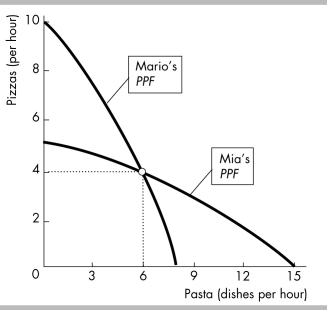 -The term "market" refers to
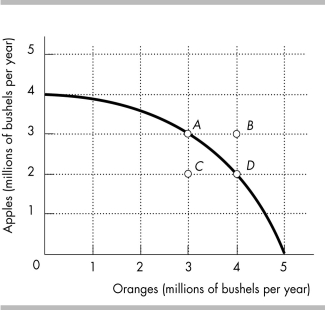 -The figure above shows a nation's production possibilities frontier for apples and oranges.
a) What combination of goods is represented by point A?
b) What combination of goods is represented by point B?
c) Which point represents an unattainable combination of goods?
-The figure above shows a nation's production possibilities frontier for apples and oranges.
a) What combination of goods is represented by point A?
b) What combination of goods is represented by point B?
c) Which point represents an unattainable combination of goods? (Essay)
4.9/5 (101)
(101) If a society is operating at a point inside its production possibilities frontier, then this society's
(Multiple Choice)
4.8/5 (74)
(74) A society that is producing on its production possibilities frontier is
(Multiple Choice)
4.8/5 (81)
(81) 
 -Sarah and her boyfriend Mike want to save some money to pay for their wedding. So they decided to help people in the neighborhood by cleaning their garages and mowing lawns. Sarah takes 60 minutes to clean a garage and 80 minutes to mow a lawn. Mike takes 80 minutes to clean a garage and 80 minutes to mow a lawn. Sarah and Mike devote 10 hours per week each to these activities and get paid $25 for each garage they clean and $25 for each lawn they mow. Sarah says to Mike: "I have an absolute advantage in cleaning and we are equally productive in mowing. Therefore I should do both cleaning and mowing but you should only mow lawns." Mike disagrees. He thinks Sarah should specialize in cleaning garages and he should specialize in mowing lawns. Help Sarah and Mike to resolve their dispute.
a) Who has an absolute advantage in cleaning garages? In mowing lawns? Explain.
b) Draw Sarah's and Mike's production possibilities frontiers. What are each individual's opportunity costs?
c) Who has a comparative advantage in cleaning garages? In mowing lawns? Explain.
d) Is Sarah right when she says that she should do both cleaning and mowing while Mike should only mow lawns? Or may be Mike is right when he suggests that Sarah specializes in cleaning and he specializes in mowing? Illustrate and substantiate your answer with a numerical example.
-Sarah and her boyfriend Mike want to save some money to pay for their wedding. So they decided to help people in the neighborhood by cleaning their garages and mowing lawns. Sarah takes 60 minutes to clean a garage and 80 minutes to mow a lawn. Mike takes 80 minutes to clean a garage and 80 minutes to mow a lawn. Sarah and Mike devote 10 hours per week each to these activities and get paid $25 for each garage they clean and $25 for each lawn they mow. Sarah says to Mike: "I have an absolute advantage in cleaning and we are equally productive in mowing. Therefore I should do both cleaning and mowing but you should only mow lawns." Mike disagrees. He thinks Sarah should specialize in cleaning garages and he should specialize in mowing lawns. Help Sarah and Mike to resolve their dispute.
a) Who has an absolute advantage in cleaning garages? In mowing lawns? Explain.
b) Draw Sarah's and Mike's production possibilities frontiers. What are each individual's opportunity costs?
c) Who has a comparative advantage in cleaning garages? In mowing lawns? Explain.
d) Is Sarah right when she says that she should do both cleaning and mowing while Mike should only mow lawns? Or may be Mike is right when he suggests that Sarah specializes in cleaning and he specializes in mowing? Illustrate and substantiate your answer with a numerical example. (Essay)
4.9/5 (75)
(75) Country A Country B  -In the table above, country A is producing 4 units of X and 8 units of Y and country B is producing 4 units of X and 6 units of Y. Regarding the production of good X,
 (Multiple Choice)
5.0/5 (92)
(92)  -In the above figure, at point a what is the opportunity cost of producing one more audio tape?
 (Multiple Choice)
4.8/5 (71)
(71) A computer software program is most strongly an example of
(Multiple Choice)
4.9/5 (87)
(87) 
Filters
- Essay(0)
- Multiple Choice(0)
- Short Answer(0)
- True False(0)
- Matching(0)