



 Chat with AI
Exam 2: The Economic Problem

Exam 1: What Is Economics479 Questions
Exam 2: The Economic Problem439 Questions
Exam 3: Demand and Supply515 Questions
Exam 4: Elasticity533 Questions
Exam 5: Efficiency and Equity449 Questions
Exam 6: Government Actions in Markets410 Questions
Exam 7: Global Markets in Action200 Questions
Exam 8: Utility and Demand364 Questions
Exam 9: Possibilities, Preferences, and Choices464 Questions
Exam 10: Organizing Production385 Questions
Exam 11: Output and Costs494 Questions
Exam 12: Perfect Competition487 Questions
Exam 13: Monopoly606 Questions
Exam 14: Monopolistic Competition320 Questions
Exam 15: Oligopoly280 Questions
Exam 16: Public Choices and Public Goods356 Questions
Exam 17: Externalities and the Environment284 Questions
Exam 18: Markets for Factors of Production382 Questions
Exam 19: Economic Inequality354 Questions
Exam 20: Uncertainty and Information233 Questions
Exam 21: Extension A: Review11 Questions
Exam 22: Extension B: Review25 Questions
Exam 23: Extension C: Review14 Questions
Exam 24: Extension D: Review38 Questions
Exam 25: Extension E: Review11 Questions
Exam 26: Extension F: Review18 Questions
Select questions type


Suppose that a typical German factory can produce 20 cameras or 1 computer in an hour, and that a typical American factory can produce 10 cameras or 1 computer in an hour. The opportunity cost of 20 cameras in terms of computers in Germany is
(Multiple Choice)
5.0/5  (75)
(75)  -In the figure above, the marginal cost of producing a computer
 (Multiple Choice)
4.8/5 (77)
(77) A situation in which some resources are NOT fully utilized is represented in a production possibilities frontier diagram by
(Multiple Choice)
4.9/5 (84)
(84) 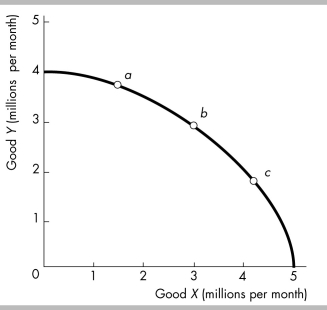 -Refer to the production possibilities frontier in the figure above. More of good X must be given up per unit of good Y gained when moving from point b to point a than when moving from point c to point b. This fact
 (Multiple Choice)
4.9/5 (76)
(76) 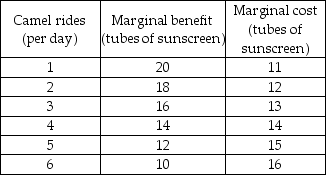 -Leisure Land produces only sun screen and camel rides. The table shows the marginal benefit and marginal cost schedules for sun screen and camel rides. The allocatively efficient number of camel rides is ________.
 (Multiple Choice)
4.8/5 (97)
(97) Homer and Teddy are stranded on a desert island. To feed themselves each day they can either catch fish or pick fruit. In a day, Teddy could pick 60 pieces of fruit or catch 20 fish. Homer could pick 100 pieces of fruit or catch 150 fish. Which of the following is correct?
(Multiple Choice)
4.8/5 (95)
(95) In general, the more resources that are devoted to technological research, the
(Multiple Choice)
4.8/5 (74)
(74) 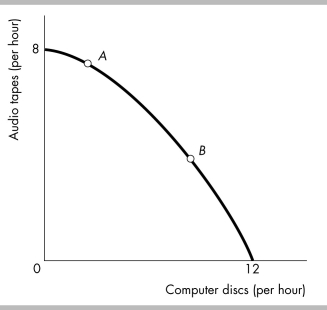 -In the above figure, point A is ________, and point B is ________.
 (Multiple Choice)
4.8/5 (78)
(78) When the production possibilities frontier is bowed outwards, the opportunity cost of producing more of one good
(Multiple Choice)
4.8/5 (68)
(68) 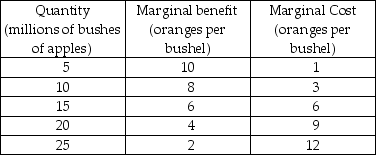 -Using the values for the marginal benefit and the marginal cost of a bushel of apples given in the table above, what is the allocatively efficient quantity of apples? Suppose 10 million bushels of apples are produced. Should the quantity be increased or decreased? What if 20 million bushels are produced; should the quantity be increased or decreased?
 (Essay)
4.9/5 (79)
(79) 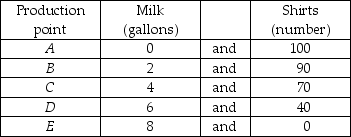 -A (very, very small) country produces milk and shirts and its production possibilities frontier is in the table above. The nation is currently producing at point B. What is the opportunity cost of two additional gallons of milk? At point C? At point D? What do your results show?
 (Essay)
4.8/5 (78)
(78) "Allocative efficiency requires that the maximum number of people have access to all of the goods and services that our economy produces." Is this statement true or false? Explain your answer.
(Essay)
4.8/5 (77)
(77) In the United States, the government coordinates most of the economic activity.
(True/False)
4.8/5 (86)
(86) A circular flow diagram shows the flows from the goods and resources markets.
(True/False)
4.8/5 (80)
(80)  -The above table shows production combinations on a country's production possibilities frontier. What is the opportunity cost of one unit of Y when the production of good Y increases from 16 to 28 units?
 (Multiple Choice)
4.7/5 (78)
(78) 
Filters
- Essay(0)
- Multiple Choice(0)
- Short Answer(0)
- True False(0)
- Matching(0)