



 Chat with AI
Exam 2: The Economic Problem

Exam 1: What Is Economics479 Questions
Exam 2: The Economic Problem439 Questions
Exam 3: Demand and Supply515 Questions
Exam 4: Elasticity533 Questions
Exam 5: Efficiency and Equity449 Questions
Exam 6: Government Actions in Markets410 Questions
Exam 7: Global Markets in Action200 Questions
Exam 8: Utility and Demand364 Questions
Exam 9: Possibilities, Preferences, and Choices464 Questions
Exam 10: Organizing Production385 Questions
Exam 11: Output and Costs494 Questions
Exam 12: Perfect Competition487 Questions
Exam 13: Monopoly606 Questions
Exam 14: Monopolistic Competition320 Questions
Exam 15: Oligopoly280 Questions
Exam 16: Public Choices and Public Goods356 Questions
Exam 17: Externalities and the Environment284 Questions
Exam 18: Markets for Factors of Production382 Questions
Exam 19: Economic Inequality354 Questions
Exam 20: Uncertainty and Information233 Questions
Exam 21: Extension A: Review11 Questions
Exam 22: Extension B: Review25 Questions
Exam 23: Extension C: Review14 Questions
Exam 24: Extension D: Review38 Questions
Exam 25: Extension E: Review11 Questions
Exam 26: Extension F: Review18 Questions
Select questions type


 -Agnes can produce either 1 unit of X or 1 unit of Y in an hour, while Brenda can produce either 2 units of X or 4 units of Y in an hour. The opportunity cost of producing a unit of X is
 (Multiple Choice)
4.9/5  (79)
(79) 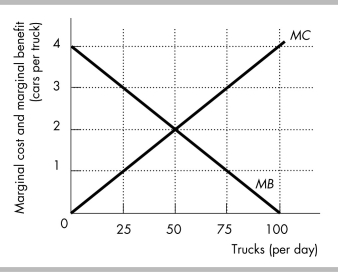 -Suppose a factory can be designed to produce either trucks or cars. The figure above shows the marginal cost and marginal benefit of producing trucks in terms of the forgone cars.
a) What is the marginal benefit of the 25th truck?
b) What is the marginal cost of the 25th truck?
c) Should the 25th truck be produced? Why or why not.
d) What is the marginal benefit of the 75th truck?
e) What is the marginal cost of the 75th truck?
f) Should the 75th truck be produced? Why or why not?
g) What is the allocatively efficient quantity of trucks?
-Suppose a factory can be designed to produce either trucks or cars. The figure above shows the marginal cost and marginal benefit of producing trucks in terms of the forgone cars.
a) What is the marginal benefit of the 25th truck?
b) What is the marginal cost of the 25th truck?
c) Should the 25th truck be produced? Why or why not.
d) What is the marginal benefit of the 75th truck?
e) What is the marginal cost of the 75th truck?
f) Should the 75th truck be produced? Why or why not?
g) What is the allocatively efficient quantity of trucks? (Essay)
4.8/5 (81)
(81)  -In the figure above,
The marginal benefit from a good is the amount a person is willing to pay for
(Multiple Choice)
4.8/5 (80)
(80) What economic concepts are represented in the production possibilities model?
(Essay)
4.9/5 (66)
(66) 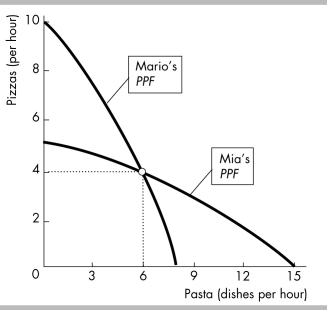 -Refer to the above figure. Mario is self-sufficient and so is Mia. Each produces 6 dishes of pasta and 4 pizzas. Mario and Mia decide to specialize and trade. After they have specialized and traded, compared to the initial situation, Mia's opportunity cost of pasta has ________ and Mario's opportunity cost of a pizza has ________.
 (Multiple Choice)
4.9/5 (74)
(74) An economy produces only food and shelter. There are two individuals in the economy: Bill and Mary. Mary's opportunity cost of producing 1 unit of shelter is 2 units of food. Bill's opportunity cost of producing 1 unit of shelter is 4 units of food.
(Multiple Choice)
4.7/5 (88)
(88) If property rights are not clearly defined and enforced, then
(Multiple Choice)
4.8/5 (92)
(92) We are using resources efficiently if we can produce more of one good without producing less of some other good that we value more highly.
(True/False)
4.7/5 (81)
(81) When producing goods and services along a PPF, tradeoffs exist because
(Multiple Choice)
4.9/5 (82)
(82) 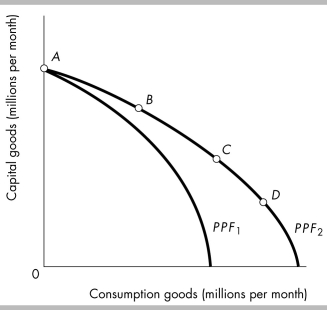 -In the above figure, in order for this country to move from production possibilities frontier PPF1 to PPF2, it might
 (Multiple Choice)
5.0/5 (74)
(74) 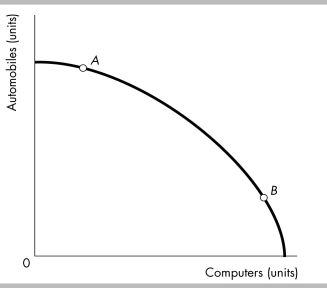 -According to the figure above, the opportunity cost of producing another computer is
 (Multiple Choice)
4.8/5 (85)
(85) Economic growth can be pictured in a production possibilities frontier diagram by
(Multiple Choice)
4.9/5 (83)
(83) The fact that individual productive resources are NOT equally useful in all activities
(Multiple Choice)
4.9/5 (67)
(67)  -The above table shows production points on Sweet-Tooth Land's production possibilities frontier. Which of the following statements is TRUE?
 (Multiple Choice)
4.9/5 (93)
(93) 
Filters
- Essay(0)
- Multiple Choice(0)
- Short Answer(0)
- True False(0)
- Matching(0)