



 Chat with AI
Exam 2: The Economic Problem

Exam 1: What Is Economics479 Questions
Exam 2: The Economic Problem439 Questions
Exam 3: Demand and Supply515 Questions
Exam 4: Elasticity533 Questions
Exam 5: Efficiency and Equity449 Questions
Exam 6: Government Actions in Markets410 Questions
Exam 7: Global Markets in Action200 Questions
Exam 8: Utility and Demand364 Questions
Exam 9: Possibilities, Preferences, and Choices464 Questions
Exam 10: Organizing Production385 Questions
Exam 11: Output and Costs494 Questions
Exam 12: Perfect Competition487 Questions
Exam 13: Monopoly606 Questions
Exam 14: Monopolistic Competition320 Questions
Exam 15: Oligopoly280 Questions
Exam 16: Public Choices and Public Goods356 Questions
Exam 17: Externalities and the Environment284 Questions
Exam 18: Markets for Factors of Production382 Questions
Exam 19: Economic Inequality354 Questions
Exam 20: Uncertainty and Information233 Questions
Exam 21: Extension A: Review11 Questions
Exam 22: Extension B: Review25 Questions
Exam 23: Extension C: Review14 Questions
Exam 24: Extension D: Review38 Questions
Exam 25: Extension E: Review11 Questions
Exam 26: Extension F: Review18 Questions
Select questions type


 -In the figure above, at the allocatively efficient level of computer production consumers are willing to give up
 (Multiple Choice)
4.8/5  (84)
(84)  -In the figure above, which of the following movements has the largest opportunity cost?
 (Multiple Choice)
4.7/5 (76)
(76)  -In the figure above, point E could be obtained if
Considering a PPF with health care services on the vertical axis and other goods and services on the horizontal axis, the increasing production of health care services in the United States as a result of the aging population represents
(Multiple Choice)
4.8/5 (88)
(88) 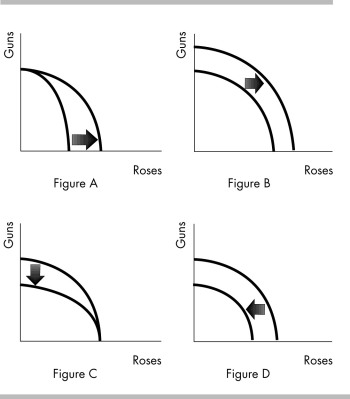 -Based on the above, which figure shows the impact of a decrease in the population available to work?
 (Multiple Choice)
4.9/5 (69)
(69) Missouri can produce 10,000 tons of pecans per year or 5,000 tons of pears per year. Washington can produce 12,000 tons of pecans per year or 48,000 tons of pears per year. Which of the following statements about opportunity cost is correct?
(Multiple Choice)
4.8/5 (71)
(71) Moving downward along a PPF, the opportunity cost of another unit of the good measured along the horizontal axis decreases.
(True/False)
4.9/5 (90)
(90) Which of the following statements regarding the production possibilities frontier is true?
(Multiple Choice)
4.8/5 (78)
(78) When the production possibilities frontier bows outward from the origin,
(Multiple Choice)
5.0/5 (84)
(84) Country A Country B  -Homer and Teddy are stranded on a desert island. To feed themselves each day they can either catch fish or pick fruit. In a day, Teddy could pick 60 pieces of fruit or catch 20 fish. Homer could pick 100 pieces of fruit or catch 150 fish. Which of the following statements is correct?
 (Multiple Choice)
4.7/5 (85)
(85)  -Refer to the production possibilities frontier in the figure above. If the country moves from point a to point c, the opportunity cost of the move is
 (Multiple Choice)
4.9/5 (71)
(71) 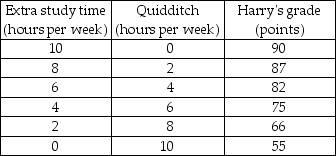
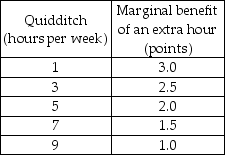 -Harry usually spends 10 hours a week playing Quidditch. However, his Defense Against the Dark Arts exam is coming and he needs more time to study for the exam. If he does not study at all, the lowest grade he will receive is 55. But Harry realizes that this grade is unacceptable and so he has to give up some of his Quidditch time. But how much? He asks his friend Hermione, who is very good at Magical Economics, to help him figure this out. Together, they come up with the schedules of Harry's possibilities and values in the tables above. Then Hermione quickly finds the solution. But Harry still looks puzzled. Help Hermione to explain her solution to Harry.
a) Draw Harry's production possibilities frontier with the Quidditch hours on the horizontal axis and Harry's grade, starting at 55, on the vertical axis.
b) What is the opportunity cost of the first two hours of Quidditch? What is the marginal cost of the 5th hour?
c) What is Harry's opportunity cost of raising his grade from 82 points to 87 points?
d) Draw Harry's marginal cost of playing Quidditch curve. What happens to the marginal cost if Harry spends more time playing Quidditch?
e) Draw Harry's marginal benefit from playing Quidditch curve. Describe the relationship between Harry's time spent playing Quidditch and the marginal benefit from playing Quidditch.
f) For how many extra hours did Hermione recommend Harry to study? Why? If Harry follows her advice, what grade will he expect? What do you think Hermione said when Harry asked why he should not spend more time playing Quidditch?
-Harry usually spends 10 hours a week playing Quidditch. However, his Defense Against the Dark Arts exam is coming and he needs more time to study for the exam. If he does not study at all, the lowest grade he will receive is 55. But Harry realizes that this grade is unacceptable and so he has to give up some of his Quidditch time. But how much? He asks his friend Hermione, who is very good at Magical Economics, to help him figure this out. Together, they come up with the schedules of Harry's possibilities and values in the tables above. Then Hermione quickly finds the solution. But Harry still looks puzzled. Help Hermione to explain her solution to Harry.
a) Draw Harry's production possibilities frontier with the Quidditch hours on the horizontal axis and Harry's grade, starting at 55, on the vertical axis.
b) What is the opportunity cost of the first two hours of Quidditch? What is the marginal cost of the 5th hour?
c) What is Harry's opportunity cost of raising his grade from 82 points to 87 points?
d) Draw Harry's marginal cost of playing Quidditch curve. What happens to the marginal cost if Harry spends more time playing Quidditch?
e) Draw Harry's marginal benefit from playing Quidditch curve. Describe the relationship between Harry's time spent playing Quidditch and the marginal benefit from playing Quidditch.
f) For how many extra hours did Hermione recommend Harry to study? Why? If Harry follows her advice, what grade will he expect? What do you think Hermione said when Harry asked why he should not spend more time playing Quidditch? (Essay)
4.9/5 (80)
(80)  -In the figure above, the marginal cost of the second computer is
 (Multiple Choice)
4.7/5 (83)
(83) Moving from one point on the production possibilities frontier to another
(Multiple Choice)
4.8/5 (79)
(79) The state of Georgia offers free college tuition to high school students with a "B" average. In 2007, the state raised the requirement so that fewer students qualified for the scholarship. At the same time, Georgia increased state spending on health care. Suppose that college education is on the vertical axis and health care is on the horizontal axis of a PPF. These changes
(Multiple Choice)
4.9/5 (82)
(82) Production points inside the production possibilities frontier
(Multiple Choice)
4.8/5 (88)
(88) "Allocative efficiency in the production of cherries means that consumers can eat all of the cherries they desire." Is this statement true or false?
(Essay)
4.9/5 (75)
(75) 
Filters
- Essay(0)
- Multiple Choice(0)
- Short Answer(0)
- True False(0)
- Matching(0)