



 Chat with AI
Exam 11: Work

Exam 1: Concepts of Motion52 Questions
Exam 2: Kinematics in One Dimension59 Questions
Exam 3: Vectors and Coordinate Systems33 Questions
Exam 4: Kinematics in Two Dimensions50 Questions
Exam 5: Force and Motion31 Questions
Exam 6: Dynamics I: Motion Along a Line46 Questions
Exam 7: Newtons Third Law43 Questions
Exam 8: Dynamics Ii: Motion in a Plane20 Questions
Exam 9: Impulse and Momentum20 Questions
Exam 10: Energy43 Questions
Exam 11: Work100 Questions
Exam 12: Rotation of a Rigid Body113 Questions
Exam 13: Newtons Theory of Gravity50 Questions
Exam 14: Oscillations49 Questions
Exam 15: Fluids and Elasticity72 Questions
Exam 16: A Macroscopic Description of Matter29 Questions
Exam 17: Work, Heat, and the First Law of Thermodynamics98 Questions
Exam 18: The Micromacro Connection39 Questions
Exam 19: Heat Engines and Refrigerators50 Questions
Exam 20: Traveling Waves49 Questions
Exam 21: Superpositions64 Questions
Exam 22: Wave Optics51 Questions
Exam 23: Ray Optics63 Questions
Exam 24: Optical Instruments49 Questions
Exam 25: Electric Charges and Forces26 Questions
Exam 26: The Electric Field32 Questions
Exam 27: Gausss Law41 Questions
Exam 28: The Electric Potential40 Questions
Exam 29: Potential and Field57 Questions
Exam 30: Current and Resistance32 Questions
Exam 31: Fundamentals of Circuits68 Questions
Exam 32: The Magnetic Field87 Questions
Exam 33: Electromagnetic Induction66 Questions
Exam 34: Electromagnetic Fields and Waves52 Questions
Exam 35: Ac Circuits46 Questions
Exam 36: Relativity49 Questions
Exam 37: The Foundations of Modern Physics8 Questions
Exam 38: Quantization54 Questions
Exam 39: Wave Functions and Uncertainty18 Questions
Exam 40: One-Dimensional Quantum Mechanics32 Questions
Exam 41: Atomic Physics39 Questions
Exam 42: Nuclear Physics65 Questions
Select questions type


Which, if any, of the following statements concerning the work done by a conservative force is NOT true?
(Multiple Choice)
4.8/5  (94)
(94) Two objects, one of mass m and the other of mass 2m, are dropped from the top of a building. When they hit the ground
(Multiple Choice)
4.7/5 (79)
(79) If a force always acts perpendicular to an object's direction of motion, that force cannot change the object's kinetic energy.
(True/False)
4.9/5 (77)
(77) Consider the motion of a 1.00-kg particle that moves with potential energy given by
U(x) = (-2.00 J∙m)/x + (4.00 J∙m2)/x2. Suppose the particle is moving with a speed of 3.00 m/s when it is located at x = 1.00 m. What is the speed of the object when it is located at x = 5.00 m?
(Multiple Choice)
5.0/5 (72)
(72) A particle experiences a force given by F(x) = α - βx3. Find the potential field U(x) the particle is in. (Assume that the zero of potential energy is located at x = 0.)
(Multiple Choice)
4.8/5 (80)
(80) A very small 100-g object is attached to one end of a massless 10-cm rod that is pivoted without friction about the opposite end. The rod is held vertical, with the object at the top, and released, allowing the rod to swing. What is the speed of the object at the instant that the rod is horizontal?
(Multiple Choice)
4.8/5 (83)
(83) Swimmers at a water park have a choice of two frictionless water slides as shown in the figure. Although both slides drop over the same height, h, slide 1 is straight while slide 2 is curved, dropping quickly at first and then leveling out. How does the speed v1 of a swimmer reaching the end of slide 1 compares with v2, the speed of a swimmer reaching the end of slide 2? 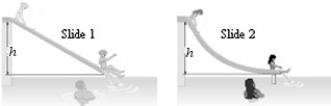
(Multiple Choice)
4.7/5 (90)
(90) A 5.00-kg box slides 4.00 m across the floor before coming to rest. What is the coefficient of kinetic friction between the floor and the box if the box had an initial speed of 3.00 m/s?
(Multiple Choice)
4.9/5 (89)
(89) Two men, Joel and Jerry, push against a wall. Jerry stops after 10 min, while Joel is able to push for 5.0 min longer. Compare the work they do.
(Multiple Choice)
4.8/5 (89)
(89) A 2.0 kg mass is moving along the x-axis. The potential energy curve as a function of position is shown in the figure. The kinetic energy of the object at the origin is 12 J. The system is conservative, and there is no friction. 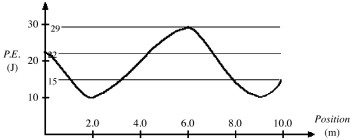 (a) What will be the kinetic energy at 2.0 m along the +x-axis?
(b) What will be the speed of the object at 6.0 m along the +x-axis?
(a) What will be the kinetic energy at 2.0 m along the +x-axis?
(b) What will be the speed of the object at 6.0 m along the +x-axis? (Essay)
4.9/5 (79)
(79) The angle between vector  = 2.00
 + 3.00
 And vector
 Is 45.0°. The scalar product of vectors
 And
 Is 3.00. If the x component of vector
 Is positive, what is vector
 .
= 2.00
+ 3.00
And vector
Is 45.0°. The scalar product of vectors
And
Is 3.00. If the x component of vector
Is positive, what is vector
. (Multiple Choice)
4.8/5 (76)
(76) Two identical balls are thrown directly upward, ball A at speed v and ball B at speed 2v, and they feel no air resistance. Which statement about these balls is correct?
(Multiple Choice)
4.9/5 (82)
(82) A child pulls on a wagon with a horizontal force of 75 N. If the wagon moves horizontally a total of 42 m in 3.0 min, what is the average power generated by the child?
(Multiple Choice)
4.9/5 (71)
(71) The potential energy for a certain mass moving in one dimension is given by U(x) = (2.0 J/m3)x3 - (15 J/m2)x2 + (36 J/m)x - 23 J. Find the location(s) where the force on the mass is zero.
(Multiple Choice)
4.9/5 (93)
(93) You carry a 7.0 kg bag of groceries 1.2 m above the level floor at a constant velocity of 75 cm/s across a room that is 2.3 m room. How much work do you do on the bag in the process?
(Multiple Choice)
4.8/5 (74)
(74) A mass is pressed against (but is not attached to) an ideal horizontal spring on a frictionless horizontal surface. After being released from rest, the mass acquires a maximum speed v and a maximum kinetic energy K. If instead the mass initially compresses the spring twice as far:
(Multiple Choice)
4.7/5 (76)
(76) A box of mass m is pressed against (but is not attached to) an ideal spring of force constant k and negligible mass, compressing the spring a distance x. After it is released, the box slides up a frictionless incline as shown in the figure and eventually stops. If we repeat this experiment with a box of mass 2m 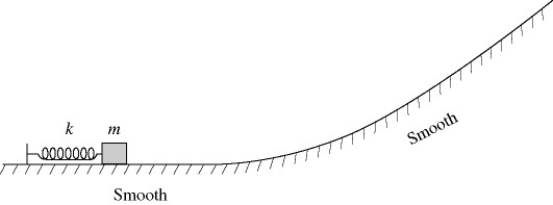
(Multiple Choice)
4.8/5 (92)
(92) A student slides her 80.0-kg desk across the level floor of her dormitory room a distance 4.00 m at constant speed. If the coefficient of kinetic friction between the desk and the floor is 0.400, how much work did she do?
(Multiple Choice)
4.7/5 (65)
(65) A graph of the force on an object as a function of its position is shown in the figure. Determine the amount of work done by this force on an object that moves from x = 1.0 m to x = 6.0 m. (Assume an accuracy of 2 significant figures for the numbers on the graph.) 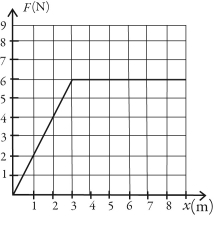
(Multiple Choice)
4.8/5 (80)
(80) A potential energy function for system 1 is given by U1(x) = Cx2 + Bx3. The potential energy function for system 2 is given by U2(x) = A + Cx2 + Bx3, where A is a positive quantity. How does the force on system 1 relate to the force on system 2 at a given position?
(Multiple Choice)
4.8/5 (83)
(83) 
Filters
- Essay(0)
- Multiple Choice(0)
- Short Answer(0)
- True False(0)
- Matching(0)