



 Chat with AI
Exam 11: Work

Exam 1: Concepts of Motion52 Questions
Exam 2: Kinematics in One Dimension59 Questions
Exam 3: Vectors and Coordinate Systems33 Questions
Exam 4: Kinematics in Two Dimensions50 Questions
Exam 5: Force and Motion31 Questions
Exam 6: Dynamics I: Motion Along a Line46 Questions
Exam 7: Newtons Third Law43 Questions
Exam 8: Dynamics Ii: Motion in a Plane20 Questions
Exam 9: Impulse and Momentum20 Questions
Exam 10: Energy43 Questions
Exam 11: Work100 Questions
Exam 12: Rotation of a Rigid Body113 Questions
Exam 13: Newtons Theory of Gravity50 Questions
Exam 14: Oscillations49 Questions
Exam 15: Fluids and Elasticity72 Questions
Exam 16: A Macroscopic Description of Matter29 Questions
Exam 17: Work, Heat, and the First Law of Thermodynamics98 Questions
Exam 18: The Micromacro Connection39 Questions
Exam 19: Heat Engines and Refrigerators50 Questions
Exam 20: Traveling Waves49 Questions
Exam 21: Superpositions64 Questions
Exam 22: Wave Optics51 Questions
Exam 23: Ray Optics63 Questions
Exam 24: Optical Instruments49 Questions
Exam 25: Electric Charges and Forces26 Questions
Exam 26: The Electric Field32 Questions
Exam 27: Gausss Law41 Questions
Exam 28: The Electric Potential40 Questions
Exam 29: Potential and Field57 Questions
Exam 30: Current and Resistance32 Questions
Exam 31: Fundamentals of Circuits68 Questions
Exam 32: The Magnetic Field87 Questions
Exam 33: Electromagnetic Induction66 Questions
Exam 34: Electromagnetic Fields and Waves52 Questions
Exam 35: Ac Circuits46 Questions
Exam 36: Relativity49 Questions
Exam 37: The Foundations of Modern Physics8 Questions
Exam 38: Quantization54 Questions
Exam 39: Wave Functions and Uncertainty18 Questions
Exam 40: One-Dimensional Quantum Mechanics32 Questions
Exam 41: Atomic Physics39 Questions
Exam 42: Nuclear Physics65 Questions
Select questions type


A 2.5-kg box, sliding on a rough horizontal surface, has a speed of 1.2 m/s when it makes contact with a spring (see the figure). The block comes to a momentary halt when the compression of the spring is 5.0 cm. The work done by the friction, from the instant the block makes contact with the spring until is comes to a momentary halt, is -0.50 J. 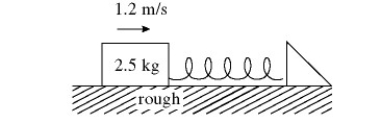 (a) What is the spring constant of the spring?
(b) What is the coefficient of kinetic friction between the box and the rough surface?
(a) What is the spring constant of the spring?
(b) What is the coefficient of kinetic friction between the box and the rough surface? (Essay)
4.9/5  (80)
(80) A constant horizontal pull acts on a sled on a horizontal frictionless ice pond. The sled starts from rest. When the pull acts over a distance x, the sled acquires a speed v and a kinetic energy K. If the same pull instead acts over twice this distance:
(Multiple Choice)
4.8/5 (86)
(86) If two nonzero vectors point in the same direction, their dot product must be zero.
(True/False)
4.8/5 (80)
(80) Block 1 and block 2 have the same mass, m, and are released from the top of two inclined planes of the same height making 30° and 60° angles with the horizontal direction, respectively. If the coefficient of friction is the same in both cases, which of the blocks is going faster when it reaches the bottom of its respective incline?
(Multiple Choice)
4.9/5 (92)
(92) The force on a 3.00-kg object as a function of position is shown in the figure. If an object is moving at 2.50 m/s when it is located at x = 2.00 m, what will its speed be when it reaches x = 8.00 m? (Assume that the numbers on the graph are accurate to 3 significant figures.) 
(Multiple Choice)
4.9/5 (64)
(64) A car needs to generate 75.0 hp in order to maintain a constant velocity of 27.3 m/s on a flat road. What is the magnitude of the total resistive force acting on the car (due to friction, air resistance, etc.)? (1 hp = 746 W)
(Multiple Choice)
4.8/5 (77)
(77) In the figure, a 700-kg crate is on a rough surface inclined at 30°. A constant external force P = 5600 N is applied horizontally to the crate. As the force pushes the crate a distance of 3.00 m up the incline, the speed changes from 1.40 m/s to 2.50 m/s. How much work does gravity do on the crate during this process? 
(Multiple Choice)
4.8/5 (87)
(87) A force on an object is given by F(x) = ( -4.00 N/m)x + ( 2.00 N/m3)x3. What is the change in potential energy in moving from x = 1.00 m to x = 2.00 m?
(Multiple Choice)
4.8/5 (84)
(84) A 3.00-kg ball swings rapidly in a complete vertical circle of radius 2.00 m by a light string that is fixed at one end. The ball moves so fast that the string is always taut and perpendicular to the velocity of the ball. As the ball swings from its lowest point to its highest point
(Multiple Choice)
4.9/5 (72)
(72) A rectangular box is positioned with its vertices at the following points:
A = (0,0,0) C = (2,4,0) E = (0,0,3) G = (2,4,3)
B = (2,0,0) D = (0,4,0) F = (2,0,3) H = (0,4,3)
If the coordinates all have three significant figures, the angle between the line segments AG and AH is closest to:
(Multiple Choice)
4.8/5 (75)
(75) The work performed as a function of time for a process is given by W = at3 where a = 2.4 J/s3. What is the instantaneous power output at t = 3.7 s?
(Multiple Choice)
4.7/5 (77)
(77) A 1.86-kg block is held in place against the spring by a 81-N horizontal external force (see the figure). The external force is removed, and the block is projected with a velocity v1 = 1.2 m/s upon separation from the spring. The block descends a ramp and has a velocity v2 = 1.9 m/s at the bottom. The track is frictionless between points A and B. The block enters a rough section at B, extending to E. The coefficient of kinetic friction over this section is 0.28. The velocity of the block is v3 = 1.4 m/s at C. The block moves on to D, where it stops. The height h of the ramp is closest to 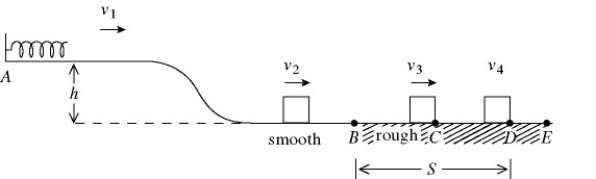
(Multiple Choice)
4.9/5 (84)
(84) A potential energy function is given by U(x) = (3.00 J)x + (1.00 J/m2)x3. What is the force function F(x) that is associated with this potential energy function?
(Short Answer)
4.9/5 (68)
(68) A box of mass m is pressed against (but is not attached to) an ideal spring of force constant k and negligible mass, compressing the spring a distance x. After it is released, the box slides up a frictionless incline as shown in the figure and eventually stops. If we repeat this experiment but instead compress the spring a distance of 2x 
(Multiple Choice)
4.8/5 (81)
(81) In the figure, a constant external force P = 160 N is applied to a 20.0-kg box, which is on a rough horizontal surface. While the force pushes the box a distance of 8.00 m, the speed changes from 0.500 m/s to 2.60 m/s. The work done by friction during this process is closest to 
(Multiple Choice)
4.8/5 (79)
(79) A ball is thrown upward at an angle with a speed and direction such that it reaches a maximum height of 16.0 m above the point it was released, with no appreciable air resistance. At its maximum height it has a speed of 18.0 m/s. With what speed was the ball released?
(Multiple Choice)
4.8/5 (78)
(78) When an object is solely under the influence of conservative forces, the sum of its kinetic and potential energies does not change.
(True/False)
4.8/5 (83)
(83) A ball drops some distance and loses 30 J of gravitational potential energy. Do NOT ignore air resistance. How much kinetic energy did the ball gain?
(Multiple Choice)
4.7/5 (71)
(71) A 60.0-kg person drops from rest a distance of 1.20 m to a platform of negligible mass supported by an ideal stiff spring of negligible mass. The platform drops 6.00 cm before the person comes to rest. What is the spring constant of the spring?
(Multiple Choice)
4.8/5 (86)
(86) A block slides down a frictionless inclined ramp. If the ramp angle is 17.0° and its length is  find the speed of the block as it reaches the bottom of the ramp, assuming it started sliding from rest at the top.
 (Multiple Choice)
4.7/5 (87)
(87) 
Filters
- Essay(0)
- Multiple Choice(0)
- Short Answer(0)
- True False(0)
- Matching(0)