



 Chat with AI
Exam 11: Work

Exam 1: Concepts of Motion52 Questions
Exam 2: Kinematics in One Dimension59 Questions
Exam 3: Vectors and Coordinate Systems33 Questions
Exam 4: Kinematics in Two Dimensions50 Questions
Exam 5: Force and Motion31 Questions
Exam 6: Dynamics I: Motion Along a Line46 Questions
Exam 7: Newtons Third Law43 Questions
Exam 8: Dynamics Ii: Motion in a Plane20 Questions
Exam 9: Impulse and Momentum20 Questions
Exam 10: Energy43 Questions
Exam 11: Work100 Questions
Exam 12: Rotation of a Rigid Body113 Questions
Exam 13: Newtons Theory of Gravity50 Questions
Exam 14: Oscillations49 Questions
Exam 15: Fluids and Elasticity72 Questions
Exam 16: A Macroscopic Description of Matter29 Questions
Exam 17: Work, Heat, and the First Law of Thermodynamics98 Questions
Exam 18: The Micromacro Connection39 Questions
Exam 19: Heat Engines and Refrigerators50 Questions
Exam 20: Traveling Waves49 Questions
Exam 21: Superpositions64 Questions
Exam 22: Wave Optics51 Questions
Exam 23: Ray Optics63 Questions
Exam 24: Optical Instruments49 Questions
Exam 25: Electric Charges and Forces26 Questions
Exam 26: The Electric Field32 Questions
Exam 27: Gausss Law41 Questions
Exam 28: The Electric Potential40 Questions
Exam 29: Potential and Field57 Questions
Exam 30: Current and Resistance32 Questions
Exam 31: Fundamentals of Circuits68 Questions
Exam 32: The Magnetic Field87 Questions
Exam 33: Electromagnetic Induction66 Questions
Exam 34: Electromagnetic Fields and Waves52 Questions
Exam 35: Ac Circuits46 Questions
Exam 36: Relativity49 Questions
Exam 37: The Foundations of Modern Physics8 Questions
Exam 38: Quantization54 Questions
Exam 39: Wave Functions and Uncertainty18 Questions
Exam 40: One-Dimensional Quantum Mechanics32 Questions
Exam 41: Atomic Physics39 Questions
Exam 42: Nuclear Physics65 Questions
Select questions type


Two stones, one of mass m and the other of mass 2m, are thrown directly upward with the same velocity at the same time from ground level and feel no air resistance. Which statement about these stones is true?
(Multiple Choice)
4.9/5  (62)
(62) In the figure, a 4.0-kg ball is on the end of a 1.6-m rope that is fixed at 0. The ball is held at point A, with the rope horizontal, and is given an initial downward velocity. The ball moves through three quarters of a circle with no friction and arrives at B, with the rope barely under tension. The initial velocity of the ball, at point A, is closest to 
(Multiple Choice)
5.0/5 (81)
(81) If electricity costs 6.00¢/kWh (kilowatt-hour), how much would it cost you to run a 120 W stereo system 4.0 hours per day for 4.0 weeks?
(Multiple Choice)
4.8/5 (84)
(84) The only force acting on an object moving along the x-axis is the conservative force given by F(x) = (2.00 N/m)x + (1.00 N/m3)x3.
(a) What is the change in potential energy when the object moves from x = 1.00 m to x = 2.00 m?
(b) What is the change in kinetic energy when the object moves from x = 1.00 m to x = 2.00 m?
(Essay)
4.8/5 (72)
(72) In the figure, a 5.00-kg block is moving at 5.00 m/s along a horizontal frictionless surface toward an ideal massless spring that is attached to a wall. After the block collides with the spring, the spring is compressed a maximum distance of 0.68 m. What is the speed of the block when it has moved so that the spring is compressed to only one-half of the maximum distance? 
(Short Answer)
4.9/5 (82)
(82) A 50.0-kg skier starting from rest travels 200 m down a hill that has a 20.0° slope and a uniform surface. When the skier reaches the bottom of the hill, her speed is 30.0 m/s.
(a) How much work is done by friction as the skier comes down the hill?
(b) What is the magnitude of the friction force if the skier travels directly down the hill?
(Essay)
4.7/5 (88)
(88) A 2.0 g bead slides along a frictionless wire, as shown in the figure. At point A, the bead is moving to the right but with negligible speed.  (a) What is the potential energy of the bead at point A?
(b) What is the kinetic energy of the bead at point B?
(c) What is the speed of the bead at point B?
(d) What is the speed of the bead at point C?
(a) What is the potential energy of the bead at point A?
(b) What is the kinetic energy of the bead at point B?
(c) What is the speed of the bead at point B?
(d) What is the speed of the bead at point C? (Essay)
4.9/5 (81)
(81) In the figure, a 900-kg crate is on a rough surface inclined at 30°. A constant external force
P = 7200 N is applied horizontally to the crate. While this force pushes the crate a distance of 3.0 m up the incline, its velocity changes from 1.2 m/s to 2.3 m/s. How much work does friction do during this process? 
(Multiple Choice)
4.9/5 (78)
(78) A small hockey puck slides without friction over the icy hill shown in the figure and lands 6.20 m from the foot of the cliff with no air resistance. What was its speed v0 at the bottom of the hill? 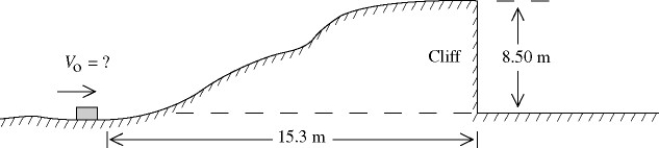
(Multiple Choice)
4.8/5 (79)
(79) An airplane flies 120 km at a constant altitude in a direction 30.0° north of east. A wind is blowing that results in a net horizontal force on the plane due to the air of 2.40 kN in a direction 10.0° south of west. How much work is done on the plane by the air?
(Multiple Choice)
4.9/5 (84)
(84) A 4.0-kg object is moving with speed 2.0 m/s. A 1.0-kg object is moving with speed 4.0 m/s. Both objects encounter the same constant braking force, and are brought to rest. Which object travels the greater distance before stopping?
(Multiple Choice)
4.8/5 (69)
(69) A graph of the force on an object as a function of its position is shown in the figure. Determine the amount of work done by this force on the object during a displacement from x = -2.00 m to x = 2.00 m. (Assume an accuracy of 3 significant figures for the numbers on the graph.) 
(Multiple Choice)
4.9/5 (78)
(78) A projectile is fired from ground level at an angle of 40.0° above horizontal at a speed of 30.0 m/s. What is the speed of the projectile when it has reached a height equal to 50.0% of its maximum height?
(Multiple Choice)
4.9/5 (81)
(81) An object of mass 4.0 kg starts at rest from the top of a rough inclined plane of height 10 m as shown in the figure. If the speed of the object at the bottom of the inclined plane is 10 m/s, how much work does friction do on this object as it slides down the incline? 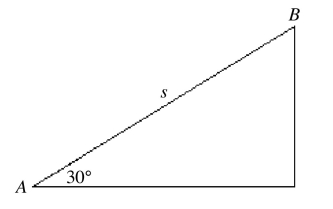
(Short Answer)
5.0/5 (73)
(73) A roller coaster of mass 80.0 kg is moving with a speed of 20.0 m/s at position A as shown in the figure. The vertical height above ground level at position A is 200 m. Neglect friction.  (a) What is the total mechanical energy of the roller coaster at point A?
(b) What is the total mechanical energy of the roller coaster at point B?
(c) What is the speed of the roller coaster at point B?
(d) What is the speed of the roller coaster at point C?
(a) What is the total mechanical energy of the roller coaster at point A?
(b) What is the total mechanical energy of the roller coaster at point B?
(c) What is the speed of the roller coaster at point B?
(d) What is the speed of the roller coaster at point C? (Essay)
4.8/5 (74)
(74) A spring-loaded dart gun is used to shoot a dart straight up into the air, and the dart reaches a maximum height of 24 meters above its point of release. The same dart is shot up a second time from the same gun, but this time the spring is compressed only half as far (compared to the first shot). How far up does the dart go this time? (Neglect friction and assume the spring is ideal and massless.)
(Multiple Choice)
4.8/5 (77)
(77) The scalar product of vector  = 3.00
 + 2.00
 And vector
 Is 10.0. Which of the following vectors could be vector
 ?
= 3.00
+ 2.00
And vector
Is 10.0. Which of the following vectors could be vector
? (Multiple Choice)
4.9/5 (88)
(88) A 2.0-kg object is moving without friction along the x-axis. The potential energy curve as a function of position is shown in the figure, and the system is conservative. If the speed of the object at the origin is 4.0 m/s, what will be its speed at 7.0 m along the +x-axis? 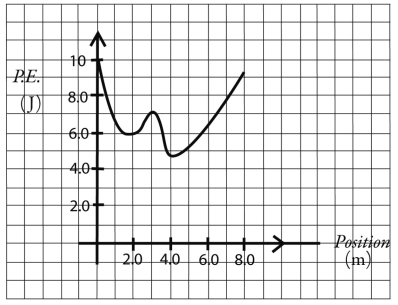
(Multiple Choice)
4.8/5 (86)
(86) A crane lifts a 425 kg steel beam vertically a distance of 117 m. How much work does the crane do on the beam if the beam accelerates upward at 1.8 m/s2? Neglect frictional forces.
(Multiple Choice)
4.8/5 (88)
(88) An 8.0-m massless rod is loosely pinned to a frictionless pivot at 0, as shown in the figure. A very small 4.0-kg ball is attached to the other end of the rod. The ball is held at A, where the rod makes a 30° angle above the horizontal, and is released. The ball-rod assembly then swings freely with negligible friction in a vertical circle between A and B. The tension in the rod when the ball passes through the lowest point at D is closest to 
(Multiple Choice)
4.9/5 (87)
(87) 
Filters
- Essay(0)
- Multiple Choice(0)
- Short Answer(0)
- True False(0)
- Matching(0)