



 Chat with AI
Exam 32: The Magnetic Field

Exam 1: Concepts of Motion52 Questions
Exam 2: Kinematics in One Dimension59 Questions
Exam 3: Vectors and Coordinate Systems33 Questions
Exam 4: Kinematics in Two Dimensions50 Questions
Exam 5: Force and Motion31 Questions
Exam 6: Dynamics I: Motion Along a Line46 Questions
Exam 7: Newtons Third Law43 Questions
Exam 8: Dynamics Ii: Motion in a Plane20 Questions
Exam 9: Impulse and Momentum20 Questions
Exam 10: Energy43 Questions
Exam 11: Work100 Questions
Exam 12: Rotation of a Rigid Body113 Questions
Exam 13: Newtons Theory of Gravity50 Questions
Exam 14: Oscillations49 Questions
Exam 15: Fluids and Elasticity72 Questions
Exam 16: A Macroscopic Description of Matter29 Questions
Exam 17: Work, Heat, and the First Law of Thermodynamics98 Questions
Exam 18: The Micromacro Connection39 Questions
Exam 19: Heat Engines and Refrigerators50 Questions
Exam 20: Traveling Waves49 Questions
Exam 21: Superpositions64 Questions
Exam 22: Wave Optics51 Questions
Exam 23: Ray Optics63 Questions
Exam 24: Optical Instruments49 Questions
Exam 25: Electric Charges and Forces26 Questions
Exam 26: The Electric Field32 Questions
Exam 27: Gausss Law41 Questions
Exam 28: The Electric Potential40 Questions
Exam 29: Potential and Field57 Questions
Exam 30: Current and Resistance32 Questions
Exam 31: Fundamentals of Circuits68 Questions
Exam 32: The Magnetic Field87 Questions
Exam 33: Electromagnetic Induction66 Questions
Exam 34: Electromagnetic Fields and Waves52 Questions
Exam 35: Ac Circuits46 Questions
Exam 36: Relativity49 Questions
Exam 37: The Foundations of Modern Physics8 Questions
Exam 38: Quantization54 Questions
Exam 39: Wave Functions and Uncertainty18 Questions
Exam 40: One-Dimensional Quantum Mechanics32 Questions
Exam 41: Atomic Physics39 Questions
Exam 42: Nuclear Physics65 Questions
Select questions type


A very long straight wire carries a 12-A current eastward and a second very long straight wire carries a 14-A current westward. The wires are parallel to each other and are 42 cm apart. Calculate the force on a 6.4 m length of one of the wires. (μ0 = 4π × 10-7 T ∙ m/A)
(Multiple Choice)
4.8/5  (86)
(86) As shown in the figure, a small particle of charge q = -7.0 × 10⁻⁶ C and mass m = 3.1 × 10⁻¹² kg has velocity v0 = 9.4 × 10³ m/s as it enters a region of uniform magnetic field. The particle is observed to travel in the semicircular path shown, with radius R = 5.0 cm. Calculate the magnitude and direction of the magnetic field in the region. 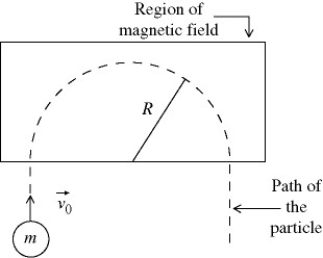
(Short Answer)
4.9/5 (90)
(90) A solenoid of length 18 cm consists of closely spaced coils of wire wrapped tightly around a wooden core. The magnetic field strength is 2.0 mT inside the solenoid near its center when a certain current flows through the coils. If the coils of the solenoid are now pulled apart slightly, stretching it to 21 cm without appreciably changing the size of the coils, what does the magnetic field become near the center of the solenoid when the same current flows through the coils? (μ0 = 4π × 10-7 T ∙ m/A)
(Multiple Choice)
4.9/5 (73)
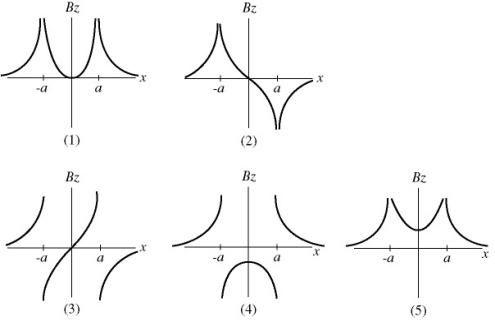
(73) Two very long parallel wires in the xy-plane, a distance 2a apart, are parallel to the y-axis and carry equal currents I as shown in the figure. The +z direction points perpendicular to the xy-plane in a right-handed coordinate system. If both currents flow in the +y direction, which one of the graphs shown in the figure below best represents the z component of the net magnetic field, in the xy-plane, as a function of x? (Caution: These graphs are not magnetic field lines.) 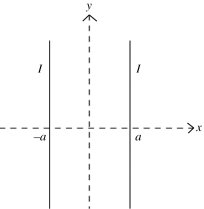
(Multiple Choice)
4.7/5 (83)
(83) A charge is accelerated from rest through a potential difference V and then enters a uniform magnetic field oriented perpendicular to its path. The field deflects the particle into a circular arc of radius R. If the accelerating potential is tripled to 3V, what will be the radius of the circular arc?
(Multiple Choice)
4.8/5 (70)
(70) Two circular coils of diameter 30.0 cm are parallel to each other and have their centers along the same line L but separated by 22.0 cm. When an experimenter views the coils along L, the coil closer to her carries a clockwise current of 2.50 A. Find the magnitude and sense (clockwise or counterclockwise) of the current needed in the other coil so that the net magnetic field on L midway between the two coils will have a magnitude of 4.10 µT and point away from the experimenter who is viewing the coils along L. (μ0 = 4π × 10-7 T ∙ m/A)
(Short Answer)
4.8/5 (66)
(66) An electron enters a magnetic field of 0.75 T with a velocity perpendicular to the direction of the field. At what frequency does the electron traverse a circular path? (mel = 9.11 × 10⁻³¹ kg, e = 1.60 × 10⁻¹⁹C)
(Multiple Choice)
4.9/5 (82)
(82) 
Filters
- Essay(0)
- Multiple Choice(0)
- Short Answer(0)
- True False(0)
- Matching(0)