



 Chat with AI
Exam 32: The Magnetic Field

Exam 1: Concepts of Motion52 Questions
Exam 2: Kinematics in One Dimension59 Questions
Exam 3: Vectors and Coordinate Systems33 Questions
Exam 4: Kinematics in Two Dimensions50 Questions
Exam 5: Force and Motion31 Questions
Exam 6: Dynamics I: Motion Along a Line46 Questions
Exam 7: Newtons Third Law43 Questions
Exam 8: Dynamics Ii: Motion in a Plane20 Questions
Exam 9: Impulse and Momentum20 Questions
Exam 10: Energy43 Questions
Exam 11: Work100 Questions
Exam 12: Rotation of a Rigid Body113 Questions
Exam 13: Newtons Theory of Gravity50 Questions
Exam 14: Oscillations49 Questions
Exam 15: Fluids and Elasticity72 Questions
Exam 16: A Macroscopic Description of Matter29 Questions
Exam 17: Work, Heat, and the First Law of Thermodynamics98 Questions
Exam 18: The Micromacro Connection39 Questions
Exam 19: Heat Engines and Refrigerators50 Questions
Exam 20: Traveling Waves49 Questions
Exam 21: Superpositions64 Questions
Exam 22: Wave Optics51 Questions
Exam 23: Ray Optics63 Questions
Exam 24: Optical Instruments49 Questions
Exam 25: Electric Charges and Forces26 Questions
Exam 26: The Electric Field32 Questions
Exam 27: Gausss Law41 Questions
Exam 28: The Electric Potential40 Questions
Exam 29: Potential and Field57 Questions
Exam 30: Current and Resistance32 Questions
Exam 31: Fundamentals of Circuits68 Questions
Exam 32: The Magnetic Field87 Questions
Exam 33: Electromagnetic Induction66 Questions
Exam 34: Electromagnetic Fields and Waves52 Questions
Exam 35: Ac Circuits46 Questions
Exam 36: Relativity49 Questions
Exam 37: The Foundations of Modern Physics8 Questions
Exam 38: Quantization54 Questions
Exam 39: Wave Functions and Uncertainty18 Questions
Exam 40: One-Dimensional Quantum Mechanics32 Questions
Exam 41: Atomic Physics39 Questions
Exam 42: Nuclear Physics65 Questions
Select questions type


A long straight wire on the z-axis carries a current of 6.0 A in the positive direction. A circular loop in the xy-plane, of radius 10 cm, carries a 1.0-A current, as shown in the figure. Point P, at the center of the loop, is 25 cm from the z-axis. An electron is projected from P with a velocity of 1.0 × 10⁶ m/s in the negative x-direction. What is the y component of the force on the electron? (e = 1.60 × 10⁻¹⁹ C, μ0 = 4π × 10-7 T ∙ m/A) 
(Multiple Choice)
4.9/5  (92)
(92) A rigid rectangular loop, which measures 0.30 m by 0.40 m, carries a current of 5.5 A, as shown in the figure. A uniform external magnetic field of magnitude 2.9 T in the negative x direction is present. Segment CD is in the xz-plane and forms a 35° angle with the z-axis, as shown. Find the magnitude of the external torque needed to keep the loop in static equilibrium. 
(Multiple Choice)
4.8/5 (74)
(74) Two coaxial circular coils of radius R = 15 cm, each carrying 4.0 A in the same direction, are positioned a distance d = 20 cm apart, as shown in the figure. Calculate the magnitude of the magnetic field halfway between the coils along the line connecting their centers. (μ0 = 4π × 10-7 T ∙ m/A) 
(Multiple Choice)
4.9/5 (92)
(92) A wire carrying a current is shaped in the form of a circular loop of radius 3.0 mm. If the magnetic field strength that this current produces at the center of the loop is 1.1 mT, what is the magnitude of the current that flows through the wire? (μ0 = 4π × 10-7 T ∙ m/A)
(Multiple Choice)
4.8/5 (71)
(71) A particle with charge -5.00 C initially moves at  = (1.00
 + 7.00
 ) m/s. If it encounters a magnetic field
 Find the magnetic force vector on the particle.
= (1.00
+ 7.00
) m/s. If it encounters a magnetic field
Find the magnetic force vector on the particle. (Multiple Choice)
4.8/5 (90)
(90) A charged particle is moving with speed v perpendicular to a uniform magnetic field. A second identical charged particle is moving with speed 2v perpendicular to the same magnetic field. If the frequency of revolution of the first particle is f, the frequency of revolution of the second particle is
(Multiple Choice)
4.8/5 (88)
(88) A wire segment 1.2 m long carries a current I = 3.5 A, and is oriented as shown in the figure. The +x-axis points directly into the page. A uniform magnetic field of magnitude 0.50 T pointing toward the -x direction is present as shown. What is the magnetic force vector on the wire segment? 
(Multiple Choice)
4.8/5 (83)
(83) A cylindrical insulated wire of diameter 5.0 mm is tightly wound 200 times around a cylindrical core to form a solenoid with adjacent coils touching each other. When a 0.10 A current is sent through the wire, what is the magnitude of the magnetic field on the axis of the solenoid near its center? (μ0 = 4π × 10-7 T ∙ m/A)
(Multiple Choice)
4.7/5 (74)
(74) A very long, hollow, thin-walled conducting cylindrical shell (like a pipe) of radius R carries a current along its length uniformly distributed throughout the thin shell. Which one of the graphs shown in the figure most accurately describes the magnitude B of the magnetic field produced by this current as a function of the distance r from the central axis? 
(Multiple Choice)
4.8/5 (80)
(80) A very long, solid, conducting cylinder of radius R carries a current along its length uniformly distributed throughout the cylinder. Which one of the graphs shown in the figure most accurately describes the magnitude B of the magnetic field produced by this current as a function of the distance r from the central axis? 
(Multiple Choice)
4.8/5 (88)
(88) Two long parallel wires placed side-by-side on a horizontal table carry identical size currents in opposite directions. The wire on your right carries current toward you, and the wire on your left carries current away from you. From your point of view, the magnetic field at the point exactly midway between the two wires
(Multiple Choice)
4.7/5 (83)
(83) Two long parallel wires carry currents of 10 A in opposite directions. They are separated by 40 cm. What is the magnitude of the magnetic field in the plane of the wires at a point that is 20 cm from one wire and 60 cm from the other? (μ0 = 4π × 10-7 T ∙ m/A)
(Multiple Choice)
4.8/5 (81)
(81) A solenoid is wound with 970 turns on a form 4.0 cm in diameter and 50 cm long. The windings carry a current I in the sense that is shown in the figure. The current produces a magnetic field, of magnitude 4.3 mT, near the center of the solenoid. Find the current in the solenoid windings. (μ0 = 4π × 10-7 T ∙ m/A) 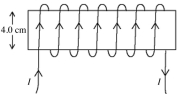
(Multiple Choice)
4.9/5 (75)
(75) A doubly charged ion (charge 2e) with velocity 6.9 × 10⁶ m/s moves in a circular path of diameter 60.0 cm in a magnetic field of 0.80 T in a mass spectrometer. What is the mass of this ion? (e = 1.60 × 10⁻¹⁹C)
(Multiple Choice)
4.7/5 (78)
(78) A circular coil of wire of 200 turns and diameter 2.0 cm carries a current of 4.0 A. It is placed in a magnetic field of 0.70 T with the plane of the coil making an angle of 30° with the magnetic field. What is the magnetic torque on the coil?
(Multiple Choice)
4.8/5 (66)
(66) A very long thin wire produces a magnetic field of 0.0050 × 10⁻⁴ T at a distance of 3.0 mm. from the central axis of the wire. What is the magnitude of the current in the wire? (μ0 = 4π × 10-7 T ∙ m/A)
(Multiple Choice)
4.9/5 (87)
(87) The figure shows two long wires carrying equal currents I1 and I2 flowing in opposite directions. Which of the arrows labeled A through D correctly represents the direction of the magnetic field due to the wires at a point located at an equal distance d from each wire? 
(Multiple Choice)
4.7/5 (73)
(73) A proton, with mass 1.67 × 10⁻²⁷ kg and charge +1.6 × 10⁻¹⁹ C, is sent with velocity 7.1 × 10⁴ m/s in the +x direction into a region where there is a uniform electric field of magnitude 730 V/m in the +y direction. What are the magnitude and direction of the uniform magnetic field in the region, if the proton is to pass through undeflected? Assume that the magnetic field has no x-component and neglect gravitational effects.
(Short Answer)
4.7/5 (74)
(74) A long straight very thin wire on the y-axis carries a 10-A current in the positive y-direction. A circular loop 0.50 m in radius, also of very thin wire and lying in the yz-plane, carries a 9.0-A current, as shown. Point P is on the positive x-axis, at a distance of 0.50 m from the center of the loop. What is the magnetic field vector at point P due to these two currents? (μ0 = 4π × 10-7 T ∙ m/A) 
(Multiple Choice)
4.9/5 (80)
(80) Ions having equal charges but masses of M and 2M are accelerated through the same potential difference and then enter a uniform magnetic field perpendicular to their path. If the heavier ions follow a circular arc of radius R, what is the radius of the arc followed by the lighter?
(Multiple Choice)
4.8/5 (84)
(84) 
Filters
- Essay(0)
- Multiple Choice(0)
- Short Answer(0)
- True False(0)
- Matching(0)