



 Chat with AI
Exam 32: The Magnetic Field

Exam 1: Concepts of Motion52 Questions
Exam 2: Kinematics in One Dimension59 Questions
Exam 3: Vectors and Coordinate Systems33 Questions
Exam 4: Kinematics in Two Dimensions50 Questions
Exam 5: Force and Motion31 Questions
Exam 6: Dynamics I: Motion Along a Line46 Questions
Exam 7: Newtons Third Law43 Questions
Exam 8: Dynamics Ii: Motion in a Plane20 Questions
Exam 9: Impulse and Momentum20 Questions
Exam 10: Energy43 Questions
Exam 11: Work100 Questions
Exam 12: Rotation of a Rigid Body113 Questions
Exam 13: Newtons Theory of Gravity50 Questions
Exam 14: Oscillations49 Questions
Exam 15: Fluids and Elasticity72 Questions
Exam 16: A Macroscopic Description of Matter29 Questions
Exam 17: Work, Heat, and the First Law of Thermodynamics98 Questions
Exam 18: The Micromacro Connection39 Questions
Exam 19: Heat Engines and Refrigerators50 Questions
Exam 20: Traveling Waves49 Questions
Exam 21: Superpositions64 Questions
Exam 22: Wave Optics51 Questions
Exam 23: Ray Optics63 Questions
Exam 24: Optical Instruments49 Questions
Exam 25: Electric Charges and Forces26 Questions
Exam 26: The Electric Field32 Questions
Exam 27: Gausss Law41 Questions
Exam 28: The Electric Potential40 Questions
Exam 29: Potential and Field57 Questions
Exam 30: Current and Resistance32 Questions
Exam 31: Fundamentals of Circuits68 Questions
Exam 32: The Magnetic Field87 Questions
Exam 33: Electromagnetic Induction66 Questions
Exam 34: Electromagnetic Fields and Waves52 Questions
Exam 35: Ac Circuits46 Questions
Exam 36: Relativity49 Questions
Exam 37: The Foundations of Modern Physics8 Questions
Exam 38: Quantization54 Questions
Exam 39: Wave Functions and Uncertainty18 Questions
Exam 40: One-Dimensional Quantum Mechanics32 Questions
Exam 41: Atomic Physics39 Questions
Exam 42: Nuclear Physics65 Questions
Select questions type


A ring with a clockwise current (as seen from above the ring) is situated with its center directly above another ring, which has a counter-clockwise current, as shown in the figure. In what direction is the net magnetic force exerted on the top ring? 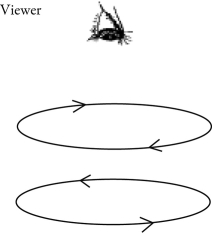
(Multiple Choice)
4.8/5  (80)
(80) An electron moves with a speed of 8.0 × 10⁶ m/s along the +x-axis. It enters a region where there is a magnetic field of 2.5 T, directed at an angle of 60° to the +x-axis and lying in the xy-plane.
(1 eV = 1.60 × 10⁻¹⁹ C, mel = 9.11 × 10⁻³¹ kg) Calculate the magnitude of
(a) the magnetic force on the electron.
(b) the acceleration of the electron.
(Essay)
5.0/5 (67)
(67) A solenoid having N turns and carrying a current of 2.000 A has a length of 34.00 cm. If the magnitude of the magnetic field generated at the center of the solenoid is 9.000 mT, what is the value of N? (μ0 = 4π × 10-7 T ∙ m/A)
(Multiple Choice)
4.7/5 (87)
(87) A negatively charged particle is moving to the right, directly above a wire having a current flowing to the right, as shown in the figure. In which direction is the magnetic force exerted on the particle? 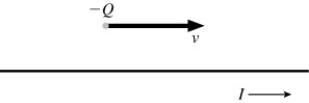
(Multiple Choice)
4.9/5 (73)
(73) The figure shows three long, parallel current-carrying wires. The magnitudes of the currents are equal and their directions are indicated in the figure. Which of the arrows drawn near the wire carrying current 1 correctly indicates the direction of the magnetic force acting on that wire? 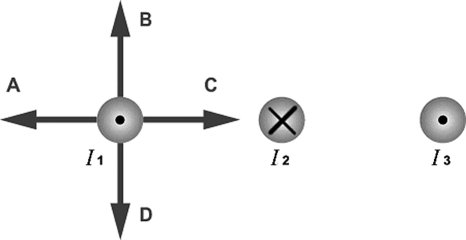
(Multiple Choice)
4.7/5 (82)
(82) The figure shows a velocity selector that can be used to measure the speed of a charged particle. A beam of particles is directed along the axis of the instrument. A parallel plate capacitor sets up an electric field E, which is oriented perpendicular to a uniform magnetic field B. If the plates are separated by 2.0 mm and the value of the magnetic field is 0.60 T, what voltage between the plates will allow particles of speed 5.0 × 10⁵ m/s to pass straight through without deflection? 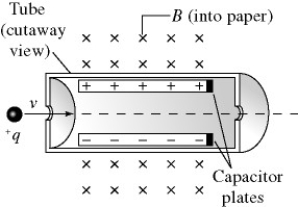
(Multiple Choice)
4.9/5 (76)
(76) A rigid circular loop has a radius of 0.20 m and is in the xy-plane. A clockwise current I is carried by the loop, as shown. The magnitude of the magnetic moment of the loop is 0.75 A · m2. A uniform external magnetic field, B = 0.20 T in the positive x-direction, is present. 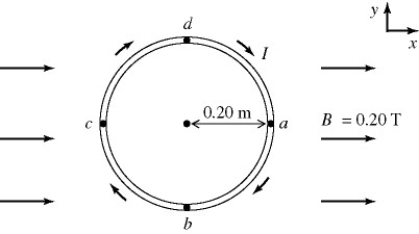 (a) What is the current in the loop?
(b) Find the magnitude of the magnetic torque exerted on the loop.
(c) If the loop is released from rest, in what direction will points a and c initially move?
(a) What is the current in the loop?
(b) Find the magnitude of the magnetic torque exerted on the loop.
(c) If the loop is released from rest, in what direction will points a and c initially move? (Essay)
4.9/5 (76)
(76) A 15-turn rectangular loop of wire of width 10 cm and length 20 cm has a current of 2.5 A flowing through it. Two sides of the loop are oriented parallel to a uniform magnetic field of strength 0.037 T, and the other two sides are perpendicular to the magnetic field.
(a) What is the magnitude of the magnetic moment of the loop?
(b) What torque does the magnetic field exert on the loop?
(Essay)
4.7/5 (84)
(84) As shown in the figure, a rectangular current loop is carrying current I1 = 3.0 A, in the direction shown, and is located near a long wire carrying a current Iw. The long wire is parallel to the sides of the rectangle. The rectangle loop has length 0.80 m and its sides are 0.10 m and 0.70 m from the wire, as shown. We measure that the net force on the rectangular loop is 4.9 × 10⁻⁶ N and is directed towards the wire. 
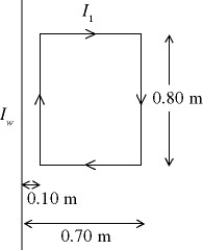 (a) What is the magnitude of the current Iw?
(b) In which direction does Iw flow: from top to bottom or from bottom to top in the sketch?
(a) What is the magnitude of the current Iw?
(b) In which direction does Iw flow: from top to bottom or from bottom to top in the sketch? (Essay)
4.9/5 (72)
(72) As shown in the figure, an insulated wire is bent into a circular loop of radius 6.0 cm and has two long straight sections. The loop is in the xy-plane, with the center at the origin. The straight sections are parallel to the z-axis. The wire carries a current of 8.0 A. What is the magnitude of the magnetic field at the origin? (μ0 = 4π × 10-7 T ∙ m/A) 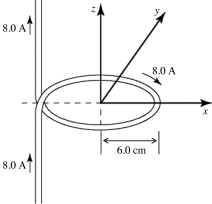
(Multiple Choice)
4.8/5 (75)
(75) An L-shaped metal machine part is made of two equal-length segments that are perpendicular to each other and carry a 4.50-A current as shown in the figure. This part has a total mass of 3.80 kg and a total length of 3.00 m, and it is in an external 1.20-T magnetic field that is oriented perpendicular to the plane of the part, as shown. What is the magnitude of the NET magnetic force that the field exerts on the part? 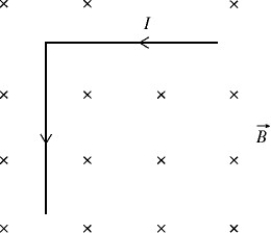
(Multiple Choice)
4.9/5 (76)
(76) The magnetic field at a distance of 2 cm from a current carrying wire is 4 μT. What is the magnetic field at a distance of 4 cm from the wire?
(Multiple Choice)
4.9/5 (80)
(80) A coaxial cable consists of an inner cylindrical conductor of radius R1 = 0.040 m on the axis of an outer hollow cylindrical conductor of inner radius R2 = 0.080 m and outer radius R3 = 0.090 m. The inner conductor carries current I1 = 4.40 A in one direction, and the outer conductor carries current I2 = 7.70 A in the opposite direction. What is the magnitude of the magnetic field at the following distances from the central axis of the cable? (μ0 = 4π × 10-7 T ∙ m/A)
(a) At r = 0.060 m (in the gap midway between the two conductors)
(b) At r = 0.150 m (outside the cable)
(Essay)
4.9/5 (80)
(80) A charged particle of mass 0.0020 kg is subjected to a 6.0 T magnetic field which acts at a right angle to its motion. If the particle moves in a circle of radius 0.20 mat a speed of 5.0 m/s, what is the magnitude of the charge on the particle?
(Multiple Choice)
4.8/5 (74)
(74) A uniform magnetic field of magnitude 0.80 T in the negative z-direction is present in a region of space, as shown in the figure. A uniform electric field is also present. An electron that is projected with an initial velocity v0 = 9.1 × 10⁴ m/s in the positive x-direction passes through the region without deflection. What is the electric field vector in the region? 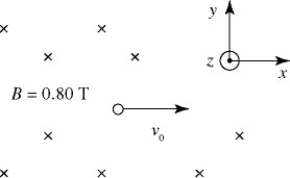
(Multiple Choice)
4.8/5 (80)
(80) A tube with a 3.0-mm radius has ions flowing through it along its length. To determine the rate at which the charge is being moved through the tube, the magnetic field just outside the tube is measured and found to be 44.0 × 10⁻⁴ T. If the only contributor to the magnetic field is the moving ions, and if the walls of the container are very thin and do not screen magnetism, what is the magnitude of the current flowing through the tube? (μ0 = 4π × 10-7 T ∙ m/A)
(Multiple Choice)
4.9/5 (83)
(83) A long straight conductor has a constant current flowing to the right. A wire rectangle is situated above the wire, and also has a constant current flowing through it (as shown in the figure). Which of the following statements is true? 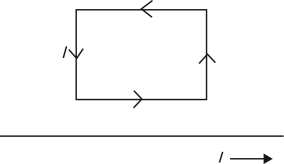
(Multiple Choice)
4.8/5 (71)
(71) A beam of electrons is accelerated through a potential difference of 10 kV before entering a region having uniform electric and magnetic fields that are perpendicular to each other and perpendicular to the direction in which the electron is moving. If the magnetic field in this region has a value of 0.010 T, what magnitude of the electric field is required if the particles are to be undeflected as they pass through the region?
(Multiple Choice)
4.9/5 (81)
(81) A wire segment 1.2 m long carries a current I = 3.5 A and is oriented as shown in the figure. A uniform magnetic field of magnitude 0.50 T pointing toward the -x direction is present as shown. The +z-axis points directly into the page. What is the magnetic force vector on the wire segment? 
(Multiple Choice)
4.9/5 (76)
(76) The figure shows the cross-section of a hollow cylinder of inner radius a = 5.0 cm and outer radius b = 7.0 cm. A uniform current density of 1.0 A/ cm2 flows through the cylinder parallel to its axis. Calculate the magnitude of the magnetic field at a distance of d = 10 cm from the axis of the cylinder. (μ0 = 4π × 10-7 T ∙ m/A) 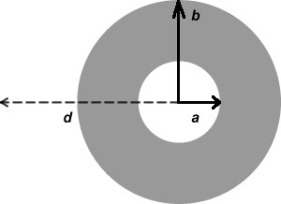
(Multiple Choice)
4.7/5 (75)
(75) 
Filters
- Essay(0)
- Multiple Choice(0)
- Short Answer(0)
- True False(0)
- Matching(0)