



 Chat with AI
Exam 13: Monopoly

Exam 1: First Principles199 Questions
Exam 2: Economic Models: Trade-Offs and Trade299 Questions
Exam 4: Consumer and Producer Surplus229 Questions
Exam 3: Supply and Demand265 Questions
Exam 5: Price Controls and Quotas: Meddling With Markets216 Questions
Exam 6: Elasticity226 Questions
Exam 7: Taxes286 Questions
Exam 8: International Trade260 Questions
Exam 9: Decision Making by Individuals and Firms186 Questions
Exam 10: The Rational Consumer182 Questions
Exam 11: Behind the Supply Curve: Inputs and Costs317 Questions
Exam 12: Perfect Competition and the Supply Curve341 Questions
Exam 13: Monopoly317 Questions
Exam 14: Oligopoly271 Questions
Exam 15: Monopolistic Competition and Product Differentiation245 Questions
Exam 16: Externalities193 Questions
Exam 17: Public Goods and Common Resources208 Questions
Exam 18: The Economics of the Welfare State126 Questions
Exam 19: Factor Markets and the Distribution of Income316 Questions
Exam 20: Uncertainty, Risk, and Private Information192 Questions
Exam 21: Graphs in Economics60 Questions
Exam 22: Consumer Preferences and Consumer Choice135 Questions
Select questions type


Use the following to answer question:
Figure: Computing Monopoly Profit  -(Figure: Computing Monopoly Profit)Use Figure: Computing Monopoly Profit.At the profit-maximizing output,total cost is:
 (Multiple Choice)
4.8/5  (80)
(80) Suppose that a monopoly computer chip maker increases production from 10 microchips to 11 microchips.If the market price declines from $30 per unit to $29 per unit,marginal revenue for the eleventh unit is:
(Multiple Choice)
4.9/5 (79)
(79) (Scenario: A Small-Town Monopolist)Use Scenario: A Small-Town Monopolist.If this monopolist must choose between selling 100 or 175 subscriptions,it will choose to sell _____ units at a price of _____ and earn economic profits equal to _____. Scenario: A Small-Town Monopolist
A monopolist sells cable subscriptions in a small town and finds that it can sell 100 subscriptions when the price is $15 a week and 175 subscriptions when the price is $10 a week.The MC for the provision of the cable is $5 a week.There are no fixed costs.
(Multiple Choice)
4.8/5 (78)
(78) Use the following to answer question:  -(Table: Lunch)Use Table: Lunch.This table shows market demand for picnic lunches for people taking all-day rafting trips on the river.Suppose that the marginal cost and average cost of each lunch are a constant $4 for all firms in the market.If Joe owns one of many firms in a competitive industry,what price will he charge for a lunch in the long run?
 (Multiple Choice)
4.9/5 (70)
(70) Use the following to answer question:
Figure: The Profit-Maximizing Output and Price  -(Figure: The Profit-Maximizing Output and Price)Use Figure: The Profit-Maximizing Output and Price.Assume that there are no fixed costs and AC = MC = $200.At the profit-maximizing output and price for a monopolist,total surplus is:
 (Multiple Choice)
4.9/5 (79)
(79) Use the following to answer question:
Figure: A Profit-Maximizing Monopoly Firm  -(Figure: A Profit-Maximizing Monopoly Firm)Use Figure: A Profit-Maximizing Monopoly Firm.The firm in this figure will produce _____ units of output per week.
 (Multiple Choice)
4.8/5 (87)
(87) If a product's usefulness increases with the number of users,it:
(Multiple Choice)
4.7/5 (74)
(74) A profit-maximizing monopoly will never set price in the inelastic region of the demand curve.
(True/False)
4.8/5 (82)
(82) Use the following to answer question:
Figure: PPV  -(Figure: PPV)Use Figure: PPV.The figure shows the demand and marginal revenue for a pay-per-view football game on cable TV.Assume that the marginal cost and average cost are a constant $40.If the cable company is a single-price monopoly,to maximize profit it will sell _____ subscriptions and charge _____ per subscription.
 (Multiple Choice)
4.9/5 (89)
(89) The marginal revenue curve for a monopolist is always less than the price because of the price effect.
(True/False)
4.8/5 (85)
(85) If a monopolist is producing a quantity where MC > MR,then profit:
(Multiple Choice)
4.8/5 (89)
(89) Use the following to answer question: 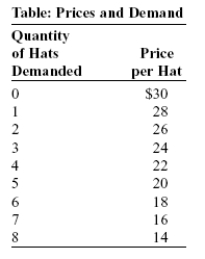 -(Table: Prices and Demand)Use Table: Prices and Demand.Professor Dumbledore has a monopoly on magic hats.The marginal cost of producing a hat is $18.Suppose Dumbledore can perfectly price-discriminate.How many hats will he produce?
 (Multiple Choice)
4.8/5 (85)
(85) Use the following to answer question:
Figure: The Monopolist  -(Figure: The Monopolist)Use Figure: The Monopolist.If this monopolist profit-maximizes,it will produce _____ units and sell them at _____.
 (Multiple Choice)
4.8/5 (86)
(86) A monopoly's short-run supply curve is upward sloping because of diminishing marginal returns.
(True/False)
4.9/5 (82)
(82) Use the following to answer question:  -(Table: Demand and Total Cost)Use Table: Demand and Total Cost.Lenoia runs a natural monopoly firm producing electricity for a small mountain village.The table shows Lenoia's demand and total cost of producing electricity.The marginal revenue of the fourth unit of production is:
 (Multiple Choice)
4.9/5 (84)
(84) Children's price elasticity of demand for hot chocolate is 0.5.Adults' price elasticity of demand for hot chocolate is 1.5.If the concession stand selling the hot chocolate wants to practice price discrimination,it should charge higher prices to adults.
(True/False)
4.7/5 (90)
(90) 
Filters
- Essay(0)
- Multiple Choice(0)
- Short Answer(0)
- True False(0)
- Matching(0)