



 Chat with AI
Exam 13: Monopoly

Exam 1: First Principles199 Questions
Exam 2: Economic Models: Trade-Offs and Trade299 Questions
Exam 4: Consumer and Producer Surplus229 Questions
Exam 3: Supply and Demand265 Questions
Exam 5: Price Controls and Quotas: Meddling With Markets216 Questions
Exam 6: Elasticity226 Questions
Exam 7: Taxes286 Questions
Exam 8: International Trade260 Questions
Exam 9: Decision Making by Individuals and Firms186 Questions
Exam 10: The Rational Consumer182 Questions
Exam 11: Behind the Supply Curve: Inputs and Costs317 Questions
Exam 12: Perfect Competition and the Supply Curve341 Questions
Exam 13: Monopoly317 Questions
Exam 14: Oligopoly271 Questions
Exam 15: Monopolistic Competition and Product Differentiation245 Questions
Exam 16: Externalities193 Questions
Exam 17: Public Goods and Common Resources208 Questions
Exam 18: The Economics of the Welfare State126 Questions
Exam 19: Factor Markets and the Distribution of Income316 Questions
Exam 20: Uncertainty, Risk, and Private Information192 Questions
Exam 21: Graphs in Economics60 Questions
Exam 22: Consumer Preferences and Consumer Choice135 Questions
Select questions type


The practice of charging different prices to different customers for the same good or service,even though the cost of supplying those customers is the same,is:
(Multiple Choice)
4.8/5  (96)
(96) Use the following to answer question:
Figure: The Profit-Maximizing Output and Price  -(Figure: The Profit-Maximizing Output and Price)Use Figure: The Profit-Maximizing Output and Price.Assume that there are no fixed costs and AC = MC = $200.At the profit-maximizing output and price for a monopolist,deadweight loss is:
 (Multiple Choice)
4.9/5 (71)
(71) (Scenario: A Small-Town Monopolist)Use Scenario: A Small-Town Monopolist.Compared with charging a single price,the deadweight loss: Scenario: A Small-Town Monopolist
A monopolist sells cable subscriptions in a small town and finds that it can sell 100 subscriptions when the price is $15 a week and 175 subscriptions when the price is $10 a week.The MC for the provision of the cable is $5 a week.There are no fixed costs.
(Multiple Choice)
4.9/5 (89)
(89) If a monopolist is producing a quantity that generates MC > MR,then profit:
(Multiple Choice)
4.9/5 (91)
(91) Use the following to answer question:  -(Table: Lunch)Use Table: Lunch.This table shows market demand for picnic lunches for people taking all-day rafting trips on the river.Joe has a firm providing this service,and his marginal cost and average cost for each lunch are a constant $4.If Joe is a monopolist,what price will he charge for a lunch in the long run?
 (Multiple Choice)
4.7/5 (72)
(72) The municipal swimming pool charges lower entrance fees to local residents than to nonresidents.Assuming that this pricing strategy increases the profits of the pool,we can conclude that nonresidents must have a _____ demand for swimming at the pool than do residents.
(Multiple Choice)
5.0/5 (78)
(78) If you had an official license for the exclusive right to sell breakfast bagels in your community,your monopoly would result from:
(Multiple Choice)
4.9/5 (88)
(88) You own a lemonade stand in a competitive market,and as such,you are a price-taking firm.Which event would MOST likely increase your market power?
(Multiple Choice)
4.9/5 (81)
(81) When a monopolist practices price discrimination as opposed to setting a single price,the monopolist sells more and increases profits.
(True/False)
4.9/5 (73)
(73) Bob owns a trout farm with monopoly power in North Carolina.Bob's optimal output occurs where marginal revenue _____ marginal cost.Because of monopoly power,Bob's supply curve _____.
(Multiple Choice)
4.8/5 (77)
(77) Use the following to answer question:
Figure: Monopoly Model  -(Figure: Monopoly Model)Use Figure: Monopoly Model.When the firm is in equilibrium (that is,maximizing its economic profit),its profit is the area of rectangle:
 (Multiple Choice)
4.8/5 (69)
(69) The De Beers company is described as a monopolist in the production of:
(Multiple Choice)
4.9/5 (76)
(76) Control of a scarce resource or input,economies of scale,technological superiority,and government-set rules and regulations are forms of:
(Multiple Choice)
4.9/5 (67)
(67) (Figure: The Monopolist III)Use Figure: The Monopolist III.If this monopolist perfectly price-discriminates,then it will produce _____ units.This will lead to producer surplus equal to _____,consumer surplus equal to _____,and a deadweight loss equal to _____. Figure: The Monopolist III 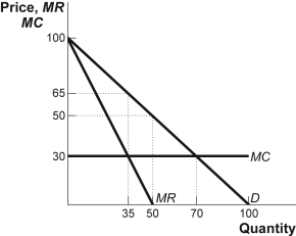
(Multiple Choice)
4.9/5 (73)
(73) When a natural monopoly is regulated to charge a price equal to average total cost,producer surplus decreases,but total surplus increases.
(True/False)
4.8/5 (87)
(87) 
Filters
- Essay(0)
- Multiple Choice(0)
- Short Answer(0)
- True False(0)
- Matching(0)