



 Chat with AI
Exam 13: Monopoly

Exam 1: First Principles199 Questions
Exam 2: Economic Models: Trade-Offs and Trade299 Questions
Exam 4: Consumer and Producer Surplus229 Questions
Exam 3: Supply and Demand265 Questions
Exam 5: Price Controls and Quotas: Meddling With Markets216 Questions
Exam 6: Elasticity226 Questions
Exam 7: Taxes286 Questions
Exam 8: International Trade260 Questions
Exam 9: Decision Making by Individuals and Firms186 Questions
Exam 10: The Rational Consumer182 Questions
Exam 11: Behind the Supply Curve: Inputs and Costs317 Questions
Exam 12: Perfect Competition and the Supply Curve341 Questions
Exam 13: Monopoly317 Questions
Exam 14: Oligopoly271 Questions
Exam 15: Monopolistic Competition and Product Differentiation245 Questions
Exam 16: Externalities193 Questions
Exam 17: Public Goods and Common Resources208 Questions
Exam 18: The Economics of the Welfare State126 Questions
Exam 19: Factor Markets and the Distribution of Income316 Questions
Exam 20: Uncertainty, Risk, and Private Information192 Questions
Exam 21: Graphs in Economics60 Questions
Exam 22: Consumer Preferences and Consumer Choice135 Questions
Select questions type


Amtrak charges lower fares to students than to its other passengers.This pricing strategy increases Amtrak's profits.From this information,we can conclude that students must have a _____ demand for Amtrak train service than do other passengers.
(Multiple Choice)
4.8/5  (77)
(77) After the first unit sold,the marginal revenue a monopolist receives from selling one more unit of a good is less than the price of that unit because of:
(Multiple Choice)
4.9/5 (79)
(79) Use the following to answer question:
Figure: The Profit-Maximizing Output and Price 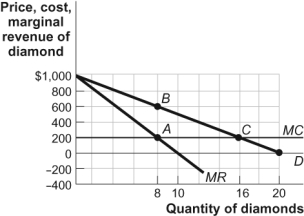 -(Figure: The Profit-Maximizing Output and Price)Use Figure: The Profit-Maximizing Output and Price.Assume that there are no fixed costs and AC = MC = $200.If this were a perfectly competitive industry,producer surplus would be:
 (Multiple Choice)
4.8/5 (90)
(90) Use the following to answer question:
Figure: PPV  -(Figure: PPV)Use Figure: PPV.The figure shows the demand and marginal revenue for a pay-per-view football game on cable TV.Assume that the marginal cost and average cost are a constant $20.If the cable company is a monopoly,how much total surplus is there when the monopolist maximizes profit?
 (Multiple Choice)
4.9/5 (79)
(79) Use the following to answer question: 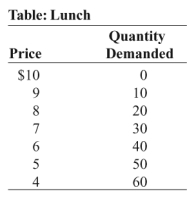 -(Table: Lunch)Use Table: Lunch.This table shows market demand for picnic lunches for people taking all-day rafting trips on the river.Joe has a firm providing this service,and his marginal cost and average cost for each lunch are a constant $4.If Joe is a monopolist,what is consumer surplus in the long run?
 (Multiple Choice)
4.9/5 (76)
(76) Suppose the price elasticity of demand for coffee at the Coffee Barn equals 1.71 for women and 0.55 for men.A successful price discrimination strategy would lead to _____ prices for men and _____ prices for women _____.
(Multiple Choice)
5.0/5 (86)
(86) Price discrimination leads to a _____ price for consumers with a _____ demand.
(Multiple Choice)
4.8/5 (81)
(81) Use the following to answer question:
Figure: PPV
-(Figure: PPV)Use Figure: PPV.The figure shows the demand and marginal revenue for a pay-per-view football game on cable TV.Assume that the marginal cost and average cost are a constant $20.If the cable company is a monopoly,how much producer surplus is there when the monopolist maximizes profit?
-(Figure: PPV)Use Figure: PPV.The figure shows the demand and marginal revenue for a pay-per-view football game on cable TV.Assume that the marginal cost and average cost are a constant $20.If the cable company is a monopoly,how much producer surplus is there when the monopolist maximizes profit? (Multiple Choice)
4.9/5 (84)
(84) An industry with a single producer that sells a single product with no substitutes is a:
(Multiple Choice)
4.9/5 (79)
(79) Suppose that a profit-maximizing monopoly firm undergoes a substantial technological change that reduces its marginal and average total costs by $40.If in response to its reduction in cost the firm changes its price in a profit-maximizing way,then we can predict that its total economic profit will:
(Multiple Choice)
4.9/5 (73)
(73) Airlines that engage in price discrimination charge higher prices to business travelers because their _____ is more _____ than that of other travelers.
(Multiple Choice)
4.9/5 (88)
(88) When a monopolist practices price discrimination,compared with a single-price monopolist,producer surplus will:
(Multiple Choice)
4.9/5 (76)
(76) In the short run,if a monopoly is forced to charge a price equal to marginal cost:
(Multiple Choice)
4.8/5 (76)
(76) If the regulation of a monopoly results in a price equal to marginal cost but the price is below average total cost:
(Multiple Choice)
4.7/5 (82)
(82) Conditions that keep new firms out of a monopoly market are:
(Multiple Choice)
4.8/5 (84)
(84) An industry with a firm that is the only producer of a good or service for which there are no close substitutes and for which entry by potential rivals is prohibitively difficult is:
(Multiple Choice)
4.8/5 (75)
(75) Use the following to answer question:
-(Table: Lunch)Use Table: Lunch.This table shows market demand for picnic lunches for people taking all-day rafting trips on the river.Joe has a firm providing this service,and his marginal cost and average cost for each lunch are a constant $4.If Joe is one of many firms in a competitive industry,how many lunches will the market produce in the long run?
-(Table: Lunch)Use Table: Lunch.This table shows market demand for picnic lunches for people taking all-day rafting trips on the river.Joe has a firm providing this service,and his marginal cost and average cost for each lunch are a constant $4.If Joe is one of many firms in a competitive industry,how many lunches will the market produce in the long run? (Multiple Choice)
4.8/5 (77)
(77) Use the following to answer question:
Figure: A Profit-Maximizing Monopoly Firm  -(Figure: A Profit-Maximizing Monopoly Firm)Use Figure: A Profit-Maximizing Monopoly Firm.This firm's price per unit is:
 (Multiple Choice)
4.9/5 (78)
(78) Use the following to answer question:
-(Table: Lunch)Use Table: figure Lunch.This table shows market demand for picnic lunches for people taking all-day rafting trips on the river.Suppose that the marginal cost and average cost of each lunch are a constant $4 for all firms in the market.What is deadweight loss in this market in the long run?
-(Table: Lunch)Use Table: figure Lunch.This table shows market demand for picnic lunches for people taking all-day rafting trips on the river.Suppose that the marginal cost and average cost of each lunch are a constant $4 for all firms in the market.What is deadweight loss in this market in the long run? (Multiple Choice)
4.8/5 (87)
(87) 
Filters
- Essay(0)
- Multiple Choice(0)
- Short Answer(0)
- True False(0)
- Matching(0)