



 Chat with AI
Exam 13: Monopoly

Exam 1: First Principles199 Questions
Exam 2: Economic Models: Trade-Offs and Trade299 Questions
Exam 4: Consumer and Producer Surplus229 Questions
Exam 3: Supply and Demand265 Questions
Exam 5: Price Controls and Quotas: Meddling With Markets216 Questions
Exam 6: Elasticity226 Questions
Exam 7: Taxes286 Questions
Exam 8: International Trade260 Questions
Exam 9: Decision Making by Individuals and Firms186 Questions
Exam 10: The Rational Consumer182 Questions
Exam 11: Behind the Supply Curve: Inputs and Costs317 Questions
Exam 12: Perfect Competition and the Supply Curve341 Questions
Exam 13: Monopoly317 Questions
Exam 14: Oligopoly271 Questions
Exam 15: Monopolistic Competition and Product Differentiation245 Questions
Exam 16: Externalities193 Questions
Exam 17: Public Goods and Common Resources208 Questions
Exam 18: The Economics of the Welfare State126 Questions
Exam 19: Factor Markets and the Distribution of Income316 Questions
Exam 20: Uncertainty, Risk, and Private Information192 Questions
Exam 21: Graphs in Economics60 Questions
Exam 22: Consumer Preferences and Consumer Choice135 Questions
Select questions type


Use the following to answer question:  -(Table: Demand and Total Cost)Use Table: Demand and Total Cost.Lenoia runs a natural monopoly firm producing electricity for a small mountain village.The table shows Lenoia's demand and total cost of producing electricity.The price effect of increasing production from 3 megawatts to 4 megawatts is:
 (Multiple Choice)
4.9/5  (74)
(74) Suppose a monopolist reduces its price in an effort to expand output.If the price effect equals the quantity effect,then the marginal revenue will be zero.
(True/False)
4.8/5 (90)
(90) Assume that a monopoly is currently earning economic profits.If a permanent change in fixed cost raises average total cost above the demand curve:
(Multiple Choice)
4.8/5 (69)
(69) When a monopoly maximizes profit,the loss of surplus by consumers is _____ the monopolist's gain in profit.
(Multiple Choice)
5.0/5 (85)
(85) Use the following to answer question:
Figure: The Profit-Maximizing Output and Price 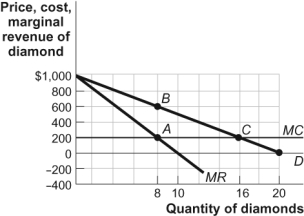 -(Figure: The Profit-Maximizing Output and Price)Use Figure: The Profit-Maximizing Output and Price.Assume that there are no fixed costs and AC = MC = $200.If this were a perfectly competitive industry,consumer surplus would be:
 (Multiple Choice)
4.9/5 (75)
(75) Use the following to answer question:
Figure: PPV  -(Figure: PPV)Use Figure: PPV.The figure shows the demand and marginal revenue for a pay-per-view football game on cable TV.Assume that the marginal cost and average cost are a constant $40.If the cable company is a single-price monopoly and maximizes profit,deadweight loss will be:
 (Multiple Choice)
4.8/5 (72)
(72) Many hotel chains offer discounts to senior citizens.This is an example of _____ that is _____ in the United States.
(Multiple Choice)
4.7/5 (71)
(71) Use the following to answer question:
Figure: The Profit-Maximizing Output and Price
-(Figure: The Profit-Maximizing Output and Price)Use Figure: The Profit-Maximizing Output and Price.Assume that there are no fixed costs and AC = MC = $200.The monopolist who can perfectly price discriminate will produce an output of _____ diamonds.
-(Figure: The Profit-Maximizing Output and Price)Use Figure: The Profit-Maximizing Output and Price.Assume that there are no fixed costs and AC = MC = $200.The monopolist who can perfectly price discriminate will produce an output of _____ diamonds. (Multiple Choice)
4.9/5 (75)
(75) Use the following to answer question:
-(Table: Demand and Total Cost)Use Table: Demand and Total Cost.Lenoia runs a natural monopoly firm producing electricity for a small mountain village.The table shows Lenoia's demand and total cost of producing electricity.To maximize profits,Lenoia should charge a price of:
-(Table: Demand and Total Cost)Use Table: Demand and Total Cost.Lenoia runs a natural monopoly firm producing electricity for a small mountain village.The table shows Lenoia's demand and total cost of producing electricity.To maximize profits,Lenoia should charge a price of: (Multiple Choice)
4.8/5 (84)
(84) If a monopolist is producing a quantity that generates MC = MR,then profit:
(Multiple Choice)
4.7/5 (78)
(78) Mr.Porter sells 10 bottles of champagne per week at $50 per bottle.He can sell 11 bottles per week if he lowers the price to $45 per bottle.The quantity and the price effects on total revenue would be,respectively,an increase of _____ and a decrease of _____.
(Multiple Choice)
4.8/5 (87)
(87) Use the following to answer question:
Figure: Demand,Revenue,and Cost Curves  -(Figure: Demand,Revenue,and Cost Curves)Use Figure: Demand,Revenue,and Cost Curves.Figglenuts-R-Us is a monopolist in the figglenut market.If the government wanted to regulate Figglenuts-R-Us such that the entire deadweight loss would be eliminated in the short run,it would impose a price ceiling of:
 (Multiple Choice)
4.9/5 (73)
(73) If a monopoly has a linear demand curve and is producing at the profit-maximizing level of output,at that level of output,demand is:
(Multiple Choice)
4.8/5 (73)
(73) The strategy that is NOT an example of price discrimination is:
(Multiple Choice)
4.7/5 (83)
(83) Use the following to answer question:
Figure: The Profit-Maximizing Output and Price
-(Figure: The Profit-Maximizing Output and Price)Use Figure: The Profit-Maximizing Output and Price.Assume that there are no fixed costs and AC = MC = $200.If this were a perfectly competitive industry,total surplus would be:
-(Figure: The Profit-Maximizing Output and Price)Use Figure: The Profit-Maximizing Output and Price.Assume that there are no fixed costs and AC = MC = $200.If this were a perfectly competitive industry,total surplus would be: (Multiple Choice)
5.0/5 (75)
(75) 
Filters
- Essay(0)
- Multiple Choice(0)
- Short Answer(0)
- True False(0)
- Matching(0)