



 Chat with AI
Exam 19: International Trade

Exam 1: The Art and Science of Economic Analysis162 Questions
Exam 1: Appendix--Understanding Graphs71 Questions
Exam 2: Economic Tools and Economics Systems211 Questions
Exam 3: Economic Decision Makers207 Questions
Exam 4: Demand, Supply, and Markets245 Questions
Exam 5: Elasticity of Demand and Supply244 Questions
Exam 5: Appendix--Price Elasticity and Tax Incidence32 Questions
Exam 6: Consumer Choice and Demand171 Questions
Exam 6: Appendix--Indifference Curves and Utility Maximization107 Questions
Exam 7: Production and Cost in the Firm218 Questions
Exam 8: A--Perfect Competition250 Questions
Exam 8: B--Perfect Competition25 Questions
Exam 9: A--Monopoly249 Questions
Exam 9: B--Monopoly18 Questions
Exam 10: Monopolistic Competition and Oligopoly233 Questions
Exam 11: Resource Markets219 Questions
Exam 12: Labor Markets and Labor Unions218 Questions
Exam 13: Capital, Interest, and Corporate Finance190 Questions
Exam 14: Transaction Costs, Imperfect Information, and Behavioral Economics187 Questions
Exam 15: Economic Regulation and Antitrust Policy179 Questions
Exam 16: Public Goods and Public Choice143 Questions
Exam 17: Externalities and the Environment203 Questions
Exam 18: Income Distribution and Poverty130 Questions
Exam 19: International Trade172 Questions
Exam 20: International Finance226 Questions
Exam 21: Economic Development97 Questions
Select questions type


The opportunity cost of producing one car in Germany is 2, 000 bushels of wheat, and the opportunity cost of producing one car in Canada is 1, 200 bushels of wheat.The two countries can realize mutual gains from trade if they agree on terms of trade that are
(Multiple Choice)
4.9/5  (75)
(75) International trade equalizes the opportunity cost of producing any good around the world.
(True/False)
4.9/5 (78)
(78) Which of the following is not a type of trade restriction?
(Multiple Choice)
4.7/5 (79)
(79) The losers when the United States institutes trade restrictions include
(Multiple Choice)
4.8/5 (71)
(71) Exhibit 19-2  In Exhibit 19-2, the opportunity cost of 1 ton of rice in Costa Rica is
 (Multiple Choice)
4.8/5 (88)
(88) The difference between an import quota and a tariff that results in the same domestic price is
(Multiple Choice)
5.0/5 (69)
(69) Exhibit 19-7 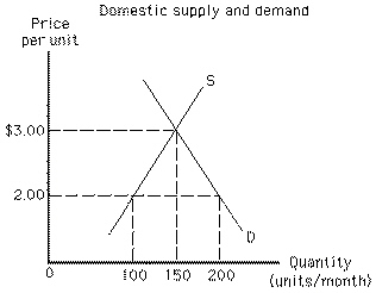 Suppose that the world price in Exhibit 19-7 is $2.00 per unit.What is the smallest import quota that would not affect the level of imports in this country?
 (Multiple Choice)
4.9/5 (80)
(80) Exhibit 19-1  Exhibit 19-1 shows the production possibilities frontiers for the countries of Lambda and Beta for fish and coconuts.What is the opportunity cost of a coconut in Beta?
 (Multiple Choice)
4.8/5 (80)
(80) For each watch Denmark produces, it gives up the opportunity to make 50 pounds of cheese.Germany can produce one watch for every 100 pounds of cheese it produces.Which of the following is true with regard to opportunity costs in the two countries?
(Multiple Choice)
4.8/5 (74)
(74) Exhibit 19-5 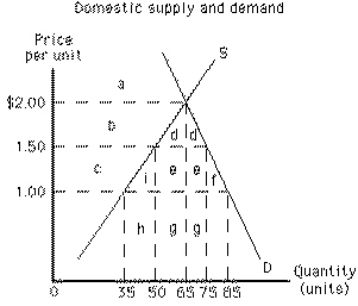 If the country illustrated in Exhibit 19-5 is initially trading without restrictions at a world price of $1.00, net welfare loss as a result of a tariff of $0.50 per unit is represented by area
 (Multiple Choice)
4.9/5 (75)
(75) International trade increases world economic efficiency for the same reasons that domestic trade increases national economic efficiency.
(True/False)
5.0/5 (87)
(87) U.S.auto workers sometimes experience structural unemployment because of the popularity of foreign cars.Which argument is a labor union most likely to present to Congress when it lobbies for trade restrictions?
(Multiple Choice)
4.7/5 (85)
(85) Exhibit 19-6 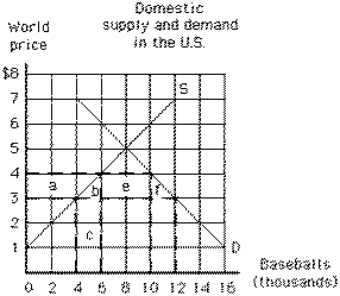 Exhibit 19-6 shows domestic supply and demand for baseballs in the United States.The world price of a baseball is $3.With free trade, how many baseballs will be purchased in the United States?
 (Multiple Choice)
4.9/5 (75)
(75) Exhibit 19-6 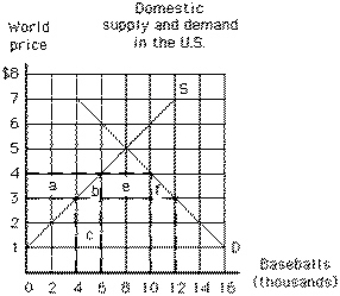 In Exhibit 19-6, if the world price of a baseball is $3 and a tariff of $1 per baseball is imposed in the United States, which area represents the amount of tariff revenue the United States government collects?
 (Multiple Choice)
4.7/5 (93)
(93) Which of the following does not explain why U.S.wage rates are higher than wage rates in developing countries?
(Multiple Choice)
4.9/5 (88)
(88) 
Filters
- Essay(0)
- Multiple Choice(0)
- Short Answer(0)
- True False(0)
- Matching(0)