



 Chat with AI
Exam 19: International Trade

Exam 1: The Art and Science of Economic Analysis162 Questions
Exam 1: Appendix--Understanding Graphs71 Questions
Exam 2: Economic Tools and Economics Systems211 Questions
Exam 3: Economic Decision Makers207 Questions
Exam 4: Demand, Supply, and Markets245 Questions
Exam 5: Elasticity of Demand and Supply244 Questions
Exam 5: Appendix--Price Elasticity and Tax Incidence32 Questions
Exam 6: Consumer Choice and Demand171 Questions
Exam 6: Appendix--Indifference Curves and Utility Maximization107 Questions
Exam 7: Production and Cost in the Firm218 Questions
Exam 8: A--Perfect Competition250 Questions
Exam 8: B--Perfect Competition25 Questions
Exam 9: A--Monopoly249 Questions
Exam 9: B--Monopoly18 Questions
Exam 10: Monopolistic Competition and Oligopoly233 Questions
Exam 11: Resource Markets219 Questions
Exam 12: Labor Markets and Labor Unions218 Questions
Exam 13: Capital, Interest, and Corporate Finance190 Questions
Exam 14: Transaction Costs, Imperfect Information, and Behavioral Economics187 Questions
Exam 15: Economic Regulation and Antitrust Policy179 Questions
Exam 16: Public Goods and Public Choice143 Questions
Exam 17: Externalities and the Environment203 Questions
Exam 18: Income Distribution and Poverty130 Questions
Exam 19: International Trade172 Questions
Exam 20: International Finance226 Questions
Exam 21: Economic Development97 Questions
Select questions type


A tax on imports equal to a percentage of the cost of those imports is known as
(Multiple Choice)
4.8/5  (84)
(84) Exhibit 19-8 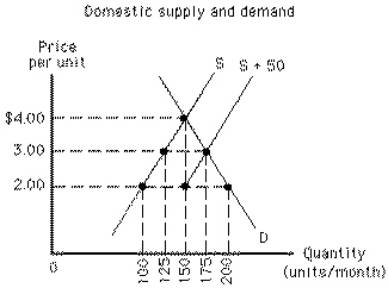 If the country in Exhibit 19-8 is initially trading without restrictions at a world price of $2.00 and an import quota of 50 units per month is enacted,
 (Multiple Choice)
4.9/5 (75)
(75) Exhibit 19-4  In Exhibit 19-4, if the world price of tulips is $1 and there are no trade restrictions, The Netherlands will
 (Multiple Choice)
4.8/5 (76)
(76) Under a tariff, the domestic government gains revenue, but under an import quota it does not, unless it sells the quota rights.
(True/False)
4.8/5 (78)
(78) Which country is the United States' largest trading partner?
(Multiple Choice)
4.8/5 (83)
(83) Which of the following is not a problem with trade restrictions?
(Multiple Choice)
4.9/5 (78)
(78) Tina Makumbi imports sesame oil from Ethiopia and sells to a market that has a downward sloping demand curve.The demand curve indicates that some consumers are willing to pay $1.50 or more per pound for the first few pounds, but every consumer gets to buy at the market clearing price of $0.50 per pound.The difference between the most that consumers would pay and the actual amount they do pay is called
(Multiple Choice)
4.9/5 (75)
(75) Low wages may be traceable to all of the following except one.Which is the exception?
(Multiple Choice)
4.9/5 (82)
(82) Which of the following factors is the most significant in determining the pattern of international trade?
(Multiple Choice)
4.9/5 (71)
(71) International trade between countries typically produces a winner and a loser.Generally, it is the economically more advanced country that gains at the expense of the less developed nation.
(True/False)
4.8/5 (71)
(71) Exhibit 19-1  Exhibit 19-1 shows the production possibilities frontiers for the countries of Lambda and Beta for fish and coconuts.What is the opportunity cost of a coconut in Lambda?
 (Multiple Choice)
4.9/5 (70)
(70) Revenue from a(n)__________ goes to the U.S.government while revenue from a(n)__________ goes to whomever secures the right to sell foreign goods in the U.S.market.
(Multiple Choice)
4.8/5 (75)
(75) The General Agreement on Tariffs and Trade (GATT)was established in
(Multiple Choice)
4.9/5 (75)
(75) For each watch Denmark produces, it gives up the opportunity to make 50 pounds of cheese.Germany can produce one watch for every 100 pounds of cheese it produces.Which of the following is true with regard to opportunity costs in the two countries?
(Multiple Choice)
4.9/5 (81)
(81) 
Filters
- Essay(0)
- Multiple Choice(0)
- Short Answer(0)
- True False(0)
- Matching(0)