



 Chat with AI
Exam 19: International Trade

Exam 1: The Art and Science of Economic Analysis162 Questions
Exam 1: Appendix--Understanding Graphs71 Questions
Exam 2: Economic Tools and Economics Systems211 Questions
Exam 3: Economic Decision Makers207 Questions
Exam 4: Demand, Supply, and Markets245 Questions
Exam 5: Elasticity of Demand and Supply244 Questions
Exam 5: Appendix--Price Elasticity and Tax Incidence32 Questions
Exam 6: Consumer Choice and Demand171 Questions
Exam 6: Appendix--Indifference Curves and Utility Maximization107 Questions
Exam 7: Production and Cost in the Firm218 Questions
Exam 8: A--Perfect Competition250 Questions
Exam 8: B--Perfect Competition25 Questions
Exam 9: A--Monopoly249 Questions
Exam 9: B--Monopoly18 Questions
Exam 10: Monopolistic Competition and Oligopoly233 Questions
Exam 11: Resource Markets219 Questions
Exam 12: Labor Markets and Labor Unions218 Questions
Exam 13: Capital, Interest, and Corporate Finance190 Questions
Exam 14: Transaction Costs, Imperfect Information, and Behavioral Economics187 Questions
Exam 15: Economic Regulation and Antitrust Policy179 Questions
Exam 16: Public Goods and Public Choice143 Questions
Exam 17: Externalities and the Environment203 Questions
Exam 18: Income Distribution and Poverty130 Questions
Exam 19: International Trade172 Questions
Exam 20: International Finance226 Questions
Exam 21: Economic Development97 Questions
Select questions type


Exhibit 19-4  In Exhibit 19-4, if the world price of tulips is $4 and there are no trade restrictions, The Netherlands will
 (Multiple Choice)
4.8/5  (66)
(66) Exhibit 19-2
 In Exhibit 19-2, the United States has a comparative advantage in the production of rice.
 (True/False)
4.8/5 (83)
(83) Exhibit 19-6 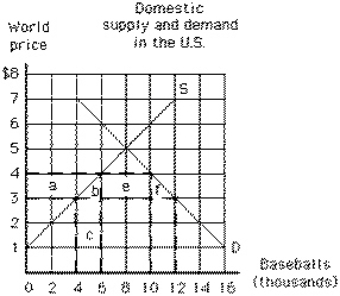 In Exhibit 19-6, if the world price of a baseball is $3 and a tariff of $1 per baseball is imposed in the United States, how many baseballs will the United States import?
 (Multiple Choice)
4.8/5 (71)
(71) If there are no trade restrictions, a country will import a particular good if
(Multiple Choice)
4.7/5 (75)
(75) Which of the following is not an argument in favor of restricting trade?
(Multiple Choice)
4.9/5 (93)
(93) Exhibit 19-2
 In Exhibit 19-2, Costa Rica has a comparative advantage in the production of rice.
 (True/False)
4.9/5 (80)
(80) Exhibit 19-3  In Exhibit 19-3, if the world price of corn is $6 and there are no trade restrictions, the United States will
 (Multiple Choice)
5.0/5 (78)
(78) Quotas and tariffs discourage foreign governments from retaliating with quotas and tariffs of their own.
(True/False)
4.9/5 (73)
(73) Exhibit 19-3  In Exhibit 19-3, if the world price of corn is $2 and there are no trade restrictions, the United States will
 (Multiple Choice)
4.7/5 (79)
(79) A major U.S.motive for negotiating a free-trade agreement with Mexico was to
(Multiple Choice)
4.7/5 (84)
(84) A nation's producers can compete effectively with imports from other nations if it has
(Multiple Choice)
5.0/5 (83)
(83) Exhibit 19-5 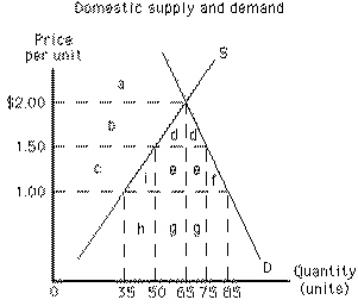 In Exhibit 19-5, with a tariff of $0.50 per unit and a world price of $1.00,
 (Multiple Choice)
4.9/5 (79)
(79) The United States exports more raw materials than finished products.
(True/False)
4.9/5 (94)
(94) 
Filters
- Essay(0)
- Multiple Choice(0)
- Short Answer(0)
- True False(0)
- Matching(0)