



 Chat with AI
Exam 19: International Trade

Exam 1: The Art and Science of Economic Analysis162 Questions
Exam 1: Appendix--Understanding Graphs71 Questions
Exam 2: Economic Tools and Economics Systems211 Questions
Exam 3: Economic Decision Makers207 Questions
Exam 4: Demand, Supply, and Markets245 Questions
Exam 5: Elasticity of Demand and Supply244 Questions
Exam 5: Appendix--Price Elasticity and Tax Incidence32 Questions
Exam 6: Consumer Choice and Demand171 Questions
Exam 6: Appendix--Indifference Curves and Utility Maximization107 Questions
Exam 7: Production and Cost in the Firm218 Questions
Exam 8: A--Perfect Competition250 Questions
Exam 8: B--Perfect Competition25 Questions
Exam 9: A--Monopoly249 Questions
Exam 9: B--Monopoly18 Questions
Exam 10: Monopolistic Competition and Oligopoly233 Questions
Exam 11: Resource Markets219 Questions
Exam 12: Labor Markets and Labor Unions218 Questions
Exam 13: Capital, Interest, and Corporate Finance190 Questions
Exam 14: Transaction Costs, Imperfect Information, and Behavioral Economics187 Questions
Exam 15: Economic Regulation and Antitrust Policy179 Questions
Exam 16: Public Goods and Public Choice143 Questions
Exam 17: Externalities and the Environment203 Questions
Exam 18: Income Distribution and Poverty130 Questions
Exam 19: International Trade172 Questions
Exam 20: International Finance226 Questions
Exam 21: Economic Development97 Questions
Select questions type


Which of the following is not a basis for trade between two nations?
(Multiple Choice)
4.8/5  (78)
(78) For each watch Denmark produces, it gives up the opportunity to make 50 pounds of cheese.Germany can produce one watch for every 100 pounds of cheese it produces.Which of the following is true concerning production possibilities curves in both countries?
(Multiple Choice)
4.8/5 (79)
(79) Exhibit 19-1  Exhibit 19-1 shows the production possibilities frontiers for the countries of Lambda and Beta for fish and coconuts.Lambda has a comparative advantage in coconuts and Beta has a comparative advantage in fish.
 (True/False)
4.7/5 (70)
(70) Exhibit 19-3  In Exhibit 19-3, if the world price of corn is $2 and there are no trade restrictions, the United States will
 (Multiple Choice)
4.9/5 (81)
(81) Exhibit 19-6 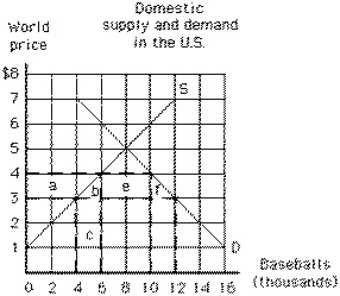 In Exhibit 19-6, the world price of a baseball is $3.With free trade, how many baseballs will the United States import?
 (Multiple Choice)
4.9/5 (85)
(85) Which of the following is not true of declining industries?
(Multiple Choice)
4.9/5 (87)
(87) Exhibit 19-9 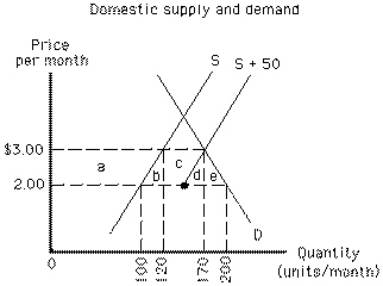 If the country in Exhibit 19-9 is initially trading without restrictions at a world price of $2.00 and an import quota of 50 units per month is enacted, the decrease in consumer surplus can be represented by area
 (Multiple Choice)
4.9/5 (87)
(87) Dumping refers to selling a commodity abroad at a price that is below its cost of production or below the price charged in the domestic market.
(True/False)
4.9/5 (88)
(88) Japan is generally considered an economy closed to foreign trade.
(True/False)
4.8/5 (80)
(80) One reason for international specialization in production is
(Multiple Choice)
5.0/5 (70)
(70) One reason for international specialization in production is
(Multiple Choice)
4.9/5 (91)
(91) Exhibit 19-5 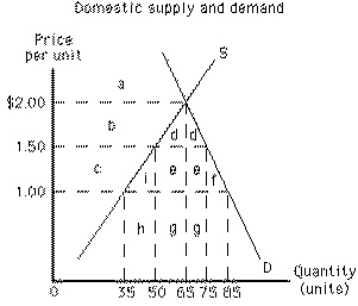 If the country illustrated in Exhibit 19-5 is initially trading without restrictions at a world price of $1.00, the loss of consumer surplus as a result of a tariff of $0.50 per unit is represented by area
 (Multiple Choice)
4.8/5 (82)
(82) When a country establishes trade restrictions, domestic producers of goods that compete with imported goods
(Multiple Choice)
4.9/5 (80)
(80) 
Filters
- Essay(0)
- Multiple Choice(0)
- Short Answer(0)
- True False(0)
- Matching(0)