



 Chat with AI
Exam 6: Consumer Choice and Demand

Exam 1: The Art and Science of Economic Analysis162 Questions
Exam 1: Appendix--Understanding Graphs71 Questions
Exam 2: Economic Tools and Economics Systems211 Questions
Exam 3: Economic Decision Makers207 Questions
Exam 4: Demand, Supply, and Markets245 Questions
Exam 5: Elasticity of Demand and Supply244 Questions
Exam 5: Appendix--Price Elasticity and Tax Incidence32 Questions
Exam 6: Consumer Choice and Demand171 Questions
Exam 6: Appendix--Indifference Curves and Utility Maximization107 Questions
Exam 7: Production and Cost in the Firm218 Questions
Exam 8: A--Perfect Competition250 Questions
Exam 8: B--Perfect Competition25 Questions
Exam 9: A--Monopoly249 Questions
Exam 9: B--Monopoly18 Questions
Exam 10: Monopolistic Competition and Oligopoly233 Questions
Exam 11: Resource Markets219 Questions
Exam 12: Labor Markets and Labor Unions218 Questions
Exam 13: Capital, Interest, and Corporate Finance190 Questions
Exam 14: Transaction Costs, Imperfect Information, and Behavioral Economics187 Questions
Exam 15: Economic Regulation and Antitrust Policy179 Questions
Exam 16: Public Goods and Public Choice143 Questions
Exam 17: Externalities and the Environment203 Questions
Exam 18: Income Distribution and Poverty130 Questions
Exam 19: International Trade172 Questions
Exam 20: International Finance226 Questions
Exam 21: Economic Development97 Questions
Select questions type


Your willingness to pay additional money for time-saving goods depends primarily on
(Multiple Choice)
4.8/5  (78)
(78) Basil is maximizing his utility from consuming tea and crumpets.If the marginal utility of the last crumpet was 32 units of utility and the prices of tea and crumpets are $4 and $8, respectively, what was the marginal utility of the last cup of tea Basil consumed?
(Multiple Choice)
4.8/5 (82)
(82) Exhibit 6-11 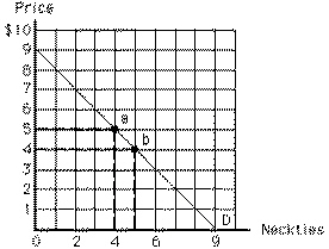 At point b in Exhibit 6-11, total utility is valued at
 (Multiple Choice)
4.8/5 (83)
(83) Suppose that for Jason the marginal utility of $50-per-serving caviar is 100 and the marginal utility of $1-per-serving popcorn is 10.For his snack, Jason should buy
(Multiple Choice)
4.9/5 (95)
(95) Newspaper vending machines illustrate that publishers believe
(Multiple Choice)
4.9/5 (79)
(79) Exhibit 6-1  Consider Exhibit 6-1 which shows the total utility derived from various numbers of glasses of milk consumed in a day.Which of the following statements is true?
 (Multiple Choice)
4.8/5 (79)
(79) Exhibit 6-9  Suppose you have $30 to spend on either bowling or billiards.A game of billiards costs you $4, and bowling costs $2 per game.Using the information in Exhibit 6-9, determine the utility-maximizing combination of bowling and billiards.
 (Multiple Choice)
4.8/5 (79)
(79) A decrease in price along the elastic segment of a demand curve will
(Multiple Choice)
4.9/5 (81)
(81) In terms of utility theory, "equilibrium" in the real world means that
(Multiple Choice)
4.9/5 (66)
(66) Suppose you have spent your entire budget and, for all the goods you purchase, the marginal utilities per dollar spent are identical.Which of the following is true?
(Multiple Choice)
4.9/5 (90)
(90) Suppose you go to a wedding reception that has free drinks.What is likely to be the marginal utility of the last drink you had?
(Multiple Choice)
4.8/5 (89)
(89) If other things constant, as more bananas are consumed, marginal utility eventually
(Multiple Choice)
4.9/5 (87)
(87) Exhibit 6-21 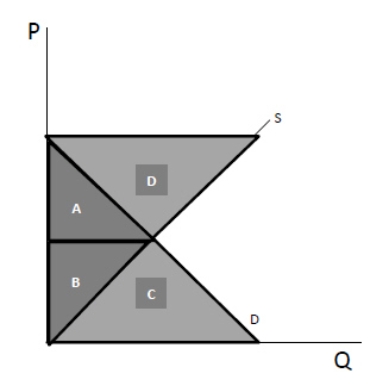 Refer to Exhibit 6-21.When this market is in equilibrium, the consumer surplus will be area
 (True/False)
4.8/5 (85)
(85) If MUx/Px > MUy/Pyx, the consumer can increase utility by buying more of good x.
(True/False)
5.0/5 (72)
(72) A business executive who buys a portable computer so that she can work on airplanes is trying to reduce the cost of traveling.
(True/False)
5.0/5 (79)
(79) Exhibit 6-15 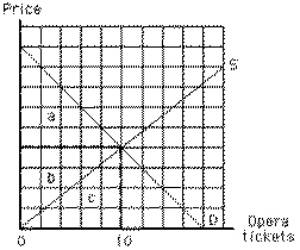 Which area in Exhibit 6-15 represents consumer surplus at market equilibrium?
 (Multiple Choice)
5.0/5 (91)
(91) 
Filters
- Essay(0)
- Multiple Choice(0)
- Short Answer(0)
- True False(0)
- Matching(0)