



 Chat with AI
Exam 6: Consumer Choice and Demand

Exam 1: The Art and Science of Economic Analysis162 Questions
Exam 1: Appendix--Understanding Graphs71 Questions
Exam 2: Economic Tools and Economics Systems211 Questions
Exam 3: Economic Decision Makers207 Questions
Exam 4: Demand, Supply, and Markets245 Questions
Exam 5: Elasticity of Demand and Supply244 Questions
Exam 5: Appendix--Price Elasticity and Tax Incidence32 Questions
Exam 6: Consumer Choice and Demand171 Questions
Exam 6: Appendix--Indifference Curves and Utility Maximization107 Questions
Exam 7: Production and Cost in the Firm218 Questions
Exam 8: A--Perfect Competition250 Questions
Exam 8: B--Perfect Competition25 Questions
Exam 9: A--Monopoly249 Questions
Exam 9: B--Monopoly18 Questions
Exam 10: Monopolistic Competition and Oligopoly233 Questions
Exam 11: Resource Markets219 Questions
Exam 12: Labor Markets and Labor Unions218 Questions
Exam 13: Capital, Interest, and Corporate Finance190 Questions
Exam 14: Transaction Costs, Imperfect Information, and Behavioral Economics187 Questions
Exam 15: Economic Regulation and Antitrust Policy179 Questions
Exam 16: Public Goods and Public Choice143 Questions
Exam 17: Externalities and the Environment203 Questions
Exam 18: Income Distribution and Poverty130 Questions
Exam 19: International Trade172 Questions
Exam 20: International Finance226 Questions
Exam 21: Economic Development97 Questions
Select questions type


Exhibit 6-11 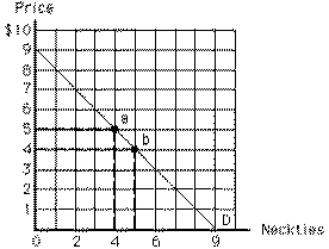 At point a in Exhibit 6-11, total expenditure on neckties is
 (Multiple Choice)
4.8/5  (87)
(87) If MUx/Px > MUy/Py, the consumer can increase utility by buying less of good y, which means the MUy will rise.
(True/False)
4.9/5 (82)
(82) Which of the following statements cannot be made regarding consumer preferences?
(Multiple Choice)
4.8/5 (72)
(72) The law of diminishing marginal utility states that as you consume more and more of a good, other things constant,
(Multiple Choice)
4.9/5 (67)
(67) Exhibit 6-5  In Exhibit 6-5, the marginal utility of consuming the fourth scone is
 (Multiple Choice)
4.7/5 (73)
(73) Exhibit 6-15 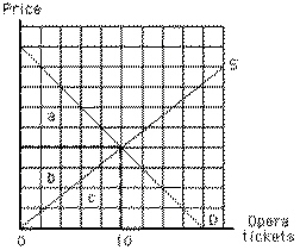 Which area in Exhibit 6-15 represents the maximum amount that consumers are willing to pay for 10 opera tickets?
 (Multiple Choice)
5.0/5 (71)
(71) The difference between the maximum amount a person is willing to pay for a given quantity of a good and the amount actually paid for that quantity is called
(Multiple Choice)
4.9/5 (82)
(82) "The marginal utility received from each additional unit of a good consumed declines, other things constant." This is a statement of the law of
(Multiple Choice)
4.9/5 (88)
(88) Exhibit 6-18 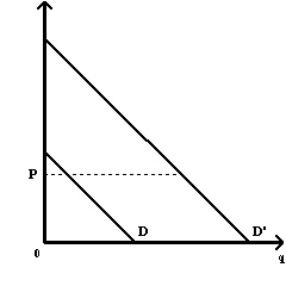 On a normal day, Emily Mapai's demand curve for a cup of hot chocolate is initially shown as D in Exhibit 6-18.On a day when the high temperature does not get above zero degrees, her demand curve increases to D'.At a price P for a cup of hot chocolate, Emily's consumer surplus on a freezing day
 (Multiple Choice)
4.9/5 (88)
(88) Exhibit 6-12 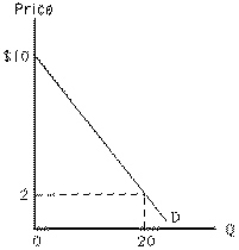 In Exhibit 6-12, at a price of $2, consumer surplus is
 (Multiple Choice)
4.9/5 (88)
(88) Which of the following statements concerning utility is correct?
(Multiple Choice)
4.8/5 (79)
(79) After paying admission and entering King's Island Amusement Park near Cincinnati, Alan Fujiwara sees a list of waiting times for each attraction and ride.At this point, Alan's marginal dollar cost is
(Multiple Choice)
4.8/5 (85)
(85) If Debbye is willing to pay $50 for a pair of shoes but only has to pay $20 because the shoes are on sale, then her consumer surplus on that pair of shoes is
(Multiple Choice)
4.8/5 (94)
(94) Which of the following must be true of an attorney who buys a portable computer so that she can work on trains and planes?
(Multiple Choice)
4.9/5 (92)
(92) When a consumer spends income so that the ratio of marginal utilities (MUs)of all goods purchased equals the ratio of their prices, the consumer is
(Multiple Choice)
4.8/5 (81)
(81) 
Filters
- Essay(0)
- Multiple Choice(0)
- Short Answer(0)
- True False(0)
- Matching(0)