



 Chat with AI
Exam 6: Consumer Choice and Demand

Exam 1: The Art and Science of Economic Analysis162 Questions
Exam 1: Appendix--Understanding Graphs71 Questions
Exam 2: Economic Tools and Economics Systems211 Questions
Exam 3: Economic Decision Makers207 Questions
Exam 4: Demand, Supply, and Markets245 Questions
Exam 5: Elasticity of Demand and Supply244 Questions
Exam 5: Appendix--Price Elasticity and Tax Incidence32 Questions
Exam 6: Consumer Choice and Demand171 Questions
Exam 6: Appendix--Indifference Curves and Utility Maximization107 Questions
Exam 7: Production and Cost in the Firm218 Questions
Exam 8: A--Perfect Competition250 Questions
Exam 8: B--Perfect Competition25 Questions
Exam 9: A--Monopoly249 Questions
Exam 9: B--Monopoly18 Questions
Exam 10: Monopolistic Competition and Oligopoly233 Questions
Exam 11: Resource Markets219 Questions
Exam 12: Labor Markets and Labor Unions218 Questions
Exam 13: Capital, Interest, and Corporate Finance190 Questions
Exam 14: Transaction Costs, Imperfect Information, and Behavioral Economics187 Questions
Exam 15: Economic Regulation and Antitrust Policy179 Questions
Exam 16: Public Goods and Public Choice143 Questions
Exam 17: Externalities and the Environment203 Questions
Exam 18: Income Distribution and Poverty130 Questions
Exam 19: International Trade172 Questions
Exam 20: International Finance226 Questions
Exam 21: Economic Development97 Questions
Select questions type


As a consumer buys more of a good, total utility eventually becomes negative.
(True/False)
4.9/5  (89)
(89) If the price of a good falls, the marginal utility per dollar received from consuming a specific unit of that good
(Multiple Choice)
4.8/5 (72)
(72) Suppose that Hannah spends $3 to buy five biscuits.The marginal utility of the fifth biscuit is valued at $0.60; total utility of the five biscuits is valued at $4.20.Given this information, what do we know about consumer surplus?
(Multiple Choice)
4.9/5 (85)
(85) Suppose you want to get to Orlando, Florida, for the week-long spring break.You can get there in two and one-half days by bus, and back in another two and one-half days.This will cost you $20 round-trip.You can fly there and back in four hours each way.This will cost $200.Which of the following is not true?
(Multiple Choice)
4.7/5 (66)
(66) Exhibit 6-11 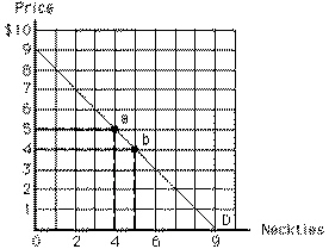 At point a in Exhibit 6-11, the monetary value that approximates the total utility received is
 (Multiple Choice)
4.9/5 (70)
(70) Exhibit 6-5  In Exhibit 6-5, the marginal utility of consuming the first scone is
 (Multiple Choice)
4.8/5 (77)
(77) When income is allocated to two goods, x and y, consumer equilibrium occurs when
(Multiple Choice)
4.8/5 (82)
(82) If by purchasing a little more milk and a little less ice cream you could increase your total utility,
(Multiple Choice)
4.9/5 (77)
(77) Different people may have different tastes, but their tastes do not change over time.
(True/False)
4.7/5 (89)
(89) Exhibit 6-5  In Exhibit 6-5, the marginal utility of consuming the second scone is
 (Multiple Choice)
4.7/5 (79)
(79) One reason why a consumer might buy from a high-priced local hardware store instead of going to a big discount store several miles away in another community is that
(Multiple Choice)
4.9/5 (79)
(79) When residential water users are charged a flat monthly rate for water, the marginal cost of an extra thousand gallons of water to a household is zero.
(True/False)
4.8/5 (79)
(79) Exhibit 6-19 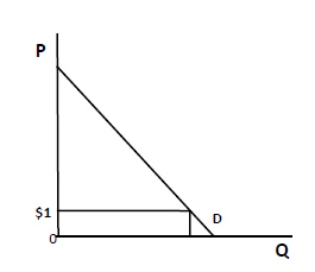 Refer to Exhibit 6-19, which is a demand curve for Medicare benefits.A $1 payment for services would reduce utilization, yet would still leave beneficiaries with a substantial consumer surplus.
 (True/False)
4.8/5 (59)
(59) People who use drive-through windows at restaurants and eat while on the road tend to
(Multiple Choice)
4.9/5 (76)
(76) Exhibit 6-2  Consider Exhibit 6-2 which shows the marginal utility of consuming milk.The total utility from 3 glasses of milk is
 (Multiple Choice)
4.7/5 (79)
(79) 
Filters
- Essay(0)
- Multiple Choice(0)
- Short Answer(0)
- True False(0)
- Matching(0)