



 Chat with AI
Exam 6: Consumer Choice and Demand

Exam 1: The Art and Science of Economic Analysis162 Questions
Exam 1: Appendix--Understanding Graphs71 Questions
Exam 2: Economic Tools and Economics Systems211 Questions
Exam 3: Economic Decision Makers207 Questions
Exam 4: Demand, Supply, and Markets245 Questions
Exam 5: Elasticity of Demand and Supply244 Questions
Exam 5: Appendix--Price Elasticity and Tax Incidence32 Questions
Exam 6: Consumer Choice and Demand171 Questions
Exam 6: Appendix--Indifference Curves and Utility Maximization107 Questions
Exam 7: Production and Cost in the Firm218 Questions
Exam 8: A--Perfect Competition250 Questions
Exam 8: B--Perfect Competition25 Questions
Exam 9: A--Monopoly249 Questions
Exam 9: B--Monopoly18 Questions
Exam 10: Monopolistic Competition and Oligopoly233 Questions
Exam 11: Resource Markets219 Questions
Exam 12: Labor Markets and Labor Unions218 Questions
Exam 13: Capital, Interest, and Corporate Finance190 Questions
Exam 14: Transaction Costs, Imperfect Information, and Behavioral Economics187 Questions
Exam 15: Economic Regulation and Antitrust Policy179 Questions
Exam 16: Public Goods and Public Choice143 Questions
Exam 17: Externalities and the Environment203 Questions
Exam 18: Income Distribution and Poverty130 Questions
Exam 19: International Trade172 Questions
Exam 20: International Finance226 Questions
Exam 21: Economic Development97 Questions
Select questions type


The law of diminishing marginal utility implies that the marginal utility of my fifth hot dog is less than the marginal utility of my second soft drink, other things constant.
(True/False)
4.8/5  (85)
(85) A consumer maximizes utility when the marginal utilities of all goods
(Multiple Choice)
4.8/5 (84)
(84) When a service, such as medical care, is provided free of charge,
(Multiple Choice)
4.8/5 (78)
(78) Exhibit 6-17 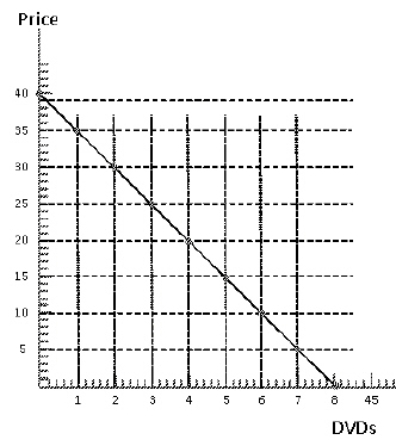 Consider Exhibit 6-17 which represents the market demand for DVDs.If the price of DVDs increases from $20 to $25, what happens to consumer's surplus?
 (Multiple Choice)
4.9/5 (99)
(99) What happens to consumer surplus as price falls along a given demand curve?
(Multiple Choice)
4.8/5 (87)
(87) Exhibit 6-16 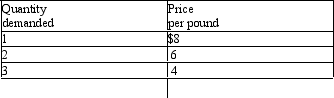 Exhibit 6-16 shows Reggie's demand for apples.If there are 100 people in this economy, and each has the same demand for apples as Reggie, what is the total quantity demanded in the market for apples at P = $6?
 (Multiple Choice)
4.8/5 (71)
(71) Exhibit 6-1  Consider Exhibit 6-1 which shows the total utility derived from various numbers of glasses of milk consumed in a day.The marginal utility of the second glass of milk is
 (Multiple Choice)
4.9/5 (90)
(90) If MUx/Px > MUy/Py, the consumer can increase utility by buying more of good x, which will cause the MUx to rise.
(True/False)
4.8/5 (68)
(68) If Arnold thinks his last dollar spent golfing yields less satisfaction than the last dollar spent on movies, and Arnold is a utility-maximizing consumer, he should
(Multiple Choice)
4.9/5 (87)
(87) Exhibit 6-20 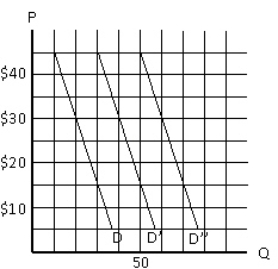 Refer to Exhibit 6-20.If D, D' and D'' represent the demand curvesfor the only three consumers in a market, then the market demand curve will be more _________ than each of the three individual demand curves.
 (Multiple Choice)
4.9/5 (89)
(89) Time has a positive value for most people, but their opportunity costs of time differ.
(True/False)
4.8/5 (77)
(77) If the marginal utility of each good a consumer buys does not diminish but remains constant, we should see consumers
(Multiple Choice)
4.9/5 (68)
(68) The market demand curve is the sum of individual quantities demanded at each price.
(True/False)
4.8/5 (72)
(72) In order to derive a demand curve for cheese, we would change
(Multiple Choice)
4.9/5 (82)
(82) Exhibit 6-1  Consider Exhibit 6-1 which shows the total utility derived from various numbers of glasses of milk consumed in a day.The total utility curve does not exhibit diminishiung returns.
 (True/False)
4.8/5 (86)
(86) Requiring Medicare participants to pay a small fraction of the cost of their medical care
(Multiple Choice)
4.9/5 (87)
(87) 
Filters
- Essay(0)
- Multiple Choice(0)
- Short Answer(0)
- True False(0)
- Matching(0)