



 Chat with AI
Exam 23: Carbohydrates and Nucleic Acids

Exam 1: Structure and Bonding127 Questions
Exam 2: Acids and Bases; Functional Groups136 Questions
Exam 3: Structure and Stereochemistry of Alkanes134 Questions
Exam 4: The Study of Chemical Reactions128 Questions
Exam 5: Stereochemistry132 Questions
Exam 6: Alkyl Halides; Nucleophilic Substitution137 Questions
Exam 7: Structure and Synthesis of Alkenes; Elimination131 Questions
Exam 8: Reactions of Alkenes134 Questions
Exam 10: Structure and Synthesis of Alcohols136 Questions
Exam 11: Reactions of Alcohols125 Questions
Exam 12: Infrared Spectroscopy and Mass Spectrometry121 Questions
Exam 13: Nuclear Magnetic Resonance Spectroscopy130 Questions
Exam 14: Ethers, Epoxides, and Thioethers127 Questions
Exam 15: Conjugated Systems, Orbital Symmetry, and Ultraviolet Spectroscopy130 Questions
Exam 16: Aromatic Compounds128 Questions
Exam 17: Reactions of Aromatic Compounds129 Questions
Exam 18: Ketones and Aldehydes131 Questions
Exam 19: Amines127 Questions
Exam 20: Carboxylic Acids125 Questions
Exam 21: Carboxylic Acid Derivatives130 Questions
Exam 22: Condensations and Alpha Substitutions of Carboxyl Compounds127 Questions
Exam 23: Carbohydrates and Nucleic Acids126 Questions
Exam 24: Amino Acids, Peptides, and Proteins127 Questions
Exam 25: Lipids127 Questions
Exam 26: Synthetic Polymers128 Questions
Select questions type


An optically active D-aldopentose produced an optically active alditol upon treatment with NaBH4. When this aldopentose was subjected to a Ruff degradation, a D-aldotetrosewas generated. This aldotetrose gave an optically active aldaric acid upon oxidation with HNO3. Use these data to provide the structure of the starting D-aldopentose.
(Essay)
4.9/5  (70)
(70) When preserving foods, sucrose is more commonly used as a sweetener than glucose. Why is this?
(Essay)
4.9/5 (69)
(69) Show the hydrogen bonding which occurs when guanine and cytosine form a base pair.
(Essay)
4.8/5 (83)
(83) Which of the following descriptions apply to both D-glucopyranose and L-galactopyranose?
I. They are both ketoses
II. They are both aldoses
III. They are enantiomers of each other
IV. They are diastereomers of each other
V. They are epimers of each other
(Multiple Choice)
4.9/5 (84)
(84) Besides a possible difference in base structure, what is the major structural difference between ribo- and deoxyribonucleosides?
(Essay)
4.8/5 (72)
(72) Would the disaccharide shown below give a positive Tollin's test? 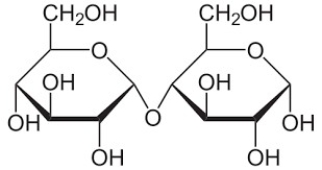
(Short Answer)
4.9/5 (96)
(96) The first step of glycolysis is the keto-enol tautomerization of the 6-phosphate ester of D-glucose. Draw the product of this reaction.
(Essay)
4.9/5 (73)
(73) Which structure shows the 3 residue segment of DNA with the following sequence: (3' end) GAT (5' end)?
(Multiple Choice)
4.9/5 (88)
(88) What nucleophilic carbon species is used in the Kiliani-Fischer synthesis?
(Short Answer)
4.9/5 (85)
(85) A diastereomer is called erythro if its Fischer projection shows similar groups ________.
(Multiple Choice)
4.8/5 (75)
(75) Which of the following correctly describes the structural relationship between D-gulose and L-gulose?
(Multiple Choice)
4.9/5 (70)
(70) What D-aldopentose results when D-allose undergoes a Ruff degradation?
(Short Answer)
4.8/5 (81)
(81) Which of the following descriptions of the nucleoside uridine does not apply to the structure of the molecule?
(Multiple Choice)
4.7/5 (74)
(74) 
Filters
- Essay(0)
- Multiple Choice(0)
- Short Answer(0)
- True False(0)
- Matching(0)