



 Chat with AI
Exam 23: Carbohydrates and Nucleic Acids

Exam 1: Structure and Bonding127 Questions
Exam 2: Acids and Bases; Functional Groups136 Questions
Exam 3: Structure and Stereochemistry of Alkanes134 Questions
Exam 4: The Study of Chemical Reactions128 Questions
Exam 5: Stereochemistry132 Questions
Exam 6: Alkyl Halides; Nucleophilic Substitution137 Questions
Exam 7: Structure and Synthesis of Alkenes; Elimination131 Questions
Exam 8: Reactions of Alkenes134 Questions
Exam 10: Structure and Synthesis of Alcohols136 Questions
Exam 11: Reactions of Alcohols125 Questions
Exam 12: Infrared Spectroscopy and Mass Spectrometry121 Questions
Exam 13: Nuclear Magnetic Resonance Spectroscopy130 Questions
Exam 14: Ethers, Epoxides, and Thioethers127 Questions
Exam 15: Conjugated Systems, Orbital Symmetry, and Ultraviolet Spectroscopy130 Questions
Exam 16: Aromatic Compounds128 Questions
Exam 17: Reactions of Aromatic Compounds129 Questions
Exam 18: Ketones and Aldehydes131 Questions
Exam 19: Amines127 Questions
Exam 20: Carboxylic Acids125 Questions
Exam 21: Carboxylic Acid Derivatives130 Questions
Exam 22: Condensations and Alpha Substitutions of Carboxyl Compounds127 Questions
Exam 23: Carbohydrates and Nucleic Acids126 Questions
Exam 24: Amino Acids, Peptides, and Proteins127 Questions
Exam 25: Lipids127 Questions
Exam 26: Synthetic Polymers128 Questions
Select questions type


Which of the following correctly describes the structural relationship between D-ribose and L-lyxose?
(Multiple Choice)
4.8/5  (80)
(80) Provide the Fischer projection of the open-chain form of the aldonic acid which results when L-glucose is treated with bromine water.
(Essay)
4.8/5 (94)
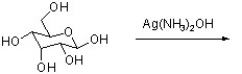
(94) 
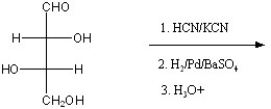
How might one separate α-D-glucopyranose from a solution also containing 
(Essay)
4.8/5 (72)
(72) Provide the structure of the product which results when D-ribose is treated with bromine water.
(Essay)
4.9/5 (86)
(86) An optically active D-aldopentose produced an optically inactive aldaric acid upon treatment with HNO3. When this aldopentose was subjected to a Ruff degradation, a D-aldotetrose was generated. This aldotetrose gave an optically inactive alditol upon reduction with NaBH4. Use these data to provide the structure of the starting D-aldopentose.
(Essay)
4.7/5 (77)
(77) When pure α-D-glucopyranose is dissolved in water, the optical rotation of the resulting solution changes over a period of time. What is the name of this phenomenon and why does it occur?
(Essay)
4.9/5 (78)
(78) Which of the following bond arrangements is not commonly found in naturally occurring disaccharides?
(Multiple Choice)
4.9/5 (86)
(86) How many asymmetric carbons are present in α-D-ribopyranose?
(Multiple Choice)
4.7/5 (90)
(90) The structure of amygdalin is shown below. Will it undergo mutarotation? 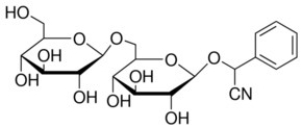
(Essay)
4.8/5 (89)
(89) Ruff degradation of D-glucose followed by oxidation with nitric acid yields the same aldaric acid as does ________ when it is treated with nitric acid.
(Multiple Choice)
4.8/5 (71)
(71) 
Filters
- Essay(0)
- Multiple Choice(0)
- Short Answer(0)
- True False(0)
- Matching(0)