



 Chat with AI
Exam 5: Stereochemistry

Exam 1: Structure and Bonding127 Questions
Exam 2: Acids and Bases; Functional Groups136 Questions
Exam 3: Structure and Stereochemistry of Alkanes134 Questions
Exam 4: The Study of Chemical Reactions128 Questions
Exam 5: Stereochemistry132 Questions
Exam 6: Alkyl Halides; Nucleophilic Substitution137 Questions
Exam 7: Structure and Synthesis of Alkenes; Elimination131 Questions
Exam 8: Reactions of Alkenes134 Questions
Exam 10: Structure and Synthesis of Alcohols136 Questions
Exam 11: Reactions of Alcohols125 Questions
Exam 12: Infrared Spectroscopy and Mass Spectrometry121 Questions
Exam 13: Nuclear Magnetic Resonance Spectroscopy130 Questions
Exam 14: Ethers, Epoxides, and Thioethers127 Questions
Exam 15: Conjugated Systems, Orbital Symmetry, and Ultraviolet Spectroscopy130 Questions
Exam 16: Aromatic Compounds128 Questions
Exam 17: Reactions of Aromatic Compounds129 Questions
Exam 18: Ketones and Aldehydes131 Questions
Exam 19: Amines127 Questions
Exam 20: Carboxylic Acids125 Questions
Exam 21: Carboxylic Acid Derivatives130 Questions
Exam 22: Condensations and Alpha Substitutions of Carboxyl Compounds127 Questions
Exam 23: Carbohydrates and Nucleic Acids126 Questions
Exam 24: Amino Acids, Peptides, and Proteins127 Questions
Exam 25: Lipids127 Questions
Exam 26: Synthetic Polymers128 Questions
Select questions type


How many asymmetric carbons are present in the compound below? 
(Short Answer)
4.7/5  (86)
(86) Draw the structure of (2R,3S)-2,3-dichloropentane. Take particular care to indicate three-dimensional stereochemical detail properly.
(Essay)
4.9/5 (81)
(81) A student measured the optical activity of an unknown sugar at two different concentrations. The results of his measurements are shown below. Given that the sample cell had a path length of 10.0 cm, calculate the specific rotation for the unknown sugar. (Hint: Consider each measurement of plane polarized light has a true reading and a "ghost" reading 180° from the true reading).
Concentration observed rotation
2)00 g sugar in 10.0 mL water +159.1°
5)00 g sugar in 10.0 mL water +127.8°
(Multiple Choice)
4.8/5 (69)
(69) Consider the four substituents below. Order them in decreasing priority according to the Cahn-Ingold-Prelog priority system. (Highest priority is first, lowest is last.)
-CH  CH2, -C(CH3)3, -CH2OH, -COOH
 (Essay)
4.7/5 (79)
(79) Captopril is used to treat high blood pressure and congestive heart failure. Label the chiral centers as R or S. 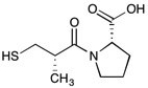
(Essay)
5.0/5 (81)
(81) 
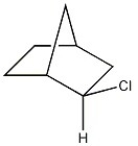
Stereoisomers which are not mirror image isomers are ________.
(Short Answer)
4.8/5 (78)
(78) 
Explain the stereochemical relationship, if any, among the following two structures and describe whether or not they could be theoretically isolated from each other. (Note: Some H atoms are omitted for clarity.) 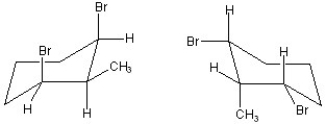
(Essay)
4.7/5 (74)
(74) How many asymmetric carbons are present in the compound below? 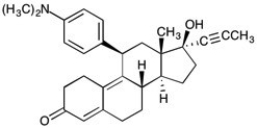
(Short Answer)
4.8/5 (86)
(86) Which of the following terms best describes the pair of compounds shown: enantiomers, diastereomers, or the same compound? 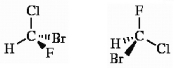
(Short Answer)
4.8/5 (75)
(75) 
Draw the structure of (S)-1-bromo-1-chloropropane. Take particular care to indicate three-dimensional stereochemical detail properly.
(Essay)
5.0/5 (71)
(71) If (S)-glyceraldehyde has a specific rotation of -8.7°, what is the specific rotation of (R)-glyceraldehyde?
(Multiple Choice)
4.7/5 (70)
(70) Is the molecule shown below chiral or achiral? Explain what this means. 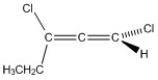
(Essay)
4.9/5 (80)
(80) The process by which enantiomers are separated is called ________.
(Short Answer)
4.8/5 (79)
(79) If possible, draw the structure of any diastereomer of the molecule shown below. 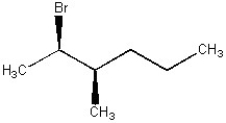
(Essay)
4.9/5 (88)
(88) Would a 50/50 mixture of the two compounds below be optically active? Briefly explain your answer. 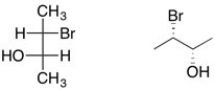
(Essay)
4.9/5 (74)
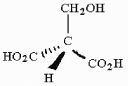
(74) 

Filters
- Essay(0)
- Multiple Choice(0)
- Short Answer(0)
- True False(0)
- Matching(0)