Multiple Choice
Passage
A student performed an experiment to determine the energy content of a sample of potato chips. The chips were blended and then freeze-dried to remove moisture from the sample. Freeze-drying, or lyophilisation, is the preferred dehydration process for food calorimetry due to its minimal impact on nutritional content. Lyophilisation removes water from frozen food samples at low pressure through sublimation. The water is later collected in a cooled condensation chamber to prevent damage to any electric components.After freeze-drying, the sample was ground into a dry homogenous powder. A 1-g sample of the powder was placed in a bomb cell, an enclosed steel-walled container, and pressurized to 25 atm with pure oxygen to ensure complete combustion. The bomb cell was submerged in 500 g of water at room temperature (25°C) in an enclosed and thermally insulated calorimetry device. The sample was combusted using an electric fuse. The temperature of the surrounding water was measured with a glass thermometer every 30 s for several minutes (Figure 1) .
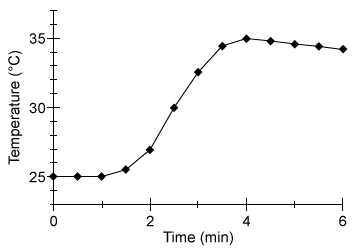 Figure 1 Temperature of the water in the bomb calorimeterThe energy content of food is given in units of dietary calories (Cal) , which is equal to 4.185 kJ, or 1,000 gram calories (cal) . A gram calorie is the amount of energy required to increase 1 g of water by 1°C.
Adapted from Jumpertz R, Venti CA, Le DS, et al., Food label accuracy of common snack foods. Obesity 2013 Wiley-Blackwell.
-For the combustion reaction of the sample into CO2 (g) and H2O (g) in the bomb cell:
A) ΔH and ΔS are both positive.
B) ΔH and ΔS are both negative.
C) ΔH is negative and ΔS is positive.
D) ΔH is positive and ΔS is negative.
Correct Answer:

Verified
Correct Answer:
Verified
Q153: Passage<br>The flow of blood through the human
Q154: Passage<br>Nitrogen is extremely cold in its liquid
Q155: A 100-g block of iron at 31°C
Q156: A cube with a side length of
Q157: Passage<br>In the event of end-stage heart failure,
Q159: Passage<br>Black holes have played an important part
Q160: Passage<br>Sound waves propagate through many conducting structures
Q161: A scientist studying capillary fluid exchange in
Q162: Passage<br>Osteoporosis is a degenerative bone condition in
Q163: <img src="https://d2lvgg3v3hfg70.cloudfront.net/MD0008/.jpg" alt=" A 4-μF capacitor