Solved

Passage Nitrogen Is Extremely Cold in Its Liquid Phase.  It Is

Question 154

Multiple Choice

Passage
Nitrogen is extremely cold in its liquid phase.  It is used in the cryopreservation of small tissue samples and in cryosurgery to freeze and destroy diseased tissues.  Liquid nitrogen can be produced from nitrogen gas using the Hampson-Linde cycle (Figure 1) .
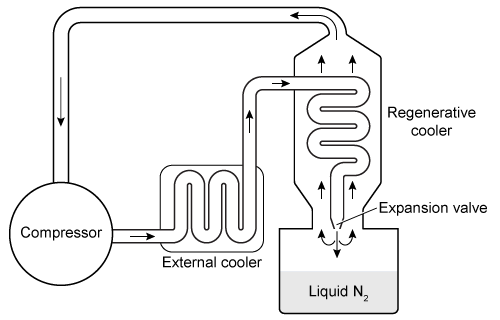
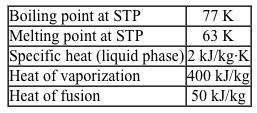
Passage Nitrogen is extremely cold in its liquid phase.  It is used in the cryopreservation of small tissue samples and in cryosurgery to freeze and destroy diseased tissues.  Liquid nitrogen can be produced from nitrogen gas using the Hampson-Linde cycle (Figure 1) .    <strong>Figure 1</strong>  Hampson-Linde cycle apparatus used to liquefy nitrogenThe cycle begins by compressing nitrogen gas and forcing it through a coil in an external cooler that contains dry ice.  The gas proceeds to a heat exchanger, where it cools further due to the countercurrent heat exchange with colder nitrogen gas returning from a later stage of the cycle; this process is known as regenerative cooling.  The gas is subsequently forced through a narrow valve, where it expands and cools significantly upon exiting.  As a result, a portion of the gas becomes liquefied.The temperature change of the gas exiting the valve is described by the Joule-Thomson effect, which occurs without heat transfer with the surroundings.  Finally, the liquefied nitrogen is collected, and the remaining gas is sent through the regenerative cooler back to the compressor to reenter the cycle.  The physical properties of nitrogen are given in Table 1.<strong>Table 1</strong>  Thermal Properties of Nitrogen    -The compressor exerts a pressure of 400 Pa to compress nitrogen gas from 3 L to 1 L.  If no heat transfer occurs, how much will the internal energy of the gas change?  (Note: 1 m<sup>3</sup> = 1000 L.)  A) 0.8 J B) 1.2 J C) 800 J D) 1200 J Figure 1  Hampson-Linde cycle apparatus used to liquefy nitrogenThe cycle begins by compressing nitrogen gas and forcing it through a coil in an external cooler that contains dry ice.  The gas proceeds to a heat exchanger, where it cools further due to the countercurrent heat exchange with colder nitrogen gas returning from a later stage of the cycle; this process is known as regenerative cooling.  The gas is subsequently forced through a narrow valve, where it expands and cools significantly upon exiting.  As a result, a portion of the gas becomes liquefied.The temperature change of the gas exiting the valve is described by the Joule-Thomson effect, which occurs without heat transfer with the surroundings.  Finally, the liquefied nitrogen is collected, and the remaining gas is sent through the regenerative cooler back to the compressor to reenter the cycle.  The physical properties of nitrogen are given in Table 1.Table 1  Thermal Properties of Nitrogen
Passage Nitrogen is extremely cold in its liquid phase.  It is used in the cryopreservation of small tissue samples and in cryosurgery to freeze and destroy diseased tissues.  Liquid nitrogen can be produced from nitrogen gas using the Hampson-Linde cycle (Figure 1) .    <strong>Figure 1</strong>  Hampson-Linde cycle apparatus used to liquefy nitrogenThe cycle begins by compressing nitrogen gas and forcing it through a coil in an external cooler that contains dry ice.  The gas proceeds to a heat exchanger, where it cools further due to the countercurrent heat exchange with colder nitrogen gas returning from a later stage of the cycle; this process is known as regenerative cooling.  The gas is subsequently forced through a narrow valve, where it expands and cools significantly upon exiting.  As a result, a portion of the gas becomes liquefied.The temperature change of the gas exiting the valve is described by the Joule-Thomson effect, which occurs without heat transfer with the surroundings.  Finally, the liquefied nitrogen is collected, and the remaining gas is sent through the regenerative cooler back to the compressor to reenter the cycle.  The physical properties of nitrogen are given in Table 1.<strong>Table 1</strong>  Thermal Properties of Nitrogen    -The compressor exerts a pressure of 400 Pa to compress nitrogen gas from 3 L to 1 L.  If no heat transfer occurs, how much will the internal energy of the gas change?  (Note: 1 m<sup>3</sup> = 1000 L.)  A) 0.8 J B) 1.2 J C) 800 J D) 1200 J
-The compressor exerts a pressure of 400 Pa to compress nitrogen gas from 3 L to 1 L.  If no heat transfer occurs, how much will the internal energy of the gas change?  (Note: 1 m3 = 1000 L.)


A) 0.8 J
B) 1.2 J
C) 800 J
D) 1200 J

Correct Answer:

verifed

Verified

Unlock this answer now
Get Access to more Verified Answers free of charge

Related Questions