Multiple Choice
Passage
In the event of end-stage heart failure, a left ventricular assist device (LVAD) can be used as a heart transplant bridge to keep a patient alive. The first iterations of LVADs were pulsatile and mimicked the physiological pumping action of the heart (Figure 1) .
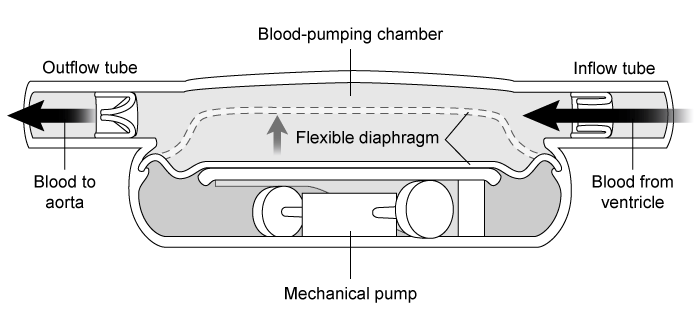 Figure 1 A pulsatile-flow LVAD schematicA pulsatile-flow LVAD assists ventricular systole by mechanically pumping blood from a weakened left ventricle into the aorta through a pair of one-way valves. The pressure differential ΔP generated by the pump is related to cardiac output (CO) and vascular resistance (VR) :ΔP = CO × VREquation 1The efficiency and performance of the heart (or LVAD) can be determined by the patient's cardiac pressure-volume (PV) loop. A cardiac PV loop plots the pressure and volume of the blood in the left ventricle throughout a single cardiac cycle (Figure 2) .
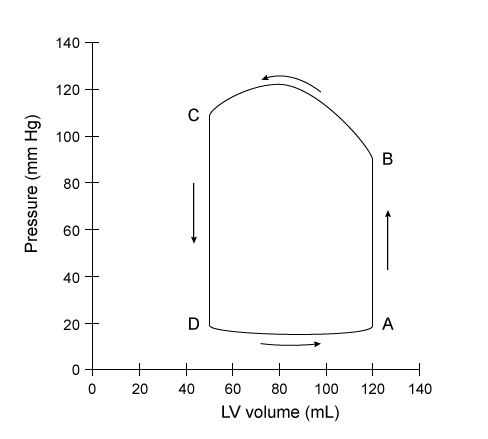 Figure 2 Cardiac PV Loop of a pulsatile-flow LVADBlood pressure is often represented by only two numbers: arterial systolic and diastolic pressures. A more detailed representation of blood pressures is shown in a blood pressure profile, which graphs the blood pressure throughout the length of the different vessel groups (Figure 3) . Multiple pressure fluctuations are shown within a vessel because the pressure is traced across multiple cardiac cycles.
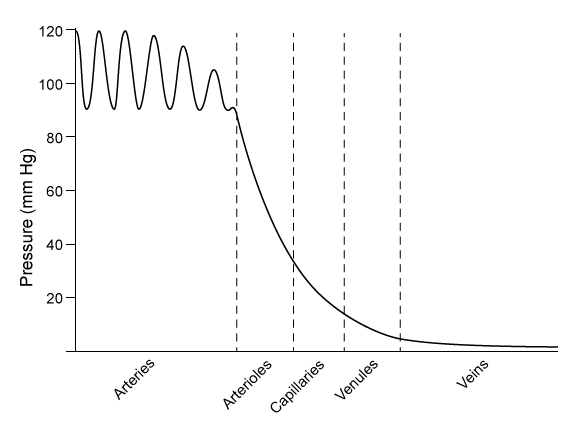 Figure 3 Blood pressure profile of the different vessels
- In the above figure, an LVAD pump is placed at one end of a "U"-shaped container, and a force gauge is placed at the other end. If the container is filled with an incompressible fluid, what is the ratio of the force measured by the force gauge to the force exerted by the LVAD?
A) 1:4
B) 1:2
C) 1:1
D) 4:1
Correct Answer:

Verified
Correct Answer:
Verified
Q152: A cable with a tension of 45
Q153: Passage<br>The flow of blood through the human
Q154: Passage<br>Nitrogen is extremely cold in its liquid
Q155: A 100-g block of iron at 31°C
Q156: A cube with a side length of
Q158: Passage<br>A student performed an experiment to determine
Q159: Passage<br>Black holes have played an important part
Q160: Passage<br>Sound waves propagate through many conducting structures
Q161: A scientist studying capillary fluid exchange in
Q162: Passage<br>Osteoporosis is a degenerative bone condition in