Multiple Choice
Passage
Sound waves propagate through many conducting structures in the ear before they are transduced into neuronal signals. When sound waves reach the fluid-filled cochlea, they are detected by hair cells lining the basilar membrane. The cochlear spiral can be modeled as a resonator system because each section of the basilar membrane is sensitive to a specific frequency (Figure 1) .
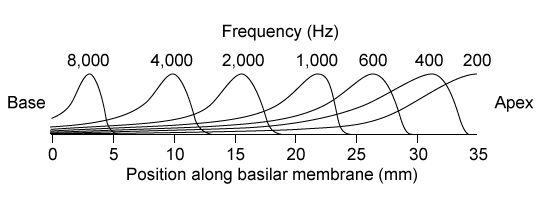 Figure 1 Amplitude pattern of the basilar membrane for different frequenciesPresbycusis (age-related hearing loss) results from a combination of factors that lessens an individual's mechanical and/or neurological sensitivity to sound. Pure tone audiometry (PTA) is used to determine an individual's ability to detect different sound frequencies and can be used to evaluate presbycusis. A "pure" tone is characterized by a single sinusoidal waveform. An audiogram plots the relative intensity required of a given frequency to be detected by the individual (Figure 2) .
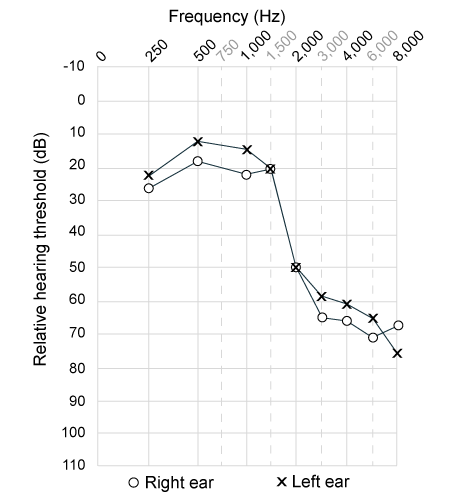 Figure 2 Audiogram of an elderly patient exhibiting presbycusis
-When sound passes from air to the tympanic membrane, what changes occur to the sound's intensity and velocity?
A) Both increase
B) Both decrease
C) Intensity increases; velocity decreases
D) Intensity decreases; velocity increases
Correct Answer:

Verified
Correct Answer:
Verified
Q155: A 100-g block of iron at 31°C
Q156: A cube with a side length of
Q157: Passage<br>In the event of end-stage heart failure,
Q158: Passage<br>A student performed an experiment to determine
Q159: Passage<br>Black holes have played an important part
Q161: A scientist studying capillary fluid exchange in
Q162: Passage<br>Osteoporosis is a degenerative bone condition in
Q163: <img src="https://d2lvgg3v3hfg70.cloudfront.net/MD0008/.jpg" alt=" A 4-μF capacitor
Q164: Which of the following procedures best describes
Q165: Passage<br>Hydrostatic weighing is a technique used to