Multiple Choice
Passage
Cable theory is a mathematical model used to calculate currents and voltages along and across axon membranes. The model treats small sections of the membrane as the resistor-capacitor circuit shown in Figure 1. An electric neuronal signal enters the circuit through the input node. A portion of the signal remains inside the axon and continues to the next section of membrane via Output 1, and the rest of the signal exits to the extracellular fluid via Output 2.
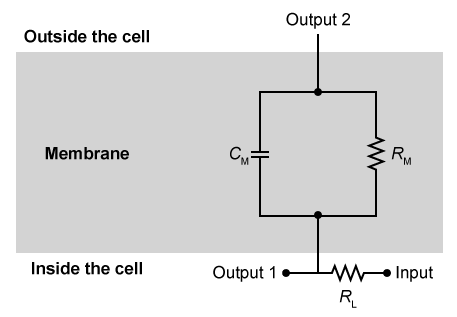 Figure 1 Circuit unit used to model axon membranesResearchers studied cable theory by recreating the circuit in Figure 1 using a 2 μF capacitor for CM, a 200 Ω resistor for RM, and a 1,000 Ω resistor for RL. The researchers sent an electrical signal through the input and discovered that the capacitor acted as a resistor whose resistance varied with the signal's frequency, as shown in Figure 2.
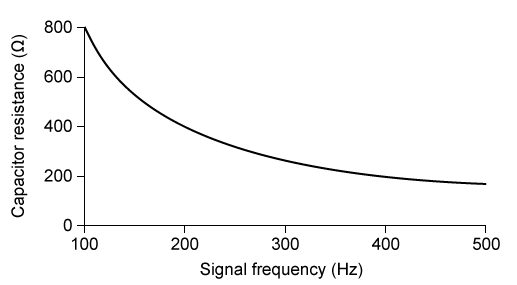 Figure 2 Capacitor equivalent resistance vs. signal frequency for CM
Adapted from Tuckwell H, Introduction to Theoretical Neurobiology 2006 SIAM.
-A voltmeter is placed across RL. If a charge of 0.1 C flows into the input node every 2 s, what will be the reading on the voltmeter?
A) 0 V
B) 50 V
C) 100 V
D) 200 V
Correct Answer:

Verified
Correct Answer:
Verified
Q7: When the side of an open tank
Q8: Passage<br>For a person with perfect vision, light
Q9: Passage<br>When present in the bloodstream above a
Q10: Passage<br>The humerus bone in the upper arm
Q11: Passage<br>The electric capacitance of biological tissues serves
Q13: Passage<br>Laparoscopy is a minimally invasive surgical procedure
Q14: Passage<br>During deep underwater dives, scuba divers must
Q15: Passage<br>In the event of end-stage heart failure,
Q16: A block with mass M slides down
Q17: Passage<br>Sound waves propagate through many conducting structures