Multiple Choice
Passage
For a person with perfect vision, light from an object is properly refracted by the eye lens to converge on a single point at the retina, forming a clear image of the object. Vision defects result from eye shape abnormalities or errors in the refractive power of the eye lens. Myopia (nearsightedness) occurs when light from a distant object is incorrectly focused in front of the retina. Hyperopia (farsightedness) occurs when light rays from a nearby object are focused beyond the retina.Many optical techniques are available to measure the refractive error of an individual to determine the necessary correction. Photorefraction is a photographic technique often used with young children because it does not require the individual to be still for a lengthy duration. When the patient is looking at the camera, a flash photograph is taken of the eye to determine the amount of light that is reflected off the retina and captured by the camera lens.In healthy eyes, all the light from the flash that enters the eye is reflected off the retina and returns back to the camera's light source. Because the camera lens does not receive this light, the pupil is completely dark in the resulting image. A myopic eye cannot properly focus the light at the retina. Due to the geometry of the eye and its lens, some of the light is reflected to the top portion of the camera lens. The camera captures an image of a pupil with a crescent of light at the top. In a hyperopic eye, the crescent appears at the bottom of the pupil. Ray diagrams for photorefraction are shown in Figure 1.
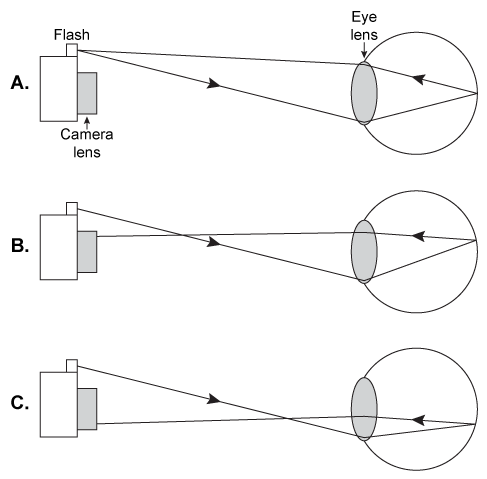 Figure 1 Paths of light in photorefraction for different eyes: (A) Healthy, (B) Myopic, and (C) Hyperopic.
HC. Howland, "Optics of photorefraction: orthogonal and isotropic methods." ©1983 Optical Society of America.
-The image of an object projected onto a fixed screen through a lens using red light is clear and focused. Using the same set-up, the image is slightly unfocused when violet light is used. This is because violet light:
A) refracts more than red light.
B) is more polarized than red light.
C) is unaffected by spherical aberrations.
D) has greater phase shifts in glass.
Correct Answer:

Verified
Correct Answer:
Verified
Q3: Passage<br>Ultrasound is a technique that uses the
Q4: Passage<br>Ultrasound is a technique that uses the
Q5: Passage<br>Positron emission tomography (PET) is a medical
Q6: Passage<br>For a person with perfect vision, light
Q7: When the side of an open tank
Q9: Passage<br>When present in the bloodstream above a
Q10: Passage<br>The humerus bone in the upper arm
Q11: Passage<br>The electric capacitance of biological tissues serves
Q12: Passage<br>Cable theory is a mathematical model used
Q13: Passage<br>Laparoscopy is a minimally invasive surgical procedure