Solved

Passage Laparoscopy Is a Minimally Invasive Surgical Procedure Where Small Surgical

Question 13

Multiple Choice

Passage
Laparoscopy is a minimally invasive surgical procedure where small surgical instruments are inserted into the body through cannulas (hollow tubes 0.5 to 1.0 cm in diameter) .  A cannula is inserted into the skin while sleeved around a trocar (Figure 1) .  The skin incision can be made directly with a sharp-tipped trocar as it is being inserted with the cannula.  If a blunt-tipped trocar is used, the incision is made beforehand with a surgical blade.  After insertion, the trocar is removed, leaving the cannula as an access point for laparoscopic procedures.
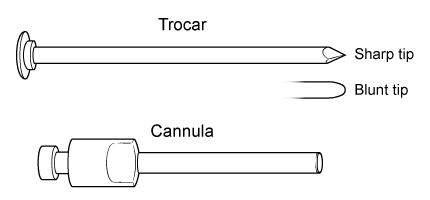
Passage Laparoscopy is a minimally invasive surgical procedure where small surgical instruments are inserted into the body through cannulas (hollow tubes 0.5 to 1.0 cm in diameter) .  A cannula is inserted into the skin while sleeved around a trocar (Figure 1) .  The skin incision can be made directly with a sharp-tipped trocar as it is being inserted with the cannula.  If a blunt-tipped trocar is used, the incision is made beforehand with a surgical blade.  After insertion, the trocar is removed, leaving the cannula as an access point for laparoscopic procedures.    <strong>Figure 1</strong>  Cannula, trocar, and two types of tipsLow-friction trocars increase surgical precision and reduce postoperative scarring.  Friction between the skin and trocar tip is tested with synthetic skin and a stationary ramp whose surface is made of the same material as the trocar.  For testing, the synthetic skin is pressed against the ramp's surface by a load, weighted to allow the skin to slide down at a constant speed (Figure 2) .  In this setup, the weight of the synthetic skin layer is negligible.    <strong>Figure 2</strong>  Experimental setup to test the friction between trocar and skin Adapted from W. Firme-Gustavo et al., (C) 2015 Society of Laparoendoscopic Surgeons. -After the load leaves the ramp, it slides on a horizontal table with a coefficient of kinetic friction μ<sub>k</sub> of 0.1 and a coefficient of static friction μ<sub>s</sub> of 0.3.  If the direction of the load's velocity is positive, what is the acceleration of the load?  (Note:  Use g = 10 m/s<sup>2</sup>.)  A) −3 m/s<sup>2</sup> B) −1 m/s<sup>2</sup> C) 1 m/s<sup>2</sup> D) 3 m/s<sup>2</sup> Figure 1  Cannula, trocar, and two types of tipsLow-friction trocars increase surgical precision and reduce postoperative scarring.  Friction between the skin and trocar tip is tested with synthetic skin and a stationary ramp whose surface is made of the same material as the trocar.  For testing, the synthetic skin is pressed against the ramp's surface by a load, weighted to allow the skin to slide down at a constant speed (Figure 2) .  In this setup, the weight of the synthetic skin layer is negligible.
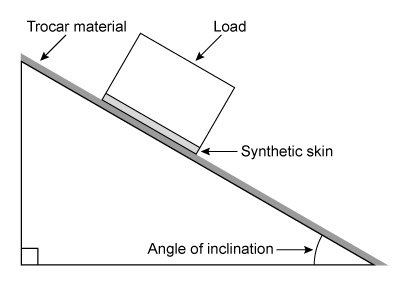
Passage Laparoscopy is a minimally invasive surgical procedure where small surgical instruments are inserted into the body through cannulas (hollow tubes 0.5 to 1.0 cm in diameter) .  A cannula is inserted into the skin while sleeved around a trocar (Figure 1) .  The skin incision can be made directly with a sharp-tipped trocar as it is being inserted with the cannula.  If a blunt-tipped trocar is used, the incision is made beforehand with a surgical blade.  After insertion, the trocar is removed, leaving the cannula as an access point for laparoscopic procedures.    <strong>Figure 1</strong>  Cannula, trocar, and two types of tipsLow-friction trocars increase surgical precision and reduce postoperative scarring.  Friction between the skin and trocar tip is tested with synthetic skin and a stationary ramp whose surface is made of the same material as the trocar.  For testing, the synthetic skin is pressed against the ramp's surface by a load, weighted to allow the skin to slide down at a constant speed (Figure 2) .  In this setup, the weight of the synthetic skin layer is negligible.    <strong>Figure 2</strong>  Experimental setup to test the friction between trocar and skin Adapted from W. Firme-Gustavo et al., (C) 2015 Society of Laparoendoscopic Surgeons. -After the load leaves the ramp, it slides on a horizontal table with a coefficient of kinetic friction μ<sub>k</sub> of 0.1 and a coefficient of static friction μ<sub>s</sub> of 0.3.  If the direction of the load's velocity is positive, what is the acceleration of the load?  (Note:  Use g = 10 m/s<sup>2</sup>.)  A) −3 m/s<sup>2</sup> B) −1 m/s<sup>2</sup> C) 1 m/s<sup>2</sup> D) 3 m/s<sup>2</sup> Figure 2  Experimental setup to test the friction between trocar and skin
Adapted from W. Firme-Gustavo et al., (C) 2015 Society of Laparoendoscopic Surgeons.
-After the load leaves the ramp, it slides on a horizontal table with a coefficient of kinetic friction μk of 0.1 and a coefficient of static friction μs of 0.3.  If the direction of the load's velocity is positive, what is the acceleration of the load?  (Note:  Use g = 10 m/s2.)


A) −3 m/s2
B) −1 m/s2
C) 1 m/s2
D) 3 m/s2

Correct Answer:

verifed

Verified

Unlock this answer now
Get Access to more Verified Answers free of charge

Related Questions