Multiple Choice
Passage
Sound waves propagate through many conducting structures in the ear before they are transduced into neuronal signals. When sound waves reach the fluid-filled cochlea, they are detected by hair cells lining the basilar membrane. The cochlear spiral can be modeled as a resonator system because each section of the basilar membrane is sensitive to a specific frequency (Figure 1) .
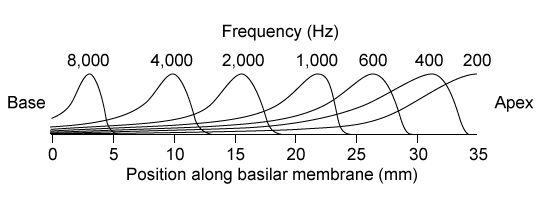 Figure 1 Amplitude pattern of the basilar membrane for different frequenciesPresbycusis (age-related hearing loss) results from a combination of factors that lessens an individual's mechanical and/or neurological sensitivity to sound. Pure tone audiometry (PTA) is used to determine an individual's ability to detect different sound frequencies and can be used to evaluate presbycusis. A "pure" tone is characterized by a single sinusoidal waveform. An audiogram plots the relative intensity required of a given frequency to be detected by the individual (Figure 2) .
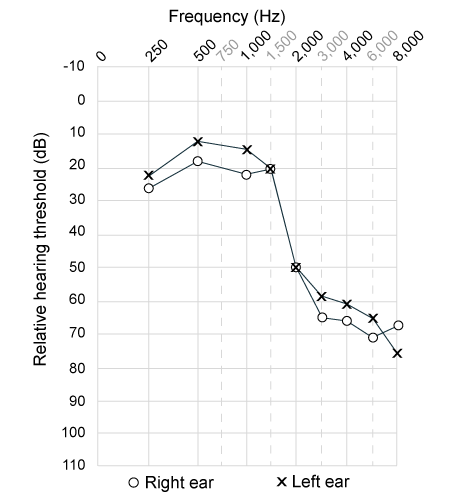 Figure 2 Audiogram of an elderly patient exhibiting presbycusis
-A sound wave used in PTA that causes resonance close to the apex of the basilar membrane has a relatively:
A) short wavelength.
B) high intensity.
C) low pitch.
D) large phase shift.
Correct Answer:

Verified
Correct Answer:
Verified
Q12: Passage<br>Cable theory is a mathematical model used
Q13: Passage<br>Laparoscopy is a minimally invasive surgical procedure
Q14: Passage<br>During deep underwater dives, scuba divers must
Q15: Passage<br>In the event of end-stage heart failure,
Q16: A block with mass M slides down
Q18: Passage<br>The flow of blood through the human
Q19: Passage<br>Cable theory is a mathematical model used
Q20: An observer perceives a sound to be
Q21: Blood flows through a vessel in the
Q22: A charged particle is accelerated in a